When Does Your Yard Need a Sump Pump Drainage System?
A yard sump pump drainage system may be needed when water collects in a low area and cannot reach a suitable outlet by gravity. Learn how sump basins, pumps, backup planning, and discharge piping work together with grading and other drainage solutions.
When a Yard Sump Pump Drainage System Makes Sense
A yard sump pump drainage system can help move standing water out of low-lying outdoor areas when a gravity outlet is not available.
Most residential drainage systems rely on gravity.
Water flows downhill, enters a drain, moves through underground pipe, and exits at a lower point.
But what happens when the lowest part of the yard is already below the available outlet?
That is where a sump pump drainage system may become necessary.
A sump pump can collect water from a low area and mechanically move it to a higher discharge point when gravity alone cannot do the job.
At OE Landscape, we look at sump pumps as one part of a complete drainage strategy. They can be highly effective in the right situation, but they should not be the first solution chosen simply because a yard is wet.
The real question is whether the property has a drainage problem that cannot be solved reliably through grading, gravity piping, yard drains, French drains, or other passive drainage systems.
For broader California context on rainfall runoff and stormwater management, homeowners can review the California State Water Resources Control Board Storm Water Program.
What Is a Yard Sump Pump Drainage System?
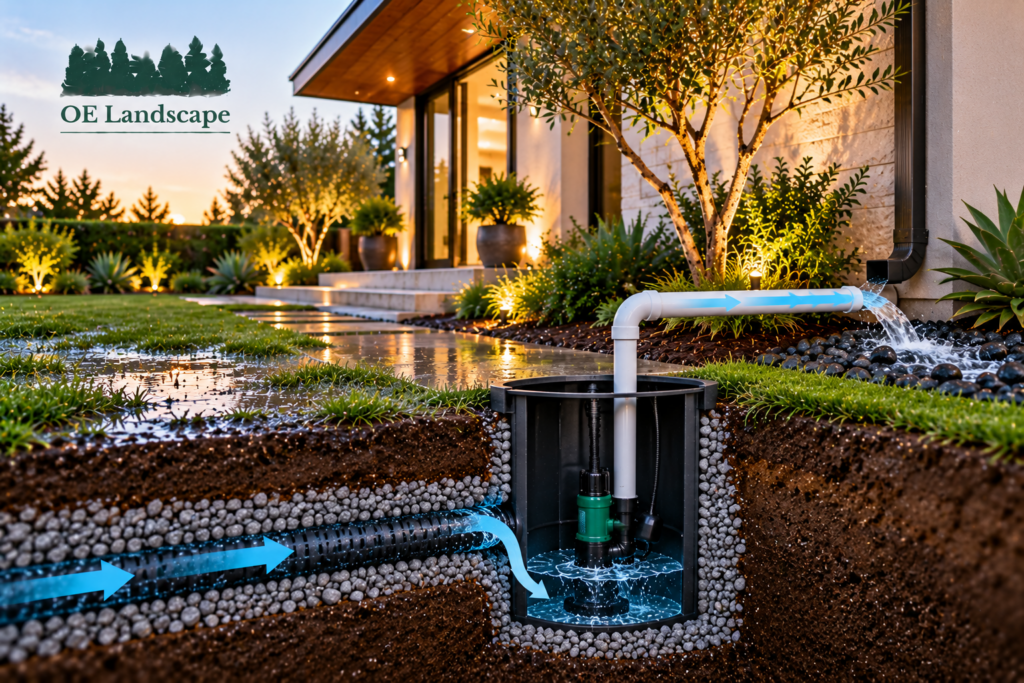
A yard sump pump drainage system typically collects runoff in a basin and pumps it to a suitable discharge point. Its main components include:
- A collection basin or sump pit
- A pump
- An electrical power source
- Inlet drainage lines
- A discharge pipe
- A planned discharge location
Water from catch basins, yard drains, French drains, or other drainage systems enters the sump basin.
As the water level rises, the pump activates and pushes the water through a discharge pipe.
Once the water level drops, the pump shuts off.
This process allows drainage to continue even when the outlet sits higher than the area where water is collecting.
The Main Reason to Use a Sump Pump
A sump pump is generally considered when gravity cannot move water out of the problem area effectively.
Imagine a backyard that sits lower than the street.
Rainwater collects in the backyard, but the street is the nearest practical drainage destination.
Because water cannot naturally flow uphill, simply installing underground pipe may not solve the problem.
A sump pump can lift the collected water to a higher elevation so it can continue toward an appropriate outlet.
This is the key difference between a pumped drainage system and a traditional gravity system.
Signs Your Yard May Need a Sump Pump Drainage System
A yard sump pump drainage system may be worth evaluating if you regularly experience:
- Standing water in a low backyard
- A sunken courtyard that floods
- Water collecting below street elevation
- A low side yard with no gravity outlet
- A below-grade patio
- Drainage basins that fill but cannot empty
- Water collecting near retaining walls
- Persistent flooding even after catch basins are installed
- A property where drainage pipes cannot achieve enough slope
These conditions do not automatically mean a sump pump is required.
But they suggest that elevation may be limiting the available drainage options.
Start With Elevation
One of the first things to evaluate is the relationship between:
- The flooded area
- The proposed drain
- The underground pipe route
- The final discharge point
If the outlet is lower than the problem area, gravity drainage may be possible.
If the outlet is higher, water cannot move there naturally.
This is why accurate elevation matters.
A property may look relatively flat, yet a few inches of elevation difference can determine whether a gravity drainage system will work.
Before installing a pump, it is important to understand the available drainage fall across the property.
A Pump Should Not Replace Proper Grading
A sump pump can move water, but it should not compensate for poor grading where grading can reasonably be corrected.
If water flows toward the house because the surrounding soil slopes in the wrong direction, regrading may still be necessary.
Likewise, if a patio contains a low spot that can be corrected during reconstruction, repairing the surface may be more appropriate than relying entirely on a pump.
A pump works best when it solves an elevation limitation that cannot easily be corrected through normal grading.
When Gravity Drainage Is Usually Better
If a reliable gravity outlet is available, gravity drainage is often simpler.
A gravity system:
- Does not require electrical power
- Has fewer mechanical parts
- Usually requires less maintenance
- Continues operating during power outages
That does not mean pumps are unreliable.
It simply means they introduce additional components that must continue functioning.
A professional drainage plan should usually evaluate passive options before deciding that pumping is necessary.
Sump Pumps Are Useful in Low Backyards
One common application is a backyard that sits significantly below the front of the property.
Surface runoff may naturally move toward the rear and collect there.
Catch basins can capture the water, but the underground pipes may have nowhere lower to discharge.
A sump basin can become the collection point.
The pump then lifts the water and sends it through a discharge line toward the approved outlet.
This creates a mechanically assisted drainage path where gravity alone cannot provide one.
Sunken Patios Can Need Pumped Drainage
Sunken outdoor living spaces are visually attractive, but they require careful drainage planning.
Because the patio sits below the surrounding landscape, runoff can move toward it from several directions.
Water may enter from:
- Adjacent planting
- Steps
- Hardscape
- Roof runoff
- Nearby slopes
If the patio drain sits below the available outlet, a sump pump may be needed.
In these areas, drainage should be considered during design—not after flooding occurs.
Courtyards Can Become Water Traps
Enclosed courtyards can create similar problems.
Walls and surrounding structures may prevent surface water from escaping naturally.
If the courtyard floor is lower than nearby drainage outlets, a floor drain or catch basin may need to feed into a sump basin.
The pump can then remove collected water from the enclosed area.
Because these spaces may be surrounded by doors and walls, reliable drainage is especially important.
Retaining Walls Can Create Low Zones
Retaining walls alter the natural elevation of a property.
In some landscapes, the lower side of a retaining wall becomes a drainage basin.
Water may collect from:
- Surface runoff
- Slope drainage
- Subsurface moisture
- Irrigation
If there is no lower gravity outlet, a sump system may be considered.
However, retaining-wall drainage may also require French drains, gravel, or other subsurface drainage features.
A pump may be only one part of the solution.
Catch Basins Often Feed the Sump Basin
A sump pump does not usually sit directly in the middle of a lawn puddle.
Instead, surface drains or catch basins collect runoff and send it into the sump basin.
For example, a system might include:
- Two backyard catch basins
- One patio channel drain
- Underground piping
- A central sump basin
- A pumped discharge line
This approach allows several drainage areas to feed one pumping system.
The pump and basin must be sized for the expected water volume. A yard sump pump drainage system should also have an appropriate discharge route and access for maintenance.
French Drains Can Also Feed a Sump Pump
A French drain may collect subsurface water that has nowhere to go by gravity.
In that situation, the French drain can route water into a sump basin.
The pump then moves the collected water to a higher outlet.
This combination can be useful in low areas where both surface and subsurface moisture are present.
The French drain collects water through the soil.
The sump pump provides the lift needed to remove it.
Channel Drains Can Connect to Pumped Systems
Channel drains are commonly used along:
- Patios
- Driveways
- Garage entrances
- Gates
- Hardscape transitions
If the channel drain sits below the discharge elevation, it may also need to connect to a sump system.
This is especially relevant for sunken hardscape areas.
A complete drainage plan may combine several collection methods before water reaches the pump.
Pump Capacity Matters
Not all sump pumps move the same amount of water.
Pump capacity should reflect the amount of runoff the system may receive.
Important factors include:
- Drainage area
- Number of catch basins
- Roof runoff connections
- Slope runoff
- French drain flow
- Expected storm intensity
- Vertical pumping height
- Pipe length
A pump that is too small may run continuously and still fail to keep up during heavier rain.
Oversizing without proper planning can also create unnecessary cycling.
The system should be matched to the actual drainage demand.
The Height the Pump Must Lift Water Matters
One important design factor is known as the pump's head height.
This refers to how high the pump must push the water.
Moving water two feet uphill is different from moving it ten feet uphill.
The farther and higher the water needs to travel, the more performance is required from the pump.
Horizontal distance, pipe diameter, fittings, and elevation all affect the final system.
This is why pump selection should be based on the actual drainage layout rather than only the size printed on the pump.
The Basin Must Be Large Enough
The sump basin acts as temporary storage.
If the basin is too small, the pump may switch on and off constantly.
This is known as short cycling.
Frequent cycling can create unnecessary wear.
A larger basin can allow more water to collect before the pump activates.
The correct size depends on:
- Incoming water volume
- Pump capacity
- Available space
- Drainage design
The basin should be considered part of the hydraulic system, not simply a container for the pump.
The Pump Needs a Reliable Power Source
Unlike gravity drainage, sump pumps depend on electricity.
The electrical setup should be appropriate for outdoor conditions and the equipment being installed.
The pump must be able to operate when storms occur.
This is especially important because heavy rain may sometimes coincide with power outages.
Where appropriate, homeowners may also consider backup options.
The drainage plan should account for what happens if power is temporarily unavailable.
Backup Planning Can Be Important
If the sump pump protects a highly sensitive low area, backup planning may deserve consideration.
Possible approaches may include:
- Battery backup
- Secondary pumps
- High-water alarms
- Emergency overflow planning
The appropriate level of backup depends on the property and consequences of pump failure.
A low lawn area may tolerate temporary flooding differently from a sunken patio beside a door.
Drainage risk should influence how much redundancy is appropriate.
FEMA flood-preparedness guidance also recommends considering a battery-operated backup for sump pumps where power loss could affect protection during a storm.
High-Water Alarms Can Provide Warning
Some sump systems can include alarms that activate if the water rises above a normal operating level.
This may indicate:
- Pump failure
- Power loss
- Blocked discharge
- Excessive inflow
An alarm does not fix the problem, but it can provide valuable warning before water reaches surrounding areas.
For systems protecting important outdoor spaces, this can be useful.
The Discharge Pipe Needs Careful Planning
The pump can only move water where the discharge pipe takes it.
The route should be:
- Properly sized
- Securely connected
- Protected from damage
- Directed toward an appropriate destination
The discharge pipe should not simply empty next to the sump basin.
Otherwise, the same water may flow back into the system.
This is sometimes called recirculation.
The goal is to move water far enough away that it does not return to the original low point.
The Outlet Must Be Appropriate
As with any drainage system, collected water needs a suitable destination.
The discharge point may depend on:
- Site elevation
- Existing drainage infrastructure
- Local rules
- Property configuration
The system should not redirect water in a way that creates problems for neighboring properties or other areas of the same yard.
The entire pump-to-discharge route should be considered before installation begins.
Check Valves Help Prevent Backflow
When the pump turns off, water remaining in the discharge pipe may try to flow back toward the basin.
A check valve can help prevent that reverse flow.
Without one, part of the water may return to the sump each time the pump stops.
That can cause unnecessary cycling and reduce efficiency.
A properly designed pumping system should account for backflow control.
Pump Location Matters
The sump basin should usually be placed where drainage lines can reach it effectively.
This is often the lowest practical area.
However, access is also important.
A basin buried beneath permanent hardscape or installed where maintenance is difficult can create future problems.
The pump may eventually require:
- Inspection
- Cleaning
- Repair
- Replacement
A good installation balances drainage efficiency with long-term accessibility.
Do Not Hide the System Where It Cannot Be Serviced
Landscape design often aims to conceal drainage infrastructure.
That is understandable.
But sump systems should remain accessible.
The lid should not be permanently covered by concrete, artificial turf, or structures in a way that makes pump access difficult.
The system can be visually integrated into the landscape while still allowing maintenance.
Drainage that cannot be serviced easily is more likely to become a problem later.
Debris Management Is Important
Catch basins and drainage lines may carry:
- Leaves
- Soil
- Mulch
- Gravel
- Grass clippings
This debris should ideally be reduced before water reaches the pump.
Catch basins may provide some sediment collection.
Grates can prevent larger debris from entering.
Routine cleaning is still necessary.
Excessive debris can affect pump performance or block the discharge system.
Sump Pumps Need Maintenance
A sump pump should not be installed and forgotten.
Periodic maintenance may include:
- Testing pump operation
- Cleaning the basin
- Inspecting the float
- Checking the discharge line
- Clearing connected drains
- Testing alarms
- Inspecting electrical connections
It can be useful to test the system before the rainy season rather than discovering a problem during a storm.
Preventive maintenance supports more reliable operation.
Test the Pump Before Heavy Rain
One simple maintenance step is confirming that the pump actually activates.
Water can be added to the basin until the float triggers the pump.
The system should then discharge normally and shut off after the water level drops.
If the pump does not start, makes unusual sounds, or fails to remove water, it should be inspected.
Testing before storms gives homeowners time to address problems.
A Sump Pump Will Not Fix Every Drainage Issue
A pump may be unnecessary if the actual problem is:
- Overwatering
- A broken irrigation line
- A clogged drain
- Poor gutter discharge
- A surface low spot that can be regraded
- An undersized catch basin
The cause should be identified before choosing a mechanical solution.
Installing a sump pump where gravity or grading could have solved the problem may add unnecessary cost and maintenance.
First Check the Irrigation System
If a yard stays wet even during dry weather, irrigation should be inspected.
Look for:
- Leaking valves
- Broken pipes
- Excessive watering
- Overspray
- Drip-system leaks
A pump should not be used to continuously remove water being added unnecessarily by irrigation.
Stopping the source is usually more effective.
Roof Runoff Can Overload a Sump System
Downspouts can contribute large amounts of water.
If roof runoff enters the same drainage network as the sump basin, pump capacity should account for it.
In some cases, roof water may be routed separately through gravity drainage.
In other situations, it may also require pumping.
The design depends on elevation and site conditions.
The important point is that roof runoff should not be added to a sump basin without considering the additional flow.
Sloped Properties Can Send Large Volumes Downhill
A low yard below a slope can receive substantial runoff.
Even if the sump pump is located correctly, upstream water should still be managed.
Possible measures may include:
- Swales
- French drains
- Erosion-control planting
- Additional catch basins
- Grading adjustments
Reducing and controlling runoff before it reaches the sump can improve system performance.
A pump should not be expected to compensate for every upstream drainage issue.
Erosion Should Be Addressed Too
Fast-moving water can carry soil into the sump system.
This can create sediment buildup in:
- Catch basins
- Pipes
- The sump basin
If erosion is occurring, the landscape may require stabilization.
Plants, grading, erosion-control materials, or changes to runoff paths can help reduce sediment entering the drainage system.
Water management and erosion control should work together.
Sump Pumps Can Protect Outdoor Living Areas
A properly designed sump system may help protect low outdoor spaces such as:
- Sunken lounges
- Outdoor kitchens
- Courtyards
- Patios
- Poolside areas
These features often contain expensive finishes and equipment.
Drainage should therefore be considered before construction.
It is much easier to coordinate drains, piping, electrical service, and the sump basin before the finished hardscape is installed.
Plan the System Before New Pavers
If a landscape renovation includes new pavers, drainage infrastructure should be installed first whenever practical.
A project sequence may include:
- Evaluate grading
- Determine drainage locations
- Install underground piping
- Install the sump basin
- Install electrical components
- Test the drainage system
- Complete the hardscape
This helps avoid removing newly installed surfaces to correct drainage later.
Artificial Turf Projects May Need Pumped Drainage
Artificial turf is sometimes installed in low yards because homeowners want a cleaner alternative to muddy grass.
But the turf itself does not eliminate the underlying drainage problem.
If the yard cannot drain by gravity, the project may require:
- Catch basins
- Base grading
- Underground drainage
- A sump basin
- A pump
Addressing the water first can help protect the finished turf installation.
Pool Areas Require Careful Drainage Planning
Pools introduce their own drainage considerations.
Deck runoff, landscape runoff, and low equipment areas may all need drainage.
A sump system may be appropriate if parts of the pool environment sit below available outlets.
However, pool water-management systems and landscape drainage should be coordinated carefully.
The goal is to prevent stormwater from becoming trapped in low outdoor areas.
Garage Entrances Can Also Be Low Points
Some driveways slope downward toward garages.
A channel drain may capture water across the entrance.
If that drain cannot empty by gravity, it may feed into a sump basin.
This is a situation where pump reliability becomes especially important because the drainage system is helping keep water away from a building opening.
Sump Pump Systems Need an Overflow Strategy
No mechanical system is completely immune to failure.
A good drainage design should consider what happens if:
- The pump loses power
- The pump fails
- The basin fills faster than expected
- The outlet becomes blocked
An emergency overflow route, secondary pump, or alarm may be appropriate depending on the risk.
Planning for failure is part of creating a resilient drainage system.
Keep the Basin Lid Secure
Sump basins should be covered securely.
This helps:
- Keep debris out
- Protect the equipment
- Reduce accidental access
- Maintain a cleaner landscape appearance
The lid should still allow service access.
Landscape materials around the basin should be installed so they do not interfere with opening it.
Noise Can Be Considered During Placement
Pumps create some operational noise.
In most outdoor drainage applications, this may not be significant.
However, placing the basin immediately beside a quiet seating area or bedroom window may make pump operation more noticeable.
Where possible, location can balance:
- Hydraulic efficiency
- Maintenance access
- Visual integration
- Noise considerations
The lowest point remains the priority, but layout choices may still improve the finished project.
Pumped Drainage Should Be Designed as a System
It is easy to focus entirely on the pump.
But the pump is only one component.
A reliable system also needs:
- Correctly placed drains
- Properly sized piping
- A suitable basin
- Backflow protection
- Electrical supply
- An appropriate discharge point
- Maintenance access
The entire system must work together.
A powerful pump cannot compensate for blocked inlets, undersized piping, or a poor discharge location.
Common Sump Pump Drainage Mistakes
Problems can occur when a system is installed without enough planning.
Common mistakes include:
- Choosing a pump that is too small
- Ignoring head height
- Using an undersized basin
- Sending too much roof runoff into the system
- Failing to include a check valve
- Installing the discharge too close to the basin
- Covering the basin where it cannot be serviced
- Ignoring grading problems
- Failing to plan for power outages
- Allowing debris into the pump
Avoiding these mistakes begins with evaluating the entire drainage condition rather than choosing equipment first.
When a Sump Pump Is Probably Not Necessary
A pump may not be needed if:
- The property has adequate gravity fall
- Regrading can direct water to an outlet
- A catch basin and gravity pipe can solve the issue
- The problem is caused primarily by irrigation
- A clogged existing system is the real cause
- Downspouts can be redirected through solid pipe
Because pumps add mechanical complexity, it makes sense to use them when the site actually requires them.
When a Sump Pump Becomes the Practical Choice
A sump pump becomes especially useful when three conditions occur together:
Water collects in a low area.
That water needs to be removed.
There is no lower practical gravity outlet.
When those conditions exist, pumping can provide the lift needed to complete the drainage path.
This is particularly common in below-grade yards and outdoor spaces.
Watch the Property During a Storm
If possible, observe the yard while rain is falling.
Look for:
- Where water begins collecting
- How quickly the low area fills
- Which drains receive water
- Whether roof runoff contributes
- Whether slopes send additional water
- Whether existing drains back up
Videos can help document the drainage behavior.
This information can make it much easier to determine whether the problem is caused by surface runoff, subsurface water, elevation, or a combination of factors.
A Complete Drainage Evaluation Comes First
The best drainage solution starts with understanding the site.
A contractor may evaluate:
- Property elevations
- Existing grading
- Drain locations
- Roof runoff
- Soil conditions
- Hardscape
- Irrigation
- Slopes
- Retaining walls
- Existing outlets
Only then can it be determined whether a sump pump is necessary.
In many cases, the final solution combines multiple drainage methods.
Your Yard May Need More Than One Drainage Solution
A low property may require a system such as:
Surface runoff → catch basin → underground pipe → sump basin → pump → discharge
Another area of the same yard may use:
Subsurface water → French drain → sump basin → pump → discharge
A driveway might use:
Hardscape runoff → channel drain → sump basin → pump → discharge
These systems can sometimes share infrastructure when properly designed.
The key is matching each type of water problem with the correct collection method.
Create a Drainage System That Works With the Property
A yard sump pump drainage system can be an effective solution for sites where gravity drainage is not practical.
But the pump should not be viewed as a shortcut.
The strongest systems combine:
- Correct grading
- Properly placed drains
- Appropriate pipe sizing
- Reliable pumping equipment
- A suitable basin
- A safe discharge route
- Maintenance access
At OE Landscape, we help Southern California homeowners address drainage challenges through sump pump systems, French drains, yard drains, catch basins, channel drains, grading, and gutter/downspout drainage, erosion-control solutions, irrigation improvements, and complete landscape renovations.
If your yard repeatedly floods in a low area or cannot drain naturally to a lower outlet, a professionally planned sump pump system may provide the mechanical lift needed to move that water where it can be managed more effectively.
OE Landscape – CA C-27 License #1109316 | Bonded & Insured
Dealing with a low yard, sunken patio, or drainage system that has nowhere to empty? Contact OE Landscape to discuss drainage options designed around your property's elevation, runoff, landscape, and available discharge conditions.
Plan the Low Point, Basin, Pump, Pipe Route, and Outlet Together
A sump pump works best as one part of a complete drainage system. OE Landscape can coordinate pumped drainage with catch basins, French drains, channel drains, grading, irrigation, artificial turf, hardscape, planting, and broader landscape improvements.
Find Out Whether Gravity Drainage or a Sump Pump Makes More Sense.
Tell OE Landscape where water collects, how the property is graded, and what happens during heavy rain. We can review the drainage path and discuss practical options for the site.