
Landscape Design Ideas Inspired
by Modern Architecture
Explore ways to connect clean architecture with planting, hardscape, outdoor rooms, lighting, materials, privacy, and modern Southern California landscape design.
Let Modern Architecture Guide the Outdoor Space
Modern architecture is known for simplicity, strong forms, open layouts, clean materials, and a close relationship between indoor and outdoor spaces.
Those same ideas can be carried into the landscape.
Instead of treating the yard as something separate from the home, modern landscape design looks for ways to create a continuous experience between architecture, planting, hardscaping, and outdoor living areas.
A patio can feel like an extension of the living room. Trees can frame the architecture rather than hide it. Planting can soften concrete and geometric forms without competing with them.
At OE Landscape, we believe landscapes are most successful when they respond to the character of the home. For modern properties, that often means creating outdoor spaces that feel organized and intentional while still allowing plants and natural materials to bring warmth and movement into the design.
Let the Architecture Lead the Landscape
A modern landscape should begin with the home itself.
Before deciding where to place plants, walkways, patios, or other features, look at the architecture.
Consider elements such as:
- Rooflines
- Windows
- Exterior materials
- Wall proportions
- Entrances
- Overhangs
- Columns
- Doors
- Architectural colors
- Existing sightlines
These features can provide clues for the landscape.
For example, a home dominated by long horizontal lines may work well with broad planting areas and low landscape elements.
A house with tall vertical windows might benefit from upright trees or architectural plants nearby.
The landscape does not need to duplicate the building, but it should feel like it belongs beside it.
Keep the Overall Design Simple
Simplicity is one of the strongest ideas behind modern architecture.
The same principle works outdoors.
A modern landscape usually becomes stronger when the number of materials, plant varieties, colors, and decorative elements is controlled.
Rather than using five different paving materials, designers might choose one primary material and one contrasting accent.
Instead of installing many unrelated plant species, a smaller palette can be repeated throughout the property.
Reducing unnecessary variety allows important features to stand out.
The landscape feels intentional instead of busy.
Create a Strong Indoor-Outdoor Connection
Modern homes often include large windows, sliding glass doors, and open interior spaces that look directly into the landscape.
This creates an opportunity to treat the outdoor environment almost like another room of the house.
A patio positioned outside a living room can extend the usable space beyond the glass.
An outdoor dining area near the kitchen can make meals outside easier.
A tree positioned within the view from a large window can become part of the interior experience.
The goal is to reduce the feeling of a hard boundary between indoors and outdoors.
When both spaces are designed to relate to one another, the entire property can feel larger and more connected.
Extend Interior Materials Outdoors
Material continuity can strengthen the relationship between the architecture and landscape.
Outdoor materials do not necessarily need to match those inside the home exactly, but they can share similar colors, textures, or proportions.
For example, a home with warm wood finishes might pair well with natural stone, wood elements, and neutral paving outside.
A property featuring concrete and dark metal details might be complemented by large-format pavers, gravel, steel accents, and sculptural planting.
Repeating materials from the building within retaining walls, planters, seating walls, or other landscape features can also create continuity.
The landscape begins to feel like an extension of the architecture rather than an unrelated addition.
Use Large, Simple Hardscape Areas
Modern architecture often relies on strong, clearly defined surfaces.
The same idea can be used in outdoor spaces.
Instead of creating patios from many small patterns or decorative borders, consider larger uninterrupted areas of paving.
Possible hardscape materials include:
- Concrete
- Large-format pavers
- Natural stone
- Porcelain outdoor pavers
- Gravel
- Decomposed granite
The appropriate material will depend on the property, desired appearance, maintenance requirements, and intended use.
Large surfaces often work particularly well around modern homes because they complement the scale and simplicity of the architecture.
Create Outdoor Rooms
Open-plan interiors are common in modern homes, but different activities still have their own zones.
The same principle can be used outside.
A backyard might include separate areas for:
- Dining
- Cooking
- Relaxing
- Gathering around a fire
- Lawn or recreation
- Gardening
- Poolside seating
These areas do not need solid walls between them.
Instead, landscape elements can create subtle boundaries.
A change in paving might define the dining area.
A low wall could separate a lounge from a planting bed.
Trees might create a canopy over one section of the yard.
The result is an open outdoor environment with clearly understood functions.
Make the Patio Feel Like an Outdoor Living Room
One of the defining ideas of modern residential design is the extension of everyday living outdoors.
A patio should therefore be more than leftover hardscape behind the house.
Think of it as an outdoor room.
The space may include comfortable seating, shade, lighting, planting, and a clear relationship to the interior.
Furniture placement should also encourage people to use the area rather than simply filling it.
A seating arrangement might face a fire feature, garden view, pool, or attractive planting area.
When the patio has a defined purpose, it becomes part of everyday life instead of an area used only occasionally.
Combine Structured Hardscape With Natural Planting
Modern architecture is often highly geometric.
Landscaping provides an opportunity to soften that geometry.
A straight walkway can be bordered by grasses that move naturally.
A concrete retaining wall can sit behind layered shrubs.
A rectangular patio may be surrounded by planting with looser forms.
This contrast between built structure and natural growth helps prevent a modern landscape from feeling overly rigid.
Hardscape provides order.
Plants introduce variation.
The relationship between the two creates balance.
Choose Plants for Form as Well as Color
Flower color is important, but in a modern landscape, the shape of the plant can be equally valuable.
Consider whether a plant has:
- Strong upright growth
- Rounded form
- Architectural leaves
- Fine texture
- Sculptural branching
- Soft movement
- Dense evergreen structure
Using plants with recognizable forms can complement the shapes found in the architecture.
A row of upright plants might reinforce a tall wall.
A group of soft ornamental grasses can contrast with a solid concrete surface.
One sculptural tree may become a focal point against a simple exterior wall.
Thinking about form helps planting remain visually interesting even when flowers are not present.
Repeat Plants Instead of Using Too Many Varieties
Modern design often relies on repetition.
In the landscape, repeating the same plant or small group of plants can create rhythm and visual consistency.
For example, one ornamental grass might appear along an entrance walkway and then reappear near the backyard patio.
The same groundcover may be used beneath different trees.
A repeated shrub may connect planting areas on opposite sides of the property.
This technique makes different parts of the landscape feel related.
It can also create a calmer appearance than a garden where every plant is different.
Introduce Warmth With Natural Textures
Modern architecture can sometimes include materials that feel visually cool, such as concrete, glass, metal, and smooth stucco.
Landscaping can introduce warmth.
Plants naturally soften hard surfaces, but other outdoor materials can help as well.
Consider incorporating:
- Wood
- Natural stone
- Gravel
- Textured planting
- Warm-toned paving
- Decorative rock
A wood bench placed against a concrete wall, for example, creates contrast.
Natural stone surrounded by grasses can soften a highly geometric planting area.
The landscape should complement modern architecture without making the property feel sterile.
Use Trees as Architectural Elements
Trees can be treated almost like living architectural features.
Their trunks create vertical structure, while their canopies define space overhead.
A strategically positioned tree can frame an entrance, shade a patio, create privacy, or provide a focal point visible from inside the home.
Multiple trees can also create rhythm when positioned thoughtfully.
The goal is not necessarily to plant trees everywhere.
One well-placed tree can sometimes provide greater visual impact than several trees installed without a clear purpose.
Mature size should always be considered so the tree has enough room to develop without interfering with buildings, walkways, or utilities.
Create a Statement Entry
The front entry is one of the best places to bring modern architecture and landscape design together.
A strong entry might combine:
- Oversized stepping pads
- A linear walkway
- Architectural plants
- Low landscape lighting
- Minimal planting
- Decorative gravel
- A specimen tree
- Simple planters
The landscape can help direct attention toward the front door without overwhelming the architecture.
Clear circulation is especially important.
Visitors should immediately understand where to walk.
Planting, paving, lighting, and architectural features can all work together to make the entrance feel welcoming and intentional.
Use Stepping Pads to Create Rhythm
Large stepping pads are frequently used in contemporary landscapes because they combine function with geometry.
They may lead through gravel, groundcover, or planting areas.
Spacing and proportion are important.
When designed well, the repeated shapes create rhythm as people move through the property.
Stepping pads can work along front entrances, side yards, garden paths, or transitions between outdoor spaces.
They can also visually reduce the amount of continuous hardscape while maintaining a clean modern appearance.
Incorporate Gravel Between Built and Planted Areas
Gravel can act as a transition between hardscape and planting.
Its texture provides contrast with smooth concrete and large-format paving while remaining visually simple.
Gravel may be used:
- Around stepping pads
- Between planting groups
- Along side yards
- Around selected drought-tolerant plants
- Beside patios
- As a decorative transition
When used appropriately, gravel can help create a more relaxed relationship between architecture and planting.
Material selection matters, however.
Gravel color, size, and texture should support the overall palette rather than becoming another competing visual element.
Use Walls as Part of the Composition
Retaining walls, privacy walls, raised planters, and seating walls can serve both functional and visual purposes.
Instead of treating these structures as purely practical, they can become part of the landscape design.
A low wall may continue the direction of the house.
A raised planter can create another horizontal layer.
A privacy wall may provide a simple backdrop for a sculptural tree.
Materials can also be chosen to relate to the home's exterior.
This makes necessary landscape structures feel integrated rather than added afterward.
Keep the Planting Palette Focused
Modern landscapes generally benefit from a clear planting strategy.
Choose plants based on their relationship to one another rather than selecting each one individually.
A planting palette may combine:
- Structural evergreen plants
- Ornamental grasses
- Groundcovers
- Accent plants
- Selected flowering varieties
- Trees
The number of varieties depends on the size and character of the property.
The important part is creating repetition and hierarchy.
Some plants should provide structure, while others provide movement, seasonal interest, or contrast.
Not every plant needs to become a focal point.
Consider Drought-Tolerant Modern Planting
Southern California offers many opportunities to combine contemporary design with climate-conscious planting.
Drought-tolerant landscapes do not need to look dry or empty.
Carefully selected plants can provide rich combinations of:
- Green foliage
- Silver tones
- Grasses
- Succulent forms
- Seasonal flowers
- Textured groundcovers
Grouping plants with similar water requirements can also support more efficient irrigation.
The design can remain modern and polished while responding to local climate conditions.
Use Water Features as Sculptural Elements
Water features in modern landscapes often emphasize simplicity.
Instead of highly decorative fountains, a contemporary design might use a clean basin, linear water feature, or simple wall fountain.
Water can add movement and sound while creating a focal point.
Placement should be intentional.
A water feature might align with a window, anchor the end of a walkway, or sit near an outdoor lounge.
It does not need to be large to have impact.
A simple design can often work better with modern architecture than something overly decorative.
Create Contrast Between Light and Dark Materials
Modern architecture frequently uses contrast.
Landscape materials can follow the same idea.
Light concrete might be paired with dark gravel.
Dark metal edging may define a pale planting surface.
Green foliage can stand out against a white or charcoal wall.
Contrast helps different elements remain visually clear.
However, using too many contrasting colors can create clutter.
Usually, a limited palette with one or two strong contrasts creates a more cohesive result.
Use Outdoor Lighting as Part of the Architecture
Lighting becomes especially important around modern homes because it can highlight both architecture and landscape structure.
Instead of trying to illuminate everything, focus on selected features.
Lighting might emphasize:
- Entry paths
- Steps
- Architectural walls
- Trees
- Planting beds
- Outdoor seating
- Retaining walls
Subtle lighting beneath steps or walls can strengthen horizontal forms.
Uplighting can emphasize a tree or vertical surface.
The goal is to make the property usable and visually interesting at night without creating excessive brightness.
Keep Privacy Clean and Intentional
Privacy is often necessary, particularly in neighborhoods where homes are close together.
Modern landscapes can provide screening without relying entirely on large continuous hedges.
Options may include:
- Strategically positioned trees
- Layered shrubs
- Vertical screens
- Garden walls
- Pergola elements
- Planting combined with fencing
The best solution often combines several methods.
A simple screen may provide immediate privacy while planting softens its appearance.
Trees can block upper-story views while allowing openness at ground level.
Targeted privacy usually feels more natural than enclosing the entire property.
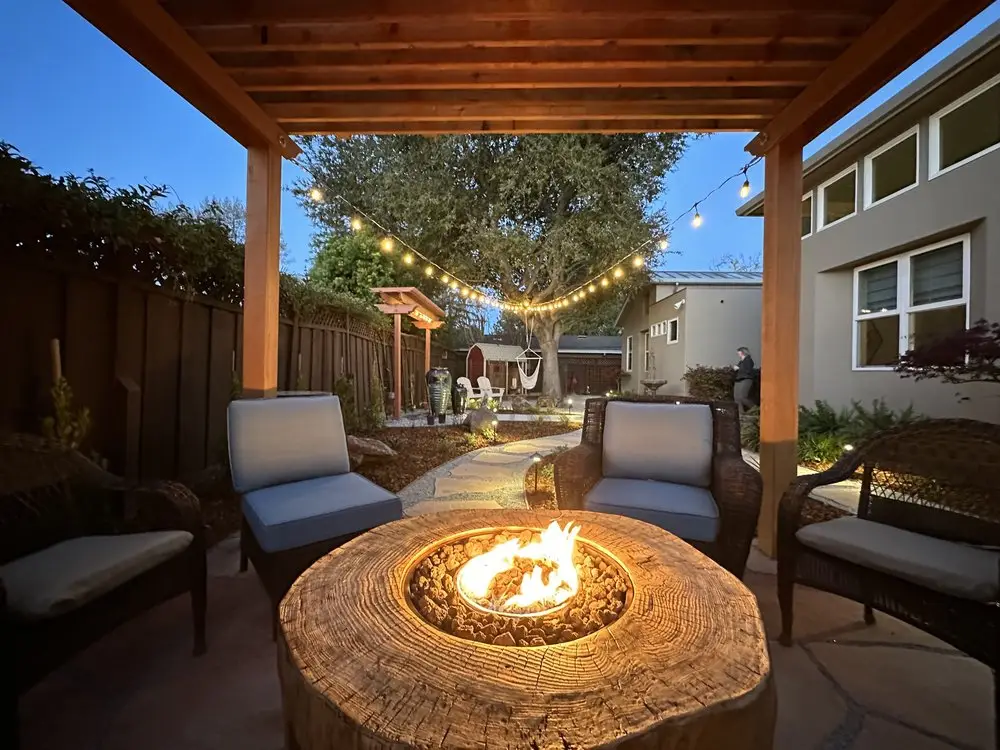
Make Room for Outdoor Fire Features
Fire features work naturally within many contemporary outdoor spaces.
A fire pit can become the center of a lounge area, while a linear fire feature may complement strong architectural lines.
The surrounding space should be considered just as carefully as the feature itself.
Seating, circulation, planting, lighting, and surrounding materials all contribute to how the area functions.
A fire feature works best when it feels like part of the overall landscape rather than an isolated object placed in the yard.
Treat the Pool as Part of the Landscape
For homes with swimming pools, the pool should relate to the architecture and surrounding outdoor environment.
Pool shape, paving, planting, furniture areas, and sightlines all contribute to the composition.
A rectangular pool may reinforce contemporary architecture.
Planting can soften its edges and provide privacy without creating excessive debris near the water.
Outdoor lounge areas can connect the pool to patios and other backyard zones.
When all of these areas are considered together, the pool becomes one part of the outdoor environment rather than dominating the entire yard.
Use Negative Space Intentionally
Modern architecture gives importance to empty space.
Landscape design should do the same.
Not every area needs another plant, feature, or material.
Open gravel zones, simple lawns, uncluttered paving, and spaces between planting groups allow stronger elements to stand out.
Negative space can also make a property feel larger.
When every available area is filled, the landscape may feel visually compressed.
Leaving carefully considered open areas gives the composition breathing room.
Keep Maintenance in Mind From the Beginning
A modern landscape usually looks best when its major forms remain clear.
Overgrown plants, damaged edging, or constantly encroaching vegetation can quickly hide those relationships.
Selecting appropriately sized plants is therefore important.
A shrub should have enough space to mature without requiring constant pruning.
Groundcover should be positioned where spreading is desirable.
Trees should have adequate room for their mature canopy.
Irrigation should also be designed around the needs of the planting plan.
Thoughtful planning at the beginning can help the landscape maintain its intended appearance over time.
Design Important Views From Inside the Home
Large windows are common in modern architecture, making outdoor views especially important.
Consider what homeowners see from:
- Living rooms
- Kitchens
- Dining areas
- Bedrooms
- Offices
A specimen tree, planting composition, fire feature, water feature, or landscape wall can become part of the interior view.
These focal points should not be placed randomly.
Looking through the windows during the planning process helps identify where landscape features can have the greatest impact.
The landscape then becomes part of the architecture even while homeowners are indoors.
Balance Modern Structure With Comfortable Living
A modern landscape should still feel comfortable.
Clean geometry does not need to mean a yard that feels formal or untouchable.
Outdoor furniture, shade, planting, fire features, trees, and soft textures can make highly structured spaces feel welcoming.
A patio should invite people to sit.
A pathway should make circulation easy.
A dining area should be convenient to use.
Planting should create interest without becoming overwhelming.
Good modern landscape design combines visual simplicity with real everyday function.
Create a Landscape That Belongs to the Architecture
The best modern landscapes are not built around a checklist of trendy materials or plants.
They begin with the property.
Architecture establishes the visual language. The landscape then extends that language through proportion, materials, planting, circulation, and outdoor living areas.
The result should feel connected without becoming repetitive.
At OE Landscape, we help Southern California homeowners transform outdoor spaces through professional landscape installation and hardscaping, plant installation, irrigation systems, artificial turf, and outdoor living improvements.
Whether you're updating the landscape around an existing modern home or planning a complete outdoor transformation, thoughtful design and quality installation can create a property where the architecture and landscape work together as one environment.
Ready to create an outdoor space inspired by your home's architecture? Contact OE Landscape to explore landscape improvements designed to complement your property and the way you use it.
Design a Landscape That Belongs to the Architecture
Modern outdoor spaces work best when architecture, planting, materials, circulation, privacy, lighting, and everyday function are planned as one composition rather than separate pieces.
See Architecture, Hardscape, and Planting Working Together
Explore OE Landscape projects featuring contemporary hardscape, structured planting, outdoor living spaces, pathways, turf, lighting, and clean transitions.
Explore Project Gallery
Ready to Create a Landscape Inspired by Your Home?
Tell OE Landscape what you want to improve and start planning an outdoor environment where architecture, planting, hardscape, and everyday outdoor living work together naturally.