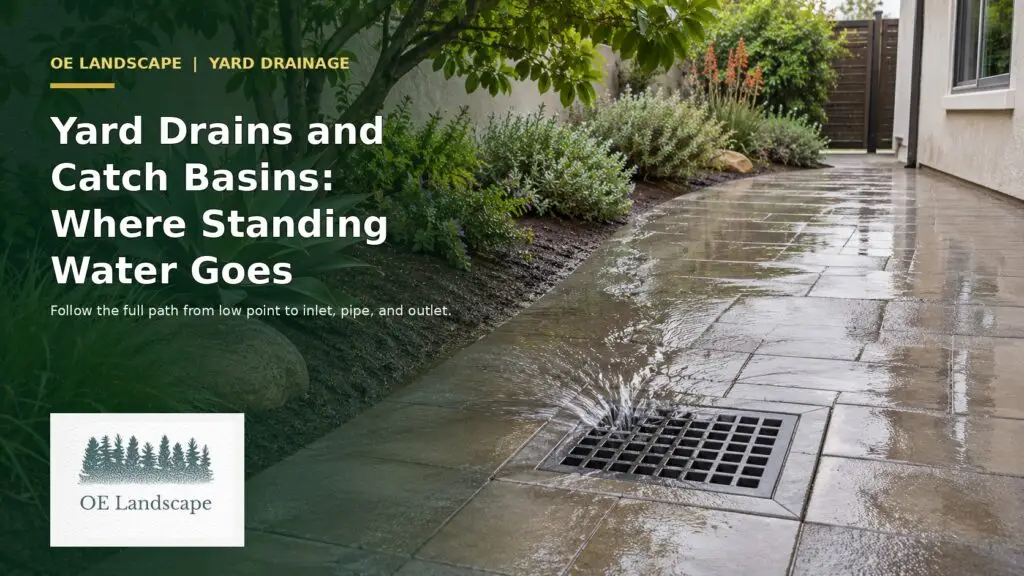
Yard Drains and Catch Basins: How to Stop Standing Water
Learn how yard drains, catch basins, grading, French drains, channel drains, downspout routing, pipe slope, and responsible discharge can help reduce recurring standing water around Southern California landscapes.
Collect Surface Runoff and Give It a Reliable Path
Standing water is one of the most obvious signs that a yard is not draining properly.
After rain, some puddles may disappear within a short period of time. But when the same areas remain wet, muddy, or unusable long after the storm has passed, the landscape may need a better way to collect and redirect surface runoff.
Two common solutions are yard drains and catch basins.
These systems are designed to capture water at low points in the landscape and move it through underground drainage pipe toward an appropriate outlet.
At OE Landscape, we help Southern California homeowners address drainage problems by looking at the entire property—not just the puddle itself. Proper grading, drain placement, pipe routing, gutters, hardscape, and discharge locations all influence whether a drainage system will work effectively.
For additional background on runoff and stormwater, homeowners can review the California Water Boards Storm Water Program.
Why Standing Water Forms in a Yard
Water naturally moves toward the lowest point available.
If the ground contains dips, flat sections, poorly graded areas, or barriers that interrupt water flow, runoff may collect instead of continuing through the landscape.
Common causes of standing water include:
- Low spots in lawn areas
- Poor grading
- Compacted soil
- Heavy soil that drains slowly
- Roof runoff
- Downspouts discharging into the yard
- Water flowing off patios or driveways
- Slopes draining toward flat areas
- Retaining walls affecting water movement
- Irrigation problems
Sometimes the puddle itself is not the real problem.
It may simply be the place where water from several different areas eventually ends up.
Understanding the surface runoff pattern across the property is the first step toward choosing the correct drainage solution.
What Is a Yard Drain?
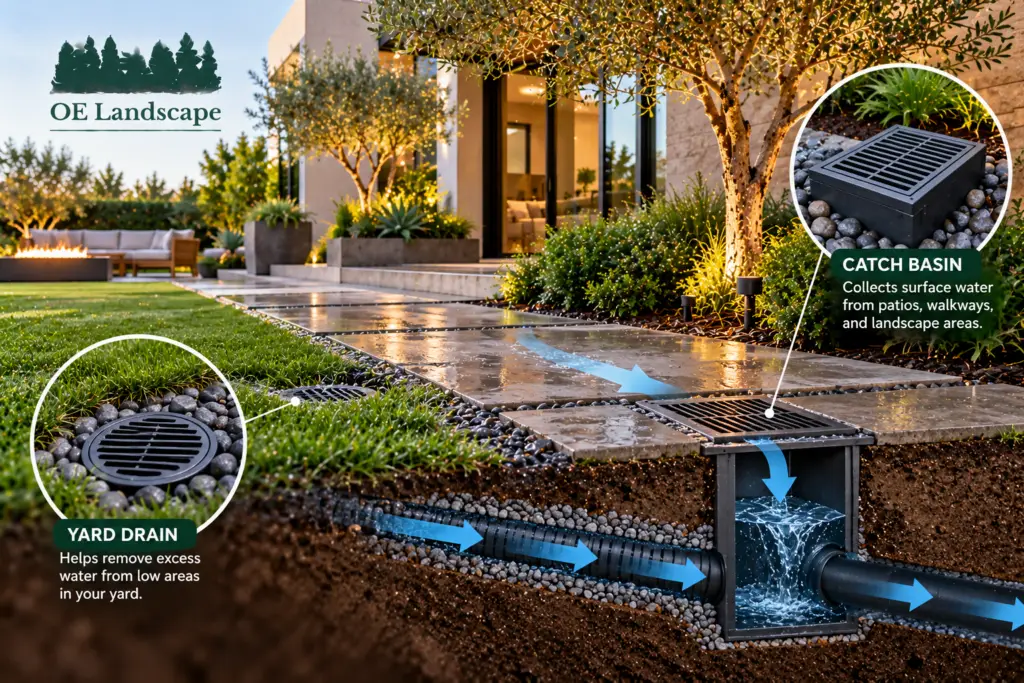
A yard drain is a surface drainage inlet installed where water naturally collects.
You may also hear these referred to as:
- Area drains
- Landscape drains
- Surface drains
- Lawn drains
The visible portion is usually a grate installed at or slightly below the surrounding surface.
Water flows across the yard and enters through the grate.
From there, underground drainage pipe carries it toward a designated discharge location.
Yard drains are especially useful for managing surface water.
That makes them different from French drains, which primarily help collect water moving through saturated soil.
What Is a Catch Basin?
A catch basin is a drainage box installed below the surface.
It usually includes:
- A grate on top
- A collection box below
- An outlet connection
- Underground drainage pipe
Water enters through the grate and collects inside the basin before flowing into the pipe.
The basin can also provide some space for sediment and debris to settle before entering the drainage line.
Catch basins are frequently installed in landscape low points where a significant amount of water gathers.
Depending on the property, they may be used in:
- Lawns
- Planting beds
- Gravel areas
- Side yards
- Areas near patios
- Locations below slopes
Yard Drains and Catch Basins Often Work Together
The terms “yard drain” and “catch basin” are sometimes used interchangeably.
In practice, a landscape drainage system may contain several different types and sizes of inlets.
A small area drain may work for a limited amount of surface runoff.
A larger catch basin may be better where more water collects or where sediment and debris are common.
Multiple basins can also be connected to the same underground drainage line.
The best setup depends on how much water reaches each location and how the site is graded.
When Standing Water Becomes a Recurring Problem
A puddle during a very heavy storm does not always mean the yard requires major drainage work.
But repeated standing water deserves attention.
Warning signs may include:
- The same puddle appearing after every rain
- Lawn remaining muddy for days
- Gravel repeatedly washing into low areas
- Water collecting near the house
- Water pooling around patio edges
- Planting beds staying saturated
- Soil erosion around low points
- Water moving toward doors or garages
Repeated water accumulation often means the property lacks a reliable pathway for runoff.
A yard drain or catch basin may provide that collection point.
Drain Placement Is Critical
A drain can only collect water that reaches it.
This sounds obvious, but incorrect placement is one of the most common problems in drainage systems.
If the basin sits slightly above the lowest point, water may collect beside it instead of entering the grate.
The surrounding landscape should direct water toward the drain.
This may require minor grading adjustments.
A properly positioned basin should work with the natural movement of water rather than expecting water to travel uphill toward the inlet.
Grading and Yard Drains Should Work Together
Installing a drain into an incorrectly graded yard may not solve the entire issue.
The land itself needs to direct water toward the drainage point.
Proper grading may involve:
- Correcting depressions
- Creating gentle slopes
- Reshaping lawn areas
- Adjusting soil near patios
- Redirecting runoff away from the home
The drain then becomes the collection point for the water that grading delivers to it.
This combination of surface grading and drainage collection is often much more effective than relying on the basin alone.
Yard Drains Are Best for Surface Water
One important distinction is the type of water being managed.
Yard drains and catch basins are usually best for visible water moving across the surface.
Examples include:
- Rainwater running across lawn
- Runoff from a slope
- Water leaving a patio
- Roof runoff entering the yard
- Irrigation runoff
If the ground remains wet even when there is little visible surface water, the issue may involve subsurface moisture.
In those situations, a French drain or another subsurface drainage strategy may also be appropriate.
French Drains and Catch Basins Solve Different Problems
A French drain and a catch basin are not competing solutions.
They solve different drainage conditions.
A catch basin collects surface water.
A French drain collects water moving through soil and gravel below the surface.
Some properties need both.
For example, a backyard may have a low point that floods during heavy rain while the soil along a nearby slope remains saturated for several days.
A catch basin could manage the surface puddle while a French drain helps intercept subsurface water.
A complete drainage plan can combine both systems when necessary.
Gutters Can Send Large Amounts of Water Into the Yard
Standing water sometimes originates on the roof rather than in the landscape.
Gutters collect water from a large roof area and concentrate it into downspouts.
If those downspouts release water directly into the yard, a small area may receive a surprisingly large volume of runoff.
This can overwhelm lawn, soil, or planting beds.
Downspouts may sometimes be connected to solid underground drainage pipe so roof runoff is routed more deliberately.
The important point is that roof drainage and yard drainage should be considered together.
A catch basin cannot always solve the problem if several downspouts continue dumping water into the same area.
Do Not Send Downspouts Into the Wrong Type of Drain
Roof runoff and yard runoff may share a larger drainage strategy, but the system should still be planned carefully.
Downspouts carry concentrated water and may also introduce leaves or roof debris.
In many situations, solid piping is used for roof water rather than allowing it to flow unnecessarily through perforated drainage systems.
The exact design depends on the property.
The goal is to prevent one drainage component from overwhelming another.
Catch Basins Can Help Protect Lawn Areas
A lawn that becomes muddy after every storm is difficult to use and maintain.
Water may collect because the area is lower than the surrounding property.
A catch basin positioned at the true low point can provide an outlet.
Grading can then be adjusted so runoff moves toward it.
This may help reduce the time the lawn remains saturated after rain.
However, if the lawn is being overwatered by irrigation, that issue should be corrected too.
Drainage should not be used to compensate for unnecessary irrigation.
Planting Beds Can Need Surface Drainage Too
Planting beds often appear to absorb water well, but they can still flood.
This is especially common when runoff enters from:
- Roofs
- Patios
- Slopes
- Walkways
- Neighboring elevations
A catch basin can sometimes be installed within the planting area to collect excess water.
It should be positioned carefully so mulch, leaves, and soil do not constantly cover the grate.
Planting and drainage need to be planned together.
Standing Water Near a Foundation Should Be Investigated
Water repeatedly collecting beside a home should not be ignored.
The surrounding grade should generally help direct runoff away from the structure.
If water is moving toward the building, simply placing a drain beside the wall may not be enough.
The broader grading pattern should also be reviewed.
A drainage solution may include:
- Regrading
- Catch basins
- Solid drainage pipe
- Gutter connections
- Surface drains
The purpose is to create a reliable path that moves water away from sensitive areas.
Patios Can Create New Drainage Problems
Adding hardscape changes how water moves.
A patio does not absorb rainfall the same way soil does.
Instead, runoff travels across the surface toward the lowest edge.
If that edge directs water into a small planting area or lawn depression, standing water may develop.
This is why drainage should be considered when patios are designed or renovated.
The patio may need:
- Proper surface slope
- Channel drains
- Catch basins nearby
- Appropriate landscape grading
A beautiful patio should not create a water problem somewhere else in the yard.
Channel Drains Work Well Across Hardscape
Catch basins collect water at individual points.
Sometimes a longer collection area is needed.
A channel drain may work better across:
- Driveways
- Garage entrances
- Patios
- Gates
- Large hardscape transitions
Channel drains capture water along a continuous line.
They may then connect into the same underground drainage network as nearby catch basins.
Using the right inlet type for the surface can improve the performance of the entire system.
Driveways Can Send Water Toward the Wrong Place
Driveways often create significant runoff.
If the driveway slopes toward the house, garage, or side yard, water may concentrate quickly during a storm.
A channel drain or strategically placed catch basin may help intercept that water.
But once again, capture is only half the job.
The collected runoff still needs somewhere to go.
Every Drain Needs an Outlet
This is one of the most important drainage principles.
A catch basin is not a storage container.
It is part of a conveyance system.
Water enters the basin, moves into underground pipe, and must eventually reach an appropriate discharge point.
The outlet may depend on:
- Property elevation
- Local drainage infrastructure
- Existing drains
- Site conditions
- Applicable local requirements
The system should not simply move water from one low spot to another.
A complete design follows the entire collection-to-discharge pathway.
Pipe Slope Matters
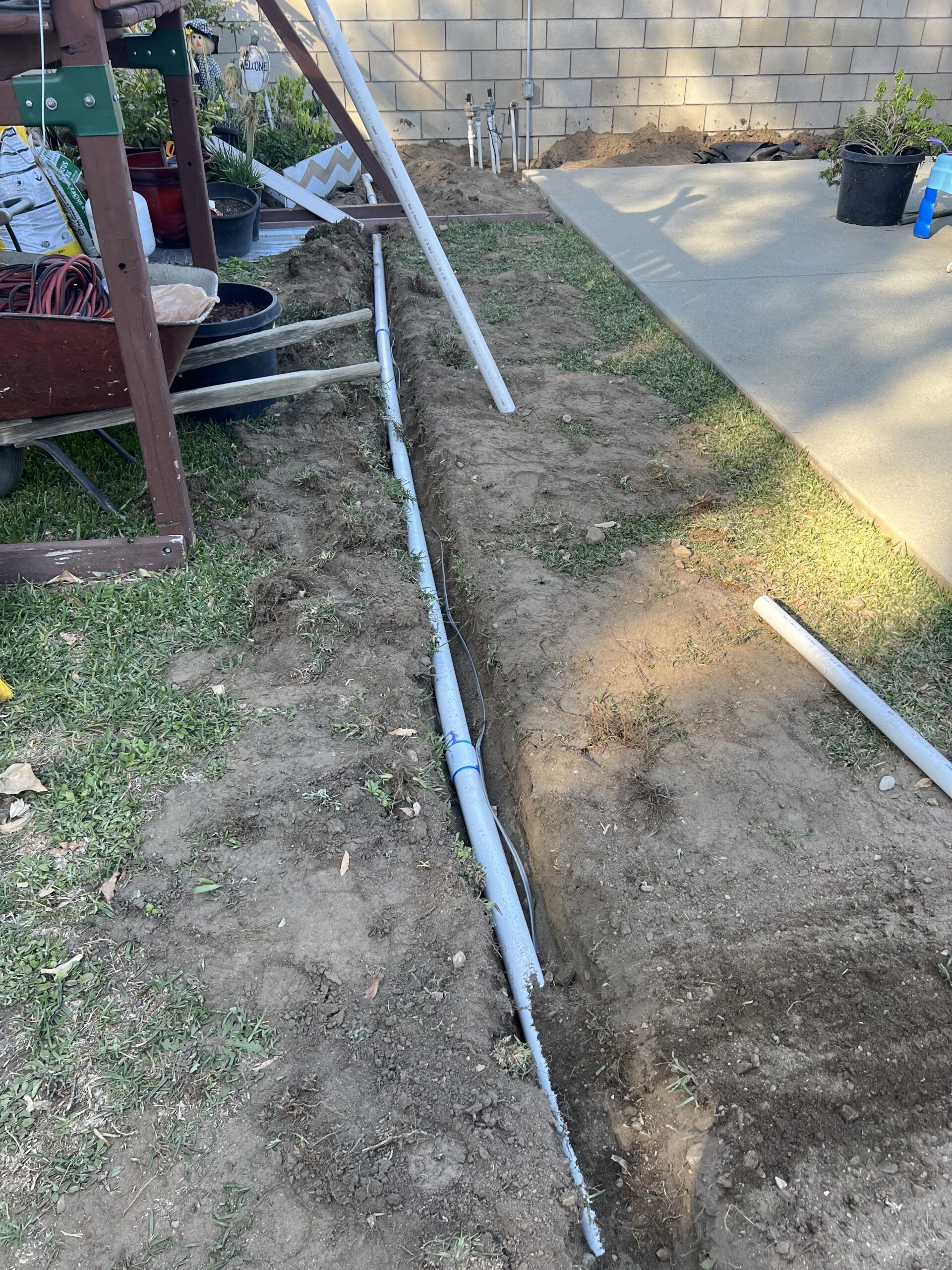
Most yard drainage systems rely on gravity.
That means the underground pipe needs enough fall to allow water to move toward the outlet.
A pipe installed too flat may drain slowly.
A pipe containing unintended low spots can hold water and sediment.
Before installation, the route should be checked for:
- Starting elevation
- Ending elevation
- Total distance
- Available slope
- Obstacles
This becomes especially important in flat yards.
Sometimes there is not enough elevation for gravity drainage, which may require a different strategy.
Sump Pumps May Help Where Gravity Cannot
Some yards contain low areas that sit below any practical gravity outlet.
In those cases, a sump basin and pump may be considered.
Water can flow into the basin through yard drains or other collection systems.
The pump then moves the water to a higher discharge location.
Pumped drainage is more complex because it depends on equipment, power, and maintenance.
That is why the site should first be evaluated for gravity-based options.
Catch Basins Can Collect Sediment
One benefit of certain catch basin designs is that they provide room below the outlet where some sediment may settle.
This can help keep some debris from immediately entering the drainage pipe.
However, sediment accumulation still needs to be removed periodically.
If a basin fills with soil, leaves, mulch, or gravel, its capacity decreases.
Routine inspection is important.
Drain Grates Need to Stay Clear
A perfectly installed drainage system cannot work if the inlet is blocked.
Common material that may cover grates includes:
- Leaves
- Mulch
- Soil
- Grass clippings
- Gravel
- Trash
Before periods of heavy rain, homeowners should inspect visible drains and clear debris.
This simple maintenance step can make a major difference.
Use the Right Basin Size for the Location
Catch basins come in different sizes.
A small basin may be suitable for a limited planting area.
A larger low point receiving runoff from several parts of the yard may require greater collection capacity.
The expected water volume should influence basin size.
Drainage design should consider how much runoff reaches the area rather than simply installing the smallest available drain.
Multiple Catch Basins Can Be Connected
Large yards may require several collection points.
For example, one basin may collect water from the back lawn while another collects runoff near a patio.
These basins can sometimes connect into a shared underground line.
The pipe size and layout should account for the combined flow.
As additional drains are connected, the system needs enough capacity to carry the increasing volume of water.
Pipe Size Should Match the System
Drainage pipe size matters.
A system receiving runoff from several catch basins and roof downspouts may carry much more water than a single small yard drain.
Pipe sizing may depend on:
- Number of inlets
- Expected runoff volume
- Roof connections
- Pipe slope
- Drainage distance
- Outlet capacity
An undersized system may struggle during heavier rainfall.
The entire network should be considered rather than sizing each drain independently.
Avoid Unnecessary Sharp Turns
Drainage pipe routes should generally be planned as efficiently as practical.
Excessive turns can make maintenance more difficult and may affect flow.
The site often contains obstacles such as:
- Foundations
- Existing utilities
- Trees
- Irrigation
- Hardscape
A well-planned route balances efficient drainage with the realities of the property.
Cleanouts Can Make Maintenance Easier
Drainage systems are easier to maintain when they include accessible points for inspection or cleaning.
Cleanouts can provide access to longer pipe runs.
This may be especially useful where several drains connect into one main line.
Planning maintenance access during installation can prevent future problems from becoming more difficult to reach.
Avoid Placing Basins Where Debris Constantly Collects
A catch basin located directly beneath a tree or at the edge of loose mulch may require frequent cleaning.
Sometimes the location cannot be avoided because it is the true low point.
If so, maintenance should be considered in the design.
Grate style, surrounding materials, and landscape detailing can help reduce unnecessary blockage.
Drainage performance should be balanced with landscape appearance.
Yard Drains Can Be Integrated Into Turf
Drainage does not have to dominate the appearance of the yard.
Catch basin grates can often be positioned discreetly within natural lawn or artificial turf.
The surrounding surface should still slope toward the drain.
The inlet should remain accessible for cleaning.
When installed properly, the drainage component becomes a functional detail rather than a major visual feature.
Drainage Should Be Planned Before Artificial Turf
If a yard already has standing water problems, those issues should be addressed before installing artificial turf.
Covering the surface does not automatically fix poor site drainage.
The base, grading, and underground drainage should all be considered.
A project may include:
- Regrading
- Catch basins
- Drainage pipe
- Base preparation
- Turf installation
Correcting drainage first can help protect the finished work.
Gravel Areas Can Still Need Catch Basins
It is easy to assume that gravel automatically solves drainage problems.
Gravel can allow some water to pass through, but the soil below may still drain slowly.
Large amounts of runoff may also exceed the area's infiltration capacity.
A gravel section located in a low spot may still benefit from a catch basin.
The basin can blend visually with the surrounding material while providing a reliable drainage outlet.
Slopes Can Overwhelm Low-Point Drains
A catch basin installed below a slope may receive a large amount of runoff during intense rain.
Water moving downhill can also carry soil, mulch, and debris.
This can clog the basin quickly.
Slope drainage may require additional strategies such as:
- Erosion-control planting
- Swales
- French drains
- Additional catch basins
- Grading
- Surface stabilization
The goal is not only to capture water at the bottom but also to manage how it arrives there.
Erosion Is a Sign of Concentrated Runoff
If water creates small channels through soil, the runoff is becoming concentrated.
A catch basin may help at the collection point, but the upstream erosion should also be addressed.
Otherwise, soil may continue washing into the drainage system.
The landscape may need changes that slow or redirect the water before it reaches the basin.
Good drainage manages both water volume and water velocity.
Retaining Walls Can Affect Surface Runoff
Retaining walls can change the natural path of water.
Runoff may collect along the top, bottom, or ends of the wall.
Surface drains may be useful in these locations depending on grading.
Subsurface drainage behind the wall may also be necessary.
This is another example where catch basins and French drains may perform different roles within the same property.
Yard Drains Work Best as Part of a System
One isolated basin may solve a small localized puddle.
More complicated properties often need an integrated system.
That system might include:
- Catch basins
- Yard drains
- French drains
- Channel drains
- Solid underground piping
- Gutter connections
- Grading
- Sump pumps
Each component addresses a different part of the drainage problem.
Thinking about the yard as one stormwater management system helps avoid fixing one area while creating another problem elsewhere.
Do Not Forget Irrigation
Water problems during dry weather may be related to irrigation rather than rainfall.
Before installing new drainage, inspect the irrigation system.
Look for:
- Broken heads
- Leaks
- Overspray
- Excessive watering
- Poorly adjusted drip systems
- Water running down slopes
A drainage contractor may identify both drainage and irrigation issues during the same evaluation.
Stopping unnecessary water at the source is often the first step.
Watch the Yard During Rain
One of the best ways to understand a drainage problem is to observe it while rain is falling.
Look for:
- Where water begins
- Which direction it travels
- Where flows combine
- Where puddles appear first
- How quickly they grow
- Which drains receive water
- Where water leaves the property
Photos and videos can be useful for documenting these patterns.
Dry-weather inspections show the shape of the site.
Rain observations reveal how the system actually behaves.
Drainage Should Be Considered During Landscape Renovation
A landscape renovation is an ideal time to address drainage.
Underground pipe can be installed before new surfaces cover the area.
Drainage can be coordinated with:
- Irrigation
- Lighting
- Planting
- Hardscape
- Artificial turf
- Outdoor living spaces
This can reduce the need to disturb finished work later.
A drainage plan should ideally be part of the landscape construction process from the beginning.
Signs a Catch Basin May Need Maintenance
Even a good drainage system requires inspection over time.
Possible warning signs include:
- Water collecting around the grate
- Drainage becoming slower
- Debris visible inside the basin
- Sediment buildup
- Water backing up during storms
- Outlet areas becoming blocked
Addressing small maintenance issues early can help preserve system performance.
Common Catch Basin Installation Mistakes
Surface drainage can underperform when:
- The basin is not at the lowest point
- Surrounding grades do not lead toward the drain
- The pipe has insufficient slope
- The outlet is blocked
- Pipe size is too small
- Too much roof runoff is added
- The basin becomes buried under mulch or soil
- Grates are not maintained
Good drainage requires more than placing a box in the ground.
The entire water path needs to be planned.
When a Drain Alone Is Not Enough
Sometimes standing water is caused by several conditions at once.
For example:
- The yard has a low spot
- The patio sends water toward it
- A downspout discharges nearby
- The soil drains slowly
Installing one catch basin may improve the puddle, but the larger system may still need changes.
The best solution might involve:
- Regrading
- Redirecting the downspout
- Installing the basin
- Adding underground pipe
- Adjusting irrigation
Solving the cause usually creates a better long-term result than treating only the visible symptom.
Create a Yard That Drains and Functions Better
Standing water can make a yard muddy, difficult to maintain, and frustrating to use.
Yard drains and catch basins provide a practical way to collect surface runoff, but their performance depends on thoughtful placement, proper grading, correctly sloped pipe, sufficient capacity, and an appropriate outlet.
At OE Landscape, we help Southern California homeowners address drainage issues through yard drains, catch basins, French drains, channel drains, sump pumps, grading, gutter and downspout drainage, erosion-control solutions, irrigation improvements, and complete landscape renovations.
By understanding how water moves across the entire property, a drainage system can be designed to capture runoff before it becomes recurring standing water.
OE Landscape – CA C-27 License #1109316 | Bonded & Insured
Dealing with standing water after rain? Contact OE Landscape to discuss yard drainage solutions designed around your property's low points, grading, hardscape, landscape, and overall water-flow conditions.
Plan the Collection Point, Pipe Route, Grade, and Outlet Together
A catch basin works best when the surrounding grade directs water toward it and the underground line has a practical route to an appropriate outlet. OE Landscape can coordinate drainage with hardscape, planting, irrigation, artificial turf, grading, and broader landscape improvements.
Let's Take a Look at Where the Water Is Collecting.
Tell OE Landscape what happens during rain or irrigation, where the puddles form, and what other landscape improvements you are considering.