


Connecting Gutters and Downspouts to a Yard Drainage System
Connecting downspouts to yard drainage works when the full route is planned - from the roof edge, through solid conveyance pipe, to a stable and appropriate outlet.

Start with the destination
A gutter is only as useful as the drainage path below it.
Gutters solve only the first part of roof drainage. They collect rain from a broad roof area and send it to a few downspouts, where the water reaches the ground in concentrated streams. If those streams empty beside the house, across a walkway, or into a low planter, the runoff can create ponding, erosion, muddy beds, or water moving back toward sensitive areas.
Connecting downspouts to yard drainage can give that water a defined route. Depending on the property, the route may use a surface extension, solid underground pipe, a rain-friendly landscape area, or a coordinated network that also addresses lawn, patio, and driveway runoff. The right answer starts with the outlet and works backward to the roof.
For Southern California homes, the goal is not simply to hide a pipe. A useful plan accounts for the roof area feeding each downspout, the property grade, soil behavior, hardscape, landscape low points, maintenance access, and an appropriate discharge or infiltration location. OE Landscape evaluates those conditions as part of a broader drainage plan.
Explore OE Landscape's drainage services or review the related guide to directing roof runoff away from the foundation.
Map the Water Path Before Choosing Pipe
Begin at the roof, but do not stop there. Note which roof planes feed each gutter, where each downspout lands, and what lies downhill. A downspout beside a planting bed may look harmless in dry weather, yet the bed can overflow toward a wall, walkway, or neighboring property once the soil is saturated.
Then identify a realistic destination. A gravity outlet to a stable, permitted location is often simpler than a pumped system, but not every lot has enough fall. A vegetated area or rain garden can slow and infiltrate runoff when soil, slope, setbacks, and local rules make that appropriate. H2OC, Orange County's stormwater program, describes downspout redirection to rain gardens, vegetated areas, and rain barrels, while advising residents to consult local building or planning departments before changing the yard.
The final route should remain on the property or reach an approved outlet without concentrating water onto a neighbor. Orange County's Local Drainage Manual summarizes the general principle that owners should not concentrate or divert runoff without making proper provision for disposal. City requirements, HOA rules, easements, and site constraints can add further limits.
- Trace each roof plane to its gutter and downspout.
- Mark foundations, doors, walls, walkways, planters, and property lines.
- Record high points, low points, and the direction water already travels.
- Confirm whether the proposed outlet works by gravity and remains accessible.
Use Solid Pipe to Convey Concentrated Roof Runoff
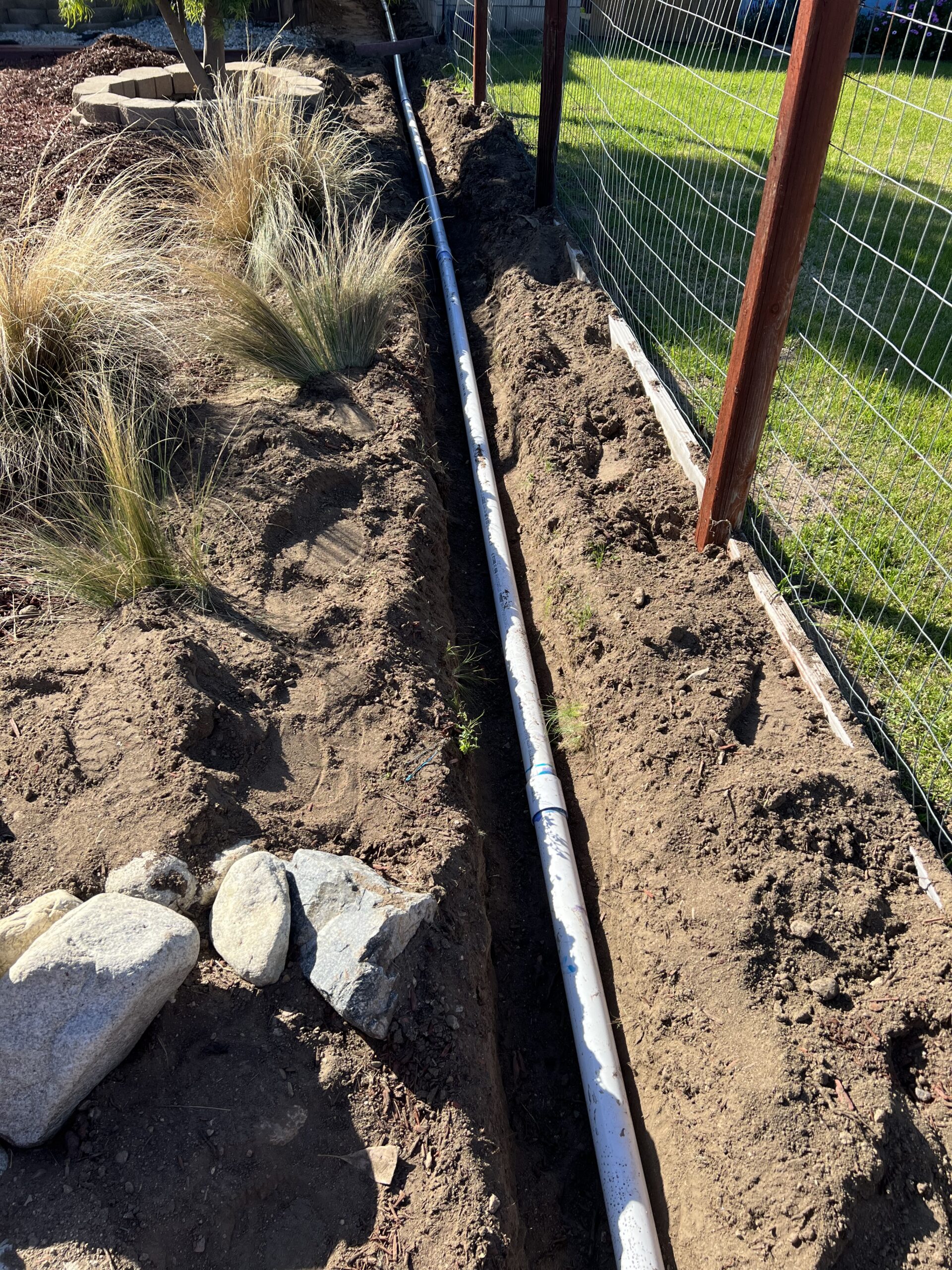
A downspout connection normally needs solid, non-perforated conveyance pipe. Its job is to carry concentrated roof water from the downspout to the planned outlet without intentionally releasing that water along the trench. The downspout transition should be secure, the route should maintain positive flow, and fittings should minimize unnecessary turns where debris can collect.
A French drain serves a different purpose. Its perforated pipe and surrounding aggregate are intended to collect water that is already in the soil. Sending a downspout directly into a perforated French-drain line can release a large pulse of roof water underground and may overload the trench. Some complete systems use both methods, but each component should keep its distinct job.
Where several downspouts or surface inlets share a network, the system must be considered as a whole. A line that handles one roof corner may not handle multiple roof planes plus patio or lawn runoff. Pipe size, slope, inlet capacity, cleanouts, and outlet capacity are design decisions tied to the property and expected flow.
- Solid pipe: moves captured roof runoff to an outlet.
- Perforated pipe: collects water from saturated soil.
- Catch basin: collects surface water at a low point.
- Channel drain: intercepts sheet flow across hardscape.
Choose Between Surface Routing and Underground Downspout Drainage
Not every downspout needs a buried line. On a simple lot, an above-ground extension and a stable splash block may move water away from the building into a suitable vegetated area. Surface routing is easy to inspect and clean, but it can cross walking paths, interfere with maintenance, or look unfinished if the layout is awkward.
Underground downspout drainage can keep walkways clear and coordinate better with a finished landscape. It is most useful when there is a confirmed outlet, enough fall, and a route that avoids utilities, major roots, footings, and other conflicts. Cleanouts or accessible connections make future maintenance far easier than a sealed system with no service points.
A catch basin is not a substitute for capturing roof water at the downspout. Catch basins are valuable where water sheets across a surface or gathers in a low area, but allowing roof runoff to spread across the yard before collecting it can worsen erosion and saturation. When feasible, direct conveyance can keep that concentrated flow controlled from the start.
- Use surface routing when the path is short, stable, visible, and out of the way.
- Consider underground routing when circulation, appearance, or distance makes surface extensions impractical.
- Keep access for cleaning at downspout adapters, direction changes, and outlets.
- Avoid routing water beneath structures or into an unknown existing pipe.
Coordinate Roof Runoff With the Whole Yard Drainage System
Roof runoff is only one source of water. A useful yard drainage plan also considers rain falling on lawns, planting beds, patios, driveways, retaining areas, and slopes. Those flows may need different collection methods even when they ultimately move toward the same general discharge area.
Grading should continue to move surface water away from the home rather than relying on pipe alone. Catch basins can collect ponding at landscape low points. Channel drains can intercept runoff where it crosses a driveway, patio, or walkway. Subsurface drainage may help where soil stays saturated. A sump pump may be considered when gravity cannot reach an acceptable outlet, but it adds power, maintenance, alarm, and backup-planning needs.
Combining these components without checking total capacity can create a new bottleneck. During a storm, roof runoff can arrive quickly while surface inlets are collecting water at the same time. The outlet must be able to receive the combined flow without backing up, eroding soil, or flooding the area it was meant to protect.
- Roof water: capture at the downspout and convey in solid pipe.
- Surface water: guide with grade and collect at low points when needed.
- Hardscape runoff: intercept before it crosses doors, garages, or walking routes.
- Subsurface water: evaluate soil saturation separately from roof discharge.
Select an Outlet That Works Without Creating a New Problem
Every drainage line needs an ending. Depending on the site and local requirements, that may be a stable daylight outlet, an approved connection, a rain garden or vegetated area, a rainwater storage system with overflow, or a pumped discharge. The correct choice depends on soil, slope, space, property boundaries, and local rules.
The U.S. Department of Energy's Building America guidance emphasizes moving roof water away from the foundation and using a stable discharge location or infiltration area. H2OC likewise encourages slowing, retaining, and infiltrating runoff where appropriate. Neither principle means every yard should use the same detail: expansive or poorly draining soil, steep slopes, retaining walls, limited setbacks, and adjacent structures can make infiltration unsuitable.
Avoid outlets that send concentrated flow across a sidewalk, create a slippery area, wash mulch or soil away, or discharge toward another property. If the proposed route reaches a public system or right-of-way, verify the city's requirements before construction. A site review is especially important where there is existing foundation moisture, a hillside, a retaining wall, or no clear gravity outlet.
- Confirm the outlet before finalizing the trench route.
- Protect the outlet from erosion and keep it visible for inspection.
- Do not assume an existing buried pipe is usable without tracing it.
- Plan overflow for rain barrels, cisterns, and infiltration features.
Build Maintenance Into the Downspout Connection
Even a well-planned system needs routine attention. Leaves, roofing granules, seed pods, and windblown debris can enter gutters and downspouts. At ground level, mulch and soil can cover an outlet or a surface inlet. A system that cannot be opened, flushed, or observed is harder to diagnose when performance changes.
Before the rainy season, clear gutters and downspouts, inspect adapters and cleanouts, and confirm that outlets are open. During a safe, moderate rain, watch how water enters the system and check for overflow, bubbling, slow drainage, or erosion. After a major storm, inspect low points and outlet areas again. Never enter floodwater or work near energized equipment during a storm.
If water begins appearing where it did not before, the cause may be a clog, a crushed or separated line, changed grading, root intrusion, a blocked outlet, or more flow entering the network than it was designed to carry. The pattern is useful evidence for a drainage professional, especially when paired with photos taken during or immediately after rainfall.
- Clean gutters and confirm downspouts are open.
- Inspect adapters, cleanouts, catch basins, and channel grates.
- Keep daylight outlets and overflow routes free of soil and vegetation.
- Photograph active runoff patterns from a safe location for site evaluation.
The practical takeaway
Plan the full route, not just the downspout connection.
Connecting gutters and downspouts to a yard drainage system works best when the design follows the water from roof to outlet. Solid pipe can control concentrated roof runoff; grading, catch basins, channel drains, and subsurface drainage can address other water sources. The components should be coordinated, accessible for maintenance, and sized for the flows they receive.
OE Landscape plans drainage improvements around the property's grade, hardscape, planting, water sources, and discharge options. If roof runoff is pooling near the home, washing through beds, or overwhelming a low area, request a property review before the next storm.
Site-specific drainage planning
Coordinate roof runoff with the rest of the landscape.
OE Landscape evaluates downspouts, grade, hardscape, soil conditions, low points, and outlet options before recommending drainage improvements. The goal is a system that fits the property and remains serviceable after installation.

Give roof runoff a controlled path through your landscape.
Share photos of the downspouts, low areas, hardscape, and existing outlets. OE Landscape can review the property and help organize a drainage approach around the site's actual conditions.