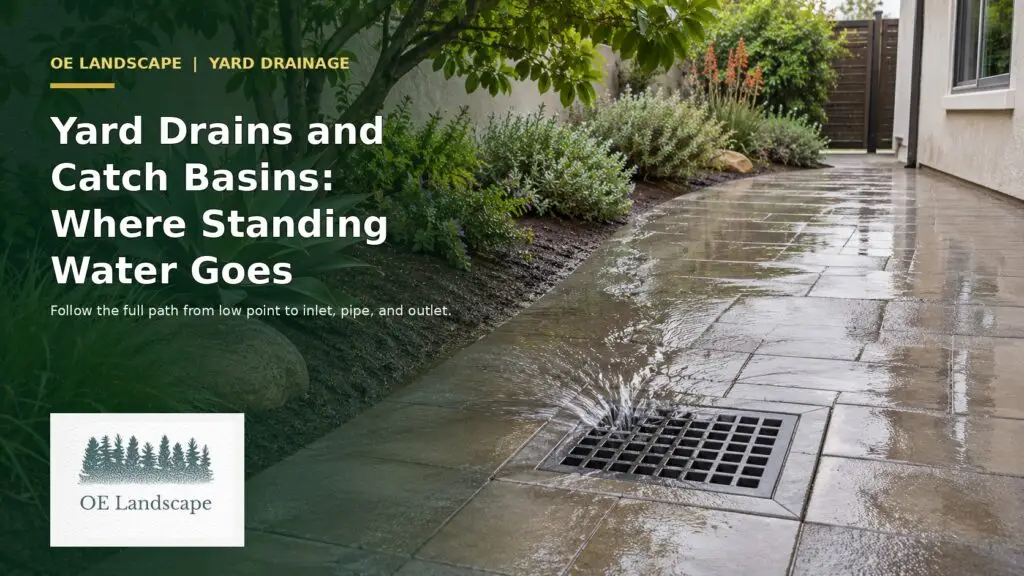

Downspout Drainage: Direct Roof Runoff Away From Your Foundation
Downspout drainage helps move concentrated roof runoff away from your foundation and other sensitive areas. Learn how gutters, solid underground piping, grading, catch basins, channel drains, and carefully planned outlets work together.
Why Downspout Drainage Matters Around Your Home
Downspout drainage is the controlled path that carries roof runoff from gutters and downspouts away from the foundation and toward an appropriate outlet. When that path is missing, water can collect beside the home, saturate soil, erode planting beds, and contribute to standing water elsewhere on the property.
When homeowners think about yard drainage, they often focus on puddles, soggy lawn areas, or water collecting near patios.
But one of the largest sources of runoff on a residential property is directly overhead.
The roof.
During rain, the roof collects water across a broad surface and directs it toward the edges of the home. Gutters capture that water and funnel it into downspouts.
From there, one question becomes extremely important:
Where does the water go next?
If downspouts release water directly beside the house, roof runoff may collect near the foundation, saturate surrounding soil, wash out planting beds, or contribute to standing water elsewhere in the yard.
At OE Landscape, we believe roof drainage should be considered part of the overall landscape drainage system. Gutters, downspouts, grading, catch basins, underground piping, French drains, and discharge locations should work together to move water away from areas where it can create problems.
For additional background on runoff and stormwater management, homeowners can review the California Water Boards Storm Water Program.
Why Downspout Drainage Matters for Roof Runoff
A roof can collect a significant amount of water during a storm.
That water does not stay evenly distributed.
Gutters concentrate it.
Downspouts concentrate it even further.
This means a large amount of rainfall may ultimately be discharged through only a few locations around the property.
If those locations are not planned correctly, concentrated runoff can create drainage problems even when the rest of the yard appears properly graded.
Common problems may include:
- Water pooling beside the house
- Soil erosion near downspouts
- Muddy planting beds
- Washed-out mulch
- Saturated soil
- Standing water in side yards
- Runoff moving toward patios
- Water reaching low areas near doors or garages
Managing roof water properly can reduce the amount of runoff that the surrounding landscape has to absorb.
The California Water Boards also treats runoff from impervious surfaces, including rooftops, as part of the broader stormwater picture.
Gutters Are the First Step in Downspout Drainage
The gutter system collects water as it reaches the edge of the roof.
Without gutters, rainfall can fall directly beside the home and repeatedly saturate the soil near exterior walls.
Gutters create a controlled collection path.
However, gutters alone do not solve the drainage problem.
They simply move the water to the downspouts.
The effectiveness of the system depends heavily on what happens after that point.
A complete roof-drainage strategy should consider:
- Gutter condition
- Gutter slope
- Downspout placement
- Downspout discharge
- Landscape grading
- Underground drainage
- Final outlet location
All of these components influence how effectively water moves away from the structure.
Downspout Drainage Needs More Than a Short Extension
A downspout that ends directly beside the foundation may concentrate roof runoff into one small area.
Even a short extension may not move the water far enough if the surrounding ground slopes back toward the house.
The goal should be to release the water where it can continue moving safely away.
That may involve:
- Surface extensions
- Splash blocks
- Underground solid pipe
- Connection to a drainage network
- Regrading surrounding soil
The correct solution depends on the property.
The important principle is that water should not simply be moved from the roof to the soil immediately beside the structure.
The U.S. EPA also provides homeowner guidance on ways to reduce and manage runoff around a property.
Grading Around the Home Matters
Downspout drainage works best when the surrounding grade also directs water away from the building.
If the soil slopes toward the house, even correctly discharged water may eventually move back toward the foundation.
This is why roof drainage and grading need to be considered together.
A complete evaluation should look at:
- The elevation around the structure
- Nearby low points
- Patio or driveway slopes
- Planting-bed grades
- Side-yard conditions
- Existing drainage inlets
Good drainage is not created by one component.
It comes from creating a continuous path for water from the roof to a safe discharge area.
Why Concentrated Roof Water Can Cause Erosion
Water leaving a downspout can move quickly.
If it falls directly onto exposed soil, mulch, or loose gravel, it may begin carrying those materials away.
Over time, homeowners may notice:
- Small channels forming in planting beds
- Soil disappearing around the outlet
- Mulch moving across the yard
- Gravel collecting in low areas
- Exposed plant roots
This erosion is a sign that the runoff is too concentrated for the surface to manage effectively.
Redirecting the downspout into a more controlled drainage route can help reduce this problem.
Underground Downspout Drainage
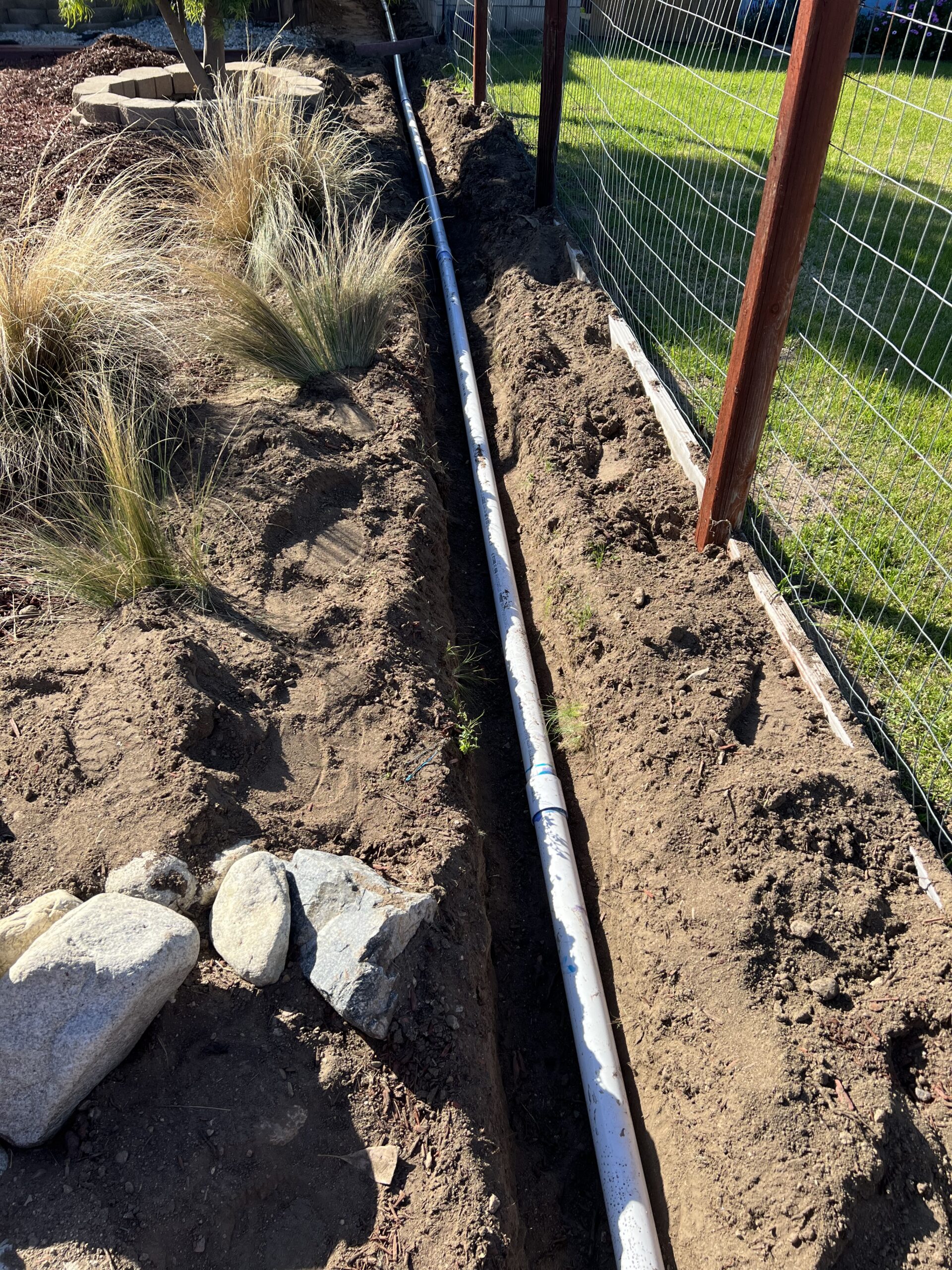
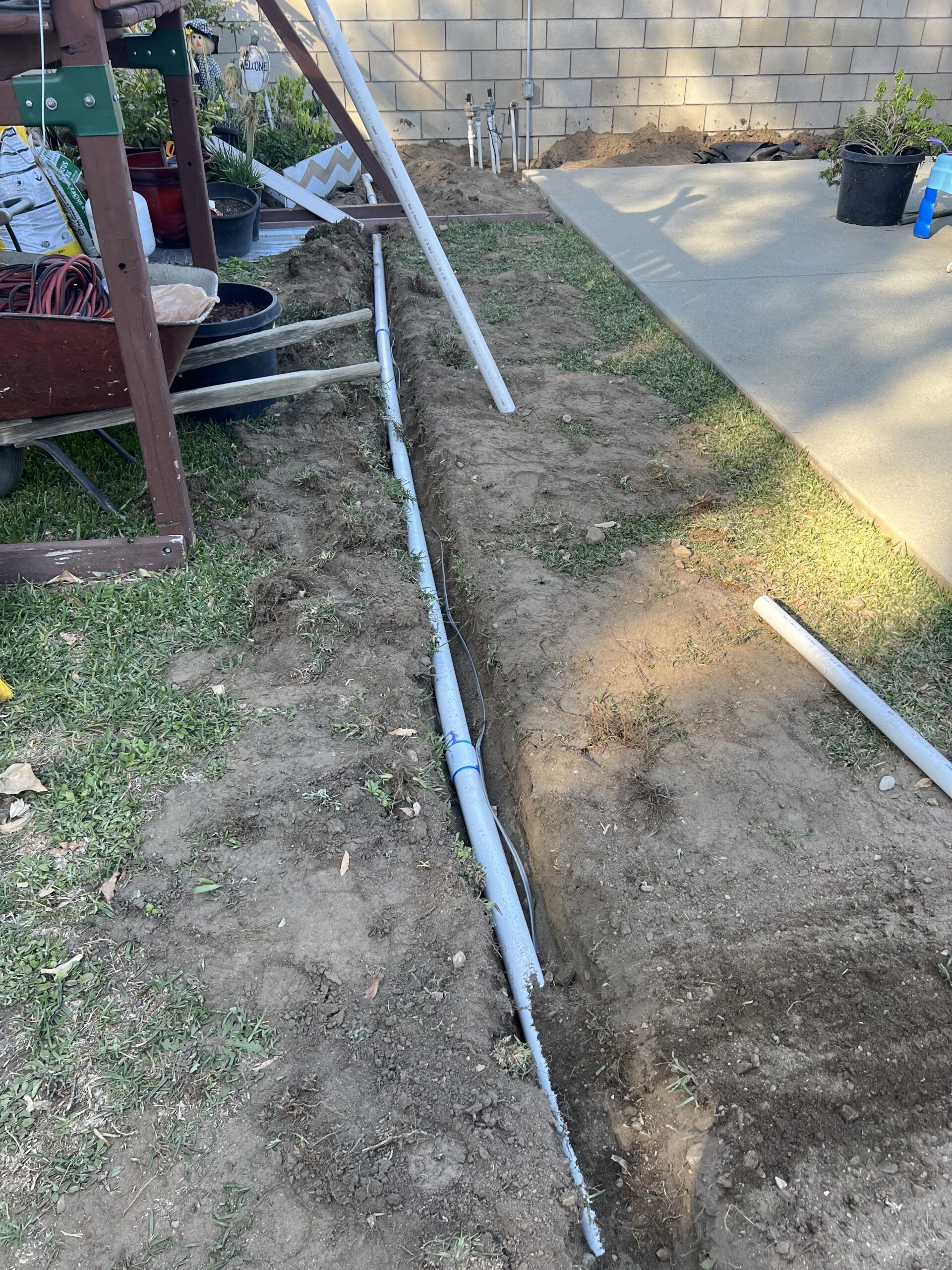
One common approach is connecting downspouts to solid underground drainage pipe.
The pipe can carry roof water away from the structure toward a planned outlet.
This helps prevent the downspout from releasing all of its water into one landscape area.
Solid pipe is typically used because the goal is to transport the collected roof runoff rather than allow it to leak into the surrounding soil along the route.
The underground pipe may connect several downspouts before reaching the final discharge location.
Pipe size, slope, routing, and capacity should all be considered.
Roof Water and French Drains Are Not the Same
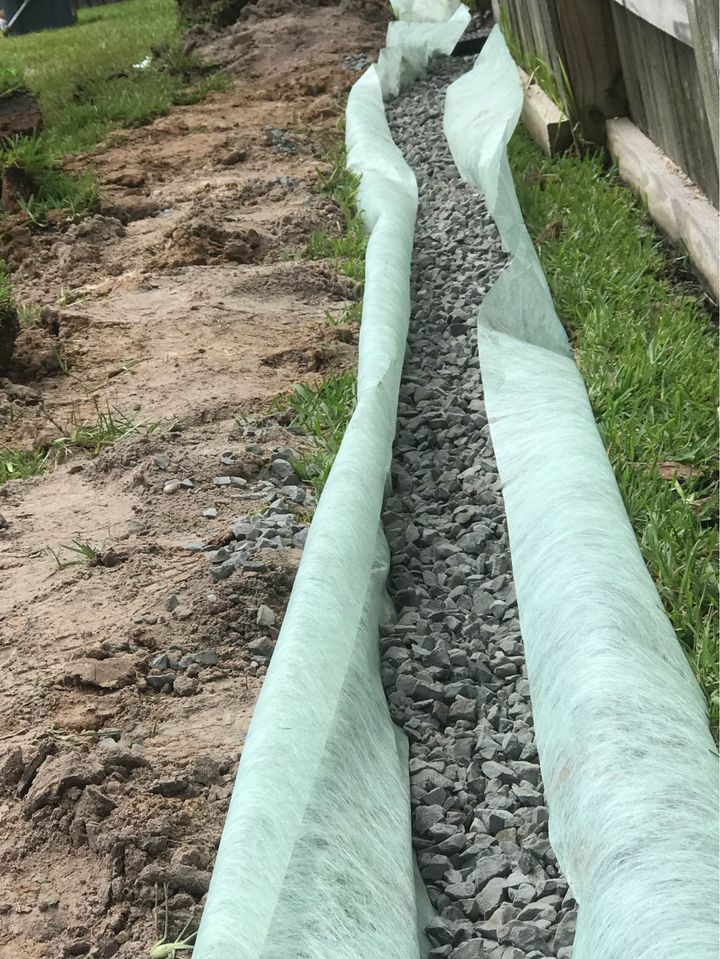
A French drain is primarily designed to collect water moving through saturated soil.
Roof runoff is different.
It arrives as a concentrated flow from a downspout.
Sending large volumes of roof water directly into a perforated French-drain system can sometimes overload the system or introduce water into areas where it is not needed.
In many cases, roof runoff is better transported through solid piping.
The French drain can then handle subsurface water separately.
Both systems may eventually be part of the same larger drainage plan, but their purposes are different.
Downspouts Can Connect to Yard Drainage Systems
Depending on the design, underground downspout piping may be coordinated with yard drains and catch basins.
For example, one drainage network may collect:
- Roof runoff
- Surface runoff from lawn
- Water from low planting areas
- Patio runoff
However, the system needs to be sized appropriately for the combined volume.
A network that works well for two catch basins may become overwhelmed when several roof downspouts are connected.
Drainage design should consider the total expected flow rather than treating each inlet separately.
Catch Basins Can Help With Overflow Areas
If downspouts contribute to a low section of yard, a catch basin may help collect surface runoff after the water reaches the ground.
But a catch basin should not automatically replace proper downspout routing.
If concentrated roof water can be captured directly through underground piping, that may reduce the amount of water reaching the landscape surface in the first place.
Catch basins are often most useful for surface water that cannot be collected before it reaches the yard.
Channel Drains May Help Near Hardscape
Roof runoff can sometimes reach patios, walkways, or driveway areas.
If a downspout or roof valley releases water near hardscape, the flow may move quickly toward:
- Doors
- Garages
- Low patios
- Side yards
A channel drain may help intercept that runoff across a wider area.
This can be especially useful where water travels across a paved surface.
The channel drain can then connect to the broader drainage system.
Side Yards Often Become Problem Areas
Side yards frequently contain downspouts because they provide convenient locations for roof drainage.
Unfortunately, side yards are also often narrow and relatively flat.
This can create ideal conditions for standing water.
Several downspouts may release water into a confined area where:
- Soil drains slowly
- Walls limit evaporation
- Walkways restrict infiltration
- Grades are difficult to adjust
Underground piping can be especially valuable in these areas because it creates a controlled route through a space that may otherwise remain wet.
Downspouts Near Driveways Need Attention
Some downspouts release water near driveways.
During a storm, that water may combine with runoff already moving across the paved surface.
If the driveway slopes toward the garage or home, this can increase the amount of water approaching the structure.
Solutions may involve:
- Redirecting the downspout
- Connecting it underground
- Installing a channel drain
- Adjusting surface grading
The roof and driveway should be evaluated as part of one runoff system.
Downspouts Near Retaining Walls Can Create Problems
Water concentrated near retaining walls deserves special attention.
If a downspout discharges onto soil above or behind a retaining wall, that water may increase soil saturation in the area.
The wall may already have its own subsurface drainage requirements.
Adding roof runoff can place additional demand on that system.
Downspouts should therefore be routed carefully around retaining structures.
The goal is to avoid unnecessarily increasing moisture behind or around the wall.
Keep Water Away From Low Exterior Openings
Doors, garages, basement-style entries, and other low exterior openings can be vulnerable when water is directed toward them.
A downspout that empties uphill from one of these locations can contribute to runoff moving in the wrong direction.
The drainage plan should identify these sensitive areas.
Water should be intercepted or redirected before it reaches the opening.
This may require a combination of:
- Grading
- Channel drains
- Catch basins
- Underground piping
- Downspout rerouting
Downspouts Can Overwhelm Planting Beds
Planting beds may appear like convenient places to release roof water.
But concentrated downspout runoff can exceed what the soil and plants can absorb.
Symptoms may include:
- Saturated soil
- Washed-out mulch
- Plants struggling from excess moisture
- Erosion
- Water spilling into nearby hardscape
A planting bed should not automatically become the final destination for roof drainage.
The amount of water reaching the area should be considered first.
Irrigation and Roof Drainage Can Combine
A planting bed may seem to drain adequately during dry weather but become saturated during storms because it already receives regular irrigation.
When roof runoff is added, the soil may have very little remaining capacity.
This is another reason drainage should be evaluated alongside irrigation.
A well-planned landscape should balance:
- Water applied intentionally through irrigation
- Rainfall
- Roof runoff
- Natural soil drainage
All of these affect how wet the landscape becomes.
Gutter Maintenance Is Part of Drainage Maintenance
Even a well-designed downspout system cannot perform properly if the gutters are clogged.
Leaves and debris can prevent water from reaching downspouts.
Instead, water may spill over the gutter edge and fall directly beside the house.
Homeowners should inspect gutters periodically, especially before periods of expected rain.
Look for:
- Leaves
- Roof debris
- Sediment
- Damaged sections
- Sagging areas
- Blocked downspout openings
Keeping the gutter system clear helps ensure roof water reaches the drainage path intended for it.
Watch for Water Overflowing From Gutters
Water flowing over the edge of a gutter may indicate several possible issues.
The gutter may be clogged.
A downspout may be blocked.
The gutter may have insufficient slope.
Or the system may not have enough capacity during intense rainfall.
Overflowing water defeats the purpose of the gutter because it sends runoff directly beside the structure.
This should be investigated before focusing only on the landscape below.
Inspect Downspout Connections
Underground downspout connections should also remain secure.
If a connection separates, water may begin discharging into the soil below the surface.
Because the failure is underground, it may not be obvious immediately.
Possible signs include:
- Unexpected wet areas
- Soil settling
- Erosion near the connection
- Water appearing where it did not before
Accessible inspection and maintenance points can make these issues easier to identify.
Underground Pipe Needs Proper Slope
Most roof drainage systems rely on gravity.
The pipe needs enough slope to carry water toward the outlet.
A poorly sloped pipe can hold water between storms.
Low sections may also collect debris.
The route should be planned using the actual elevation of the property.
Important factors include:
- Downspout connection height
- Pipe length
- Available fall
- Outlet elevation
- Obstacles along the route
A visually convenient pipe route is not always the best drainage route.
Pipe Capacity Matters During Heavy Rain
Several downspouts can generate significant flow at the same time.
If they are connected to one underground line, the pipe needs sufficient capacity.
The design should account for:
- Number of connected downspouts
- Roof area
- Additional yard drains
- Pipe slope
- Pipe length
- Final outlet capacity
An undersized system may back up during stronger storms.
That can cause water to return toward downspouts or overflow from connected inlets.
Avoid Excessive Turns Where Possible
Every turn in underground drainage can make the system more difficult to inspect and clean.
Some turns are unavoidable because of structures, utilities, or landscape features.
However, drainage routes should generally be as direct as practical.
This helps support water movement and future maintenance.
Cleanouts can also be added at strategic locations where long pipe runs or directional changes occur.
Every Downspout System Needs a Final Destination
Routing downspouts underground solves only part of the problem.
The water still needs somewhere to go.
The final discharge strategy depends on:
- Property slope
- Existing drainage infrastructure
- Local requirements
- Available outlets
- Soil and site conditions
The goal is to avoid simply relocating the water to another part of the property where it creates a new problem.
A complete drainage plan follows the runoff from:
roof → gutter → downspout → pipe → outlet
Every stage matters.
Avoid Sending Water Toward Neighboring Properties
Drainage improvements should not create problems elsewhere.
Water should not simply be redirected toward neighboring structures or properties.
The discharge plan needs to consider the broader site and applicable local requirements.
This is one reason professional drainage planning is important.
A solution should improve water management without creating another drainage issue beyond the original problem area.
Sump Pumps May Be Needed on Low Properties
Some properties are too flat or too low to provide a practical gravity outlet.
In these situations, underground downspout drainage may feed into a sump basin.
A pump can then move the collected water to an appropriate discharge location.
Pumped drainage requires additional planning for:
- Pump capacity
- Electrical supply
- Maintenance
- Basin size
- Discharge routing
Whenever practical, gravity drainage is usually simpler.
But site elevation determines what is possible.
Downspout Drainage Should Be Planned Before New Hardscape
If a homeowner is preparing to install:
- Pavers
- Concrete
- Artificial turf
- A patio
- An outdoor kitchen
- New planting
it is an ideal time to review downspout routing.
Installing underground drainage before the finished surfaces are completed can avoid the need to disturb new work later.
Drainage lines can also be coordinated with irrigation and landscape lighting.
Planning underground infrastructure first usually produces a cleaner final result.
New Patios Can Change Roof Drainage Behavior
A downspout that previously released water onto soil may behave very differently after a patio is installed nearby.
The new hardscape may redirect the runoff toward another location.
This can create unexpected puddles.
Whenever hardscape is expanded, nearby downspouts should be reviewed.
The project should consider both the new surface drainage and the existing roof runoff.
Artificial Turf Does Not Replace Downspout Drainage
Artificial turf may allow water to drain through its base, but concentrated roof runoff can still be too much for a small area to handle effectively.
If downspouts already create soggy areas, those conditions should be addressed before turf is installed.
A complete project may involve:
- Underground downspout piping
- Regrading
- Catch basins
- Base preparation
- Artificial turf installation
Drainage should support the new surface rather than relying on the surface itself to solve an existing runoff problem.
Gravel Does Not Automatically Solve Roof Runoff
Replacing soil or mulch with gravel may reduce visible mud, but it does not necessarily solve the drainage issue below.
If the underlying soil drains slowly, roof water can still collect beneath the gravel.
The surface may look dry while the area remains saturated.
Gravel can be part of the landscape design, but concentrated downspout runoff should still have a reliable drainage route.
Roof Valleys Can Create High-Flow Areas
Some roof shapes concentrate rainfall into valleys before it reaches the gutter.
This can create particularly high flow at certain downspouts.
Those locations may require extra attention.
If one downspout repeatedly causes erosion or overflow while others do not, the roof area feeding it may simply be larger.
Drainage planning should consider where the roof sends the most water, not just the number of downspouts.
Observe the Property During Rain
One of the most useful ways to evaluate roof drainage is to watch it during an actual storm.
Look for:
- Gutters overflowing
- Downspouts backing up
- Water discharging beside the house
- Soil erosion
- Water moving across patios
- Standing water near walls
- Side yards filling up
- Water moving toward doors or garages
Photos or videos can help document these patterns.
This information can be valuable when planning drainage improvements after the weather clears.
For general flood and heavy-rain preparedness information, homeowners can also review Ready.gov flood guidance.
Inspect the Yard After Rain
The condition of the property after a storm can reveal just as much.
Look for areas where:
- Soil remains saturated
- Water is still standing
- Mulch has moved
- Gravel has washed away
- Drainage grates are covered
- Water has stained hardscape
- Soil has eroded near downspouts
These signs help show where the current drainage system is underperforming.
Protecting the Foundation Starts With the Entire Property
Directing downspouts away from the foundation is important, but roof runoff is only one part of the drainage picture.
The surrounding property should also manage:
- Surface runoff
- Landscape grading
- Irrigation
- Driveway drainage
- Patio drainage
- Slope runoff
- Subsurface moisture
A strong drainage plan looks at how these water sources interact.
For example, moving a downspout farther away may not solve the problem if the yard slopes back toward the house.
The entire water path should be considered.
Signs Your Downspout Drainage May Need Improvement
Homeowners may want to investigate their roof drainage if they notice:
- Water pooling beside downspouts
- Soil washing away
- Mud around the foundation
- Downspouts emptying directly beside walls
- Standing water in side yards
- Saturated planting beds
- Water flowing toward patios
- Gutters overflowing
- Water collecting near garages or doors
- Downspout extensions constantly being moved or disconnected
These symptoms may indicate that roof runoff needs a more reliable route away from the structure.
Good Roof Drainage Can Be Discreet
Drainage systems do not need to dominate the landscape.
Underground piping can hide much of the infrastructure.
Downspout connections can be coordinated with planting and hardscape.
Catch basins can be positioned within turf or planting areas.
Channel drains can align with paving.
When planned properly, the system can perform an important function while remaining visually integrated with the landscape.
Think of Gutters as Part of the Landscape System
Gutters are attached to the house, but their job does not end at the wall.
The water they collect eventually enters the landscape.
That makes them part of the outdoor drainage system.
A successful property-wide drainage strategy may include:
- Gutters
- Downspouts
- Solid underground piping
- Yard drains
- Catch basins
- Channel drains
- French drains
- Grading
- Sump pumps
- Erosion-control measures
Each component manages water at a different stage.
The strongest system is one where all of them work together.
Plan Downspout Drainage as a Complete System
Water will always follow gravity.
The goal of drainage design is to give that water a controlled path before it finds an undesirable one on its own.
For roof runoff, that path begins with the gutter.
The downspout carries the water to ground level.
From there, grading and drainage infrastructure should continue directing the water away from the house and toward an appropriate outlet.
At OE Landscape, we help Southern California homeowners address drainage challenges through gutter and downspout drainage connections, French drains, yard drains, catch basins, channel drains, sump pumps, grading, erosion-control solutions, irrigation improvements, and complete landscape renovations.
By treating downspout drainage as part of the entire landscape drainage system, homeowners can reduce unnecessary water accumulation near the home and create a property that handles rainfall more effectively.
OE Landscape – CA C-27 License #1109316 | Bonded & Insured
Concerned about where your gutters and downspouts are sending rainwater? Contact OE Landscape to discuss drainage solutions designed around your roof runoff, property grading, landscape, and overall water-flow conditions.
Plan the Downspout Route, Pipe Slope, Grade, and Outlet Together
Roof runoff should not simply move from the gutter to the soil beside the house. OE Landscape can coordinate downspout drainage with grading, catch basins, French drains, channel drains, hardscape, irrigation, artificial turf, and broader landscape improvements.
Need Better Downspout Drainage Around Your Home?
Tell OE Landscape where your downspouts discharge, what happens during rain, and where water collects around the property. We can evaluate downspout drainage options that fit your grading, hardscape, planting, and overall water-flow conditions.