

Winter Rain Readiness
Drainage Planning for Southern California Homes Before Winter Rain
A practical drainage plan traces runoff from roof to outlet, protects the building with positive grade, and matches each low spot or saturated area with the right surface or subsurface solution before winter rain arrives.

Before the forecast turns wet
Start with the water path, not a product
Southern California yards can look dry and trouble-free for most of the year, then reveal their drainage weaknesses during the first sustained winter rain. Roof runoff may land beside a foundation, a patio may send water toward a door, or a low planting bed may hold water long after the storm has passed. The best time to find those weak points is before the forecast turns wet.
Drainage planning for Southern California homes is not simply adding a drain at the deepest puddle. It starts by understanding where water enters the property, how grading and hardscape move it, where soil can absorb it, and where runoff can be discharged legally and safely. A good plan protects the home first, reduces avoidable erosion and standing water, and coordinates drainage with the rest of the landscape.
Use the following pre-rain review to document what is happening and decide whether maintenance, regrading, surface collection, subsurface drainage, or a professional site assessment is the right next step.
OE Landscape coordinates landscape drainage with landscape design, hardscape, planting, and irrigation so the solution fits the whole property.
Why Drainage Planning for Southern California Homes Starts With the Water Path
Start at the highest points of the property and follow water downhill. Mark roof valleys, downspouts, patio edges, driveway slopes, retaining walls, side yards, planting beds, and the lowest visible points. A few minutes of observation during light rain or a controlled hose test can reveal more than a dry-weather inspection alone.
Look for evidence as well as active water: silt lines, mulch carried out of beds, algae on paving, stained walls, soil pulled away from a slab, soft turf, or plants that repeatedly decline in one pocket. Photograph each location and note the direction of flow. That record helps distinguish a clogged inlet from a grading problem or a larger capacity issue.
Also map runoff entering from outside the immediate yard. Water may arrive from an uphill slope, a shared boundary, a driveway apron, or a roof area that is larger than it first appears. Do not redirect water onto a neighboring property or make an unverified connection to a public drain. Discharge rules and available outlets vary by jurisdiction and site.
- Roof areas, gutters, and every downspout
- Driveway, patio, walkway, and pool-deck slopes
- Low spots, retaining walls, and narrow side yards
- Existing catch basins, channel drains, pipes, and outlets
- Erosion, sediment, staining, algae, or persistently wet soil
- Off-site water entering the property
Clear and Inspect the Existing Drainage Route
Before planning construction, restore the system you already have. Remove leaves and sediment from gutters, downspouts, catch-basin grates, channel drains, swales, and visible outlets. Confirm that decorative rock, mulch, roots, or recent hardscape work has not covered an inlet or blocked a shallow flow path.
Check that downspouts remain connected and that extensions have not separated or been crushed. At the outlet, look for a buried grate, a stuck pop-up emitter, erosion, or water flowing back toward the house. If a pipe is slow, repeatedly backs up, or cannot be traced, a professional inspection is safer than forcing tools or high-pressure water into an unknown line.
The California Department of Water Resources advises residents to keep storm drains clear as part of flood readiness. On private property, routine cleaning is useful but it does not increase the designed capacity of an undersized system. If water still reaches doors, walls, or occupied areas after maintenance, move to a site-level drainage review.
- Clean gutters and downspouts before the first forecast rain
- Lift grates and remove sediment from accessible basins
- Confirm each visible outlet is open and stable
- Replace broken grates and secure trip hazards
- Schedule unknown blockages or buried lines for inspection
Protect the Building With Positive Grade
Surface grading is the first line of defense because it moves water before a pipe has to collect it. The University of California's lawn-preparation guidance notes that a general 1-to-2-percent slope away from buildings is often sufficient for a planting area. That is a useful planning reference, not a universal construction specification: actual elevations, soil, doors, paving, walls, and local requirements must be reviewed on site.
Avoid solving a low spot by piling soil or mulch against stucco, siding, vents, weep screeds, or wood. Raising soil can hide moisture pathways and reduce required clearances. Likewise, a new berm should not trap water against a wall or send it toward a neighbor. Small elevation changes can redirect a surprising amount of runoff.
Where there is enough room, a shallow swale or carefully regraded bed may move water to a safe collection point with fewer buried components. Where doors, narrow side yards, or fixed paving limit the available slope, a channel drain or catch basin may be part of the solution. The design should still preserve a continuous route from collection point to a lawful outlet.
Match the Drainage Method to the Actual Failure
Different drainage tools solve different problems. A catch basin collects surface water at a low point. A channel drain intercepts sheet flow across paving or near an opening. A swale guides runoff across the surface. A French drain manages water moving through saturated soil. A sump and pump can lift water when gravity drainage is not possible, but it adds maintenance and power dependence.
Do not assume a French drain is the default answer for roof runoff or a patio that slopes the wrong way. Subsurface systems work only when their trench, aggregate, fabric, pipe slope, cleanouts, and outlet are appropriate for the soil and intended flow. UC Statewide IPM notes that some landscapes may need drain pipe, drain tile, or a sump to provide adequate drainage, particularly where hardpan or poor soil drainage is present.
Infiltration features such as dry wells require extra care. Soil must accept water at a suitable rate, groundwater and utilities must be considered, and local rules may control their placement or use. In heavy clay, compacted fill, or a confined side yard, storing water underground without a verified release path can move the problem rather than solve it.
- Regrading or swale: broad surface-flow problem with usable fall
- Catch basin: localized low point receiving surface runoff
- Channel drain: sheet flow crossing hardscape or approaching an opening
- French drain: subsurface saturation, not a universal roof-drain substitute
- Sump and pump: no reliable gravity outlet, with maintenance and backup planning
Test the Route Before the First Major Storm
After maintenance or installation, test one water source at a time. Begin with a modest hose flow at a downspout connection, basin, or short section of paving. Watch the entire route, including the outlet. The goal is to verify direction and identify leaks or backups, not to simulate a severe storm.
Check whether water enters the intended inlet, whether grate elevation is low enough to collect it, whether pipes drain without surfacing, and whether the outlet causes erosion or returns water to the property. Recheck after the first real rain because leaves, sediment, and saturated soil can change performance.
Keep a simple maintenance record with photos, dates, and any locations that needed clearing. It makes seasonal preparation faster and gives a drainage contractor better information if a problem returns. For a new landscape, coordinate this testing with irrigation so a broken sprinkler or overwatered zone is not mistaken for storm runoff.
- Test one source at a time and follow water to the outlet
- Watch for joint leaks, bubbling grates, and slow drawdown
- Confirm the outlet does not create erosion or unsafe ponding
- Recheck after the first meaningful rain
- Photograph recurring trouble spots for the site assessment
Know When the Problem Is Bigger Than Yard Drainage
A residential drainage system can improve how ordinary runoff is collected and directed, but it cannot guarantee that a property will never flood. Homes in mapped flood areas, below steep slopes, near channels, or downslope of a recent burn scar require broader risk planning and close attention to official guidance.
California's Department of Water Resources recommends knowing your flood risk, monitoring forecasts and local authorities, keeping storm drains clear, and preparing to act. DWR's flood-risk resources point homeowners to state hazard tools and FEMA flood information. The National Weather Service also warns that intense rain near burned slopes can produce flash flooding and debris flows; residents in those areas should follow local evacuation directions rather than relying on yard drainage improvements.
If water is arriving rapidly from beyond the property, threatening occupied space, or carrying mud and debris, stop outdoor troubleshooting and follow emergency instructions. Never enter moving water or open a drain during dangerous conditions. A pre-season landscape assessment is useful, but it is not a substitute for flood insurance decisions, emergency planning, or public-safety alerts.
Coordinated site planning
Drainage works best as part of the landscape
The most useful drainage plan explains the full path of water, not just the location of a new drain. It should identify the contributing runoff, protect the home with appropriate grade, select collection points that match the site, provide a maintainable route to a safe outlet, and preserve an overflow path for conditions beyond the system's routine capacity.
OE Landscape can review how drainage relates to grading, planting, hardscape, irrigation, and the larger landscape plan. Share photos of where water collects, when it appears, and any existing drains or outlets when requesting a free estimate. A site assessment is the right place to confirm scope, access, elevations, discharge options, and whether other specialists are needed.

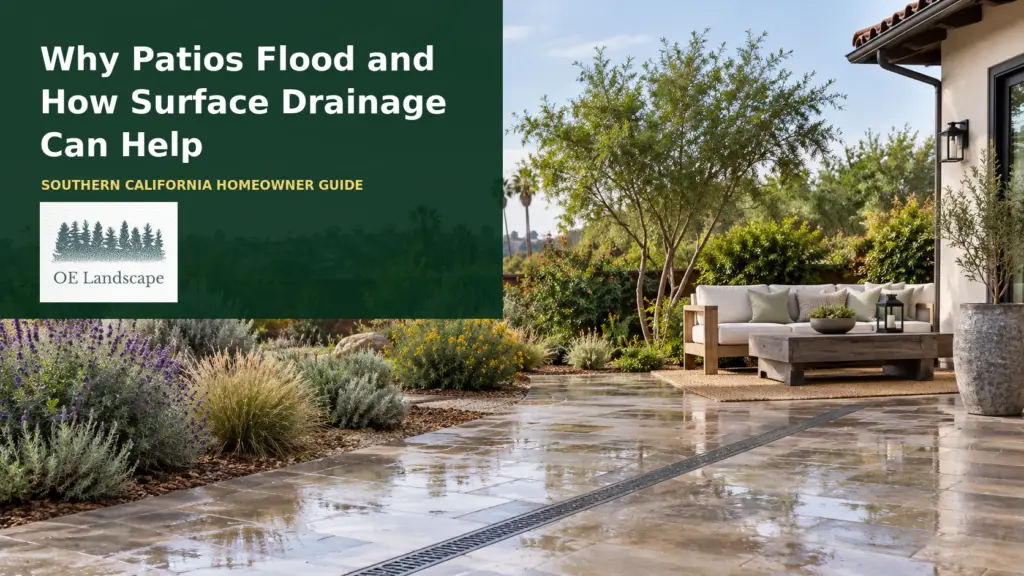
Project images illustrate coordinated landscape planning; they are not represented as drainage case studies.
Plan before winter rain
Show us where the water goes
Send photos of low spots, downspouts, hardscape slopes, and existing drains. OE Landscape can review drainage in the context of your complete outdoor space.