
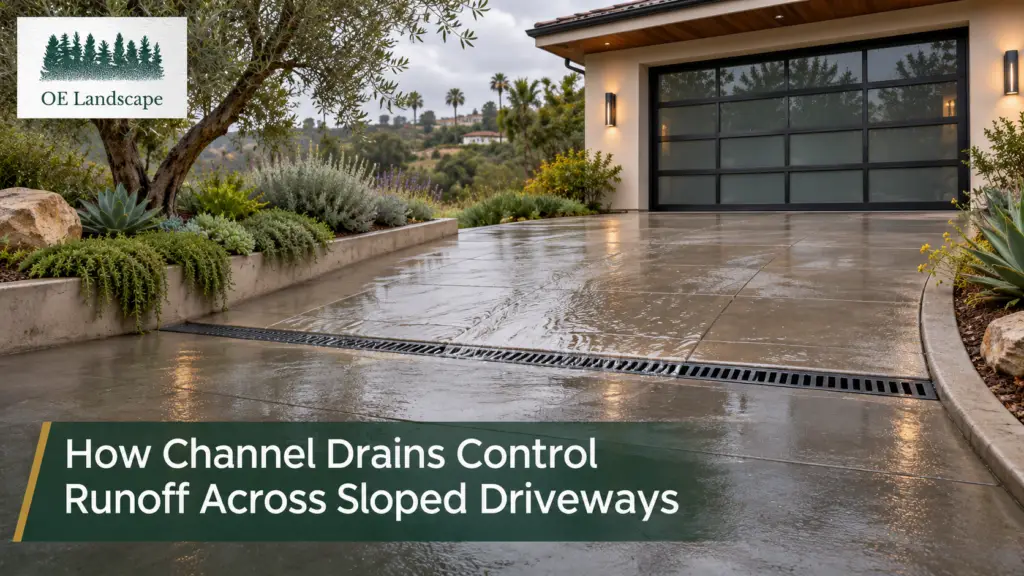

How Channel Drains Control Runoff Across Sloped Driveways
Channel drains for sloped driveways create a continuous interception line across moving runoff before it reaches a garage, doorway, sidewalk, or street. The drain only works as well as the pavement slope, grate, outlet pipe, and legal discharge route connected to it.

Intercept the flow before the driveway reaches its vulnerable low point.
A sloped driveway can collect rain across a broad paved area and deliver it toward one lower edge. If that edge is a garage threshold, side yard, public sidewalk, or neighboring property line, the runoff needs a planned path before the next storm exposes the problem.
A channel drain, also called a trench drain or linear drain, spans the flow path and collects water through a grate. The channel sends that water to an underground pipe and then to an appropriate outlet. Unlike a small point drain, it can intercept sheet flow across much of the driveway width.
That does not make the drain a stand-alone fix. OE Landscape evaluates the contributing pavement, roof runoff, surface grades, drain location, outlet elevation, vehicle loads, maintenance access, and discharge restrictions together. See the broader OE Landscape drainage service and the related guide to channel drains for driveways, patios, and walkways.
The U.S. EPA explains that impervious surfaces generate runoff that can carry sediment, trash, chemicals, and other pollutants. A responsible design manages both the water quantity and where that water ultimately goes.
Why a sloped driveway changes the drainage problem
Concrete, asphalt, and conventional pavers allow far less infiltration than a planted area. Rain stays near the surface and follows the driveway grade. As the slope steepens or the paved area grows, water can reach the lower edge more quickly and may carry leaves, soil, mulch, or vehicle residue with it.
The first design question is not “Which drain should we buy?” It is “Where does all of the water come from, and where does it move?” Driveway runoff may be joined by a walkway, uphill landscape, retaining wall drain, or downspout. Those extra sources can substantially change what the collection system must handle.
- Watch the driveway during actual rain when it is safe.
- Mark where separate flows merge.
- Note water stains and debris lines after the storm.
- Check whether roof downspouts release onto the pavement.
- Identify the true low point near the garage or street.
- Photograph water that bypasses an existing drain.
Safety note: Do not enter fast-moving water or open a drain during a storm. Document conditions from a dry, stable location.
Place the drain across the water, not merely near the puddle
A channel drain works by crossing the runoff path. On a driveway that slopes toward a garage, the collection line is often placed across the driveway before the garage apron or threshold, with enough separation to allow a stable installation and a deliberate grade between the drain and the building.
The finished pavement on the uphill side must deliver water to the grate. The grate must sit at the intended collection elevation, and the ends of the drain must not allow water to slip around them. If the surface is back-pitched, settled, or crowned away from the channel, runoff may bypass the drain even when the product itself is sound.
One line of defense may not be enough
Sunken garages, long steep driveways, and below-grade entries can have little tolerance for overflow. Depending on site conditions, the plan may require a second collection point, a curb or grade adjustment, an overflow route, or a sump system when gravity cannot carry water to a lower approved outlet. No residential drainage system can guarantee that water intrusion will never occur under every storm condition.
Size the complete collection and discharge path
The visible grate is only the entrance. Capacity depends on the contributing drainage area, expected rainfall, surface slope, grate inlet area, channel geometry, outlet pipe, pipe slope, fittings, and the outlet’s ability to receive flow. A wide grate connected to a restricted or flat pipe can still back up.
Roof water deserves separate attention. A downspout that releases onto the driveway adds runoff before it reaches the channel. Where site conditions and local requirements allow, routing roof drainage through a coordinated system may reduce the burden on the driveway surface. The route should never send water toward a foundation, unstable slope, neighboring property, or unapproved location.
- Contributing driveway width and length
- Adjacent hardscape and landscape inflows
- Roof and downspout contributions
- Grate open area and debris exposure
- Outlet pipe size, fall, and fittings
- Gravity outlet or pump requirements
Local review matters: Drainage routes may be affected by municipal standards, HOA rules, easements, property boundaries, and permitting. Structural, hillside, foundation, or unusually complex drainage conditions may require engineering or other specialized review.
Use the drain type that matches the water
Channel drains are well suited to sheet flow crossing a hard surface because they collect along a line. A catch basin is a point inlet for water that already converges at a low spot. A French drain is generally used to intercept water moving through saturated soil, not broad surface flow racing down concrete. Regrading may be more important than adding any drain when the pavement does not direct water to a workable collection point.
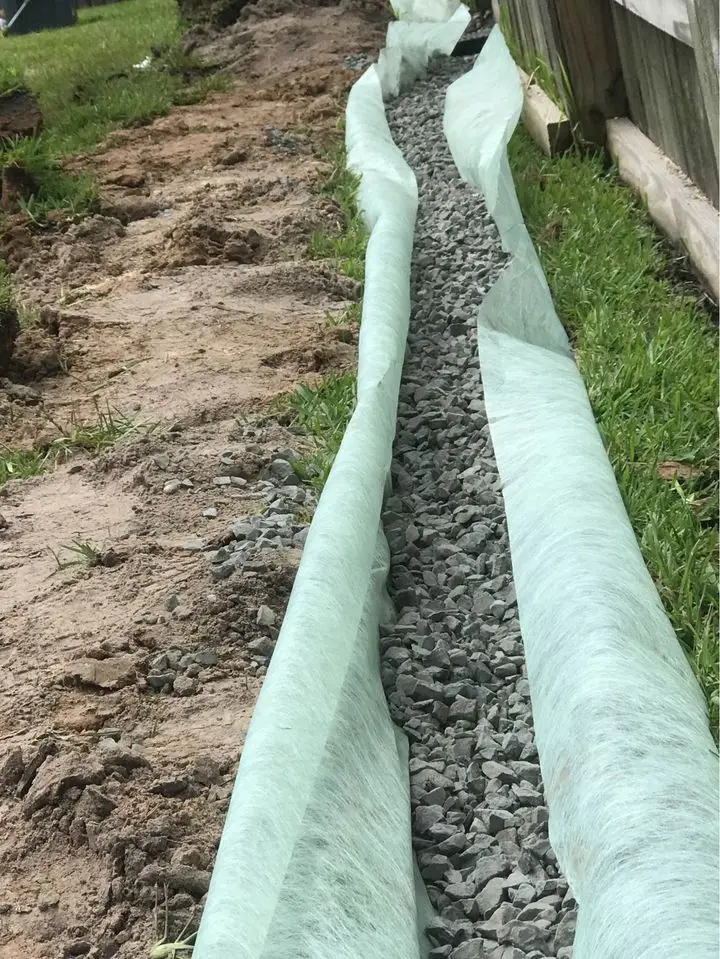
Some properties need a combination. A channel drain may collect driveway runoff, connect to solid underground pipe, pass through a maintenance basin, and discharge through an approved route. A separate French drain may manage wet soil beside the driveway. Each component should solve a specific part of the water path.
- Channel drain: broad surface flow across hardscape
- Catch basin: concentrated surface water at a point
- French drain: subsurface moisture in soil
- Regrading: incorrect or ineffective surface direction
- Downspout routing: concentrated roof runoff
- Sump system: collection below the available outlet
Driveway installation details affect long-term performance
A drain that crosses a vehicle path must be selected and installed for the loads it will actually experience. The grate and channel need appropriate support, the surrounding hardscape should resist movement, and the finished elevation should admit water without creating an abrupt wheel impact or trip edge.
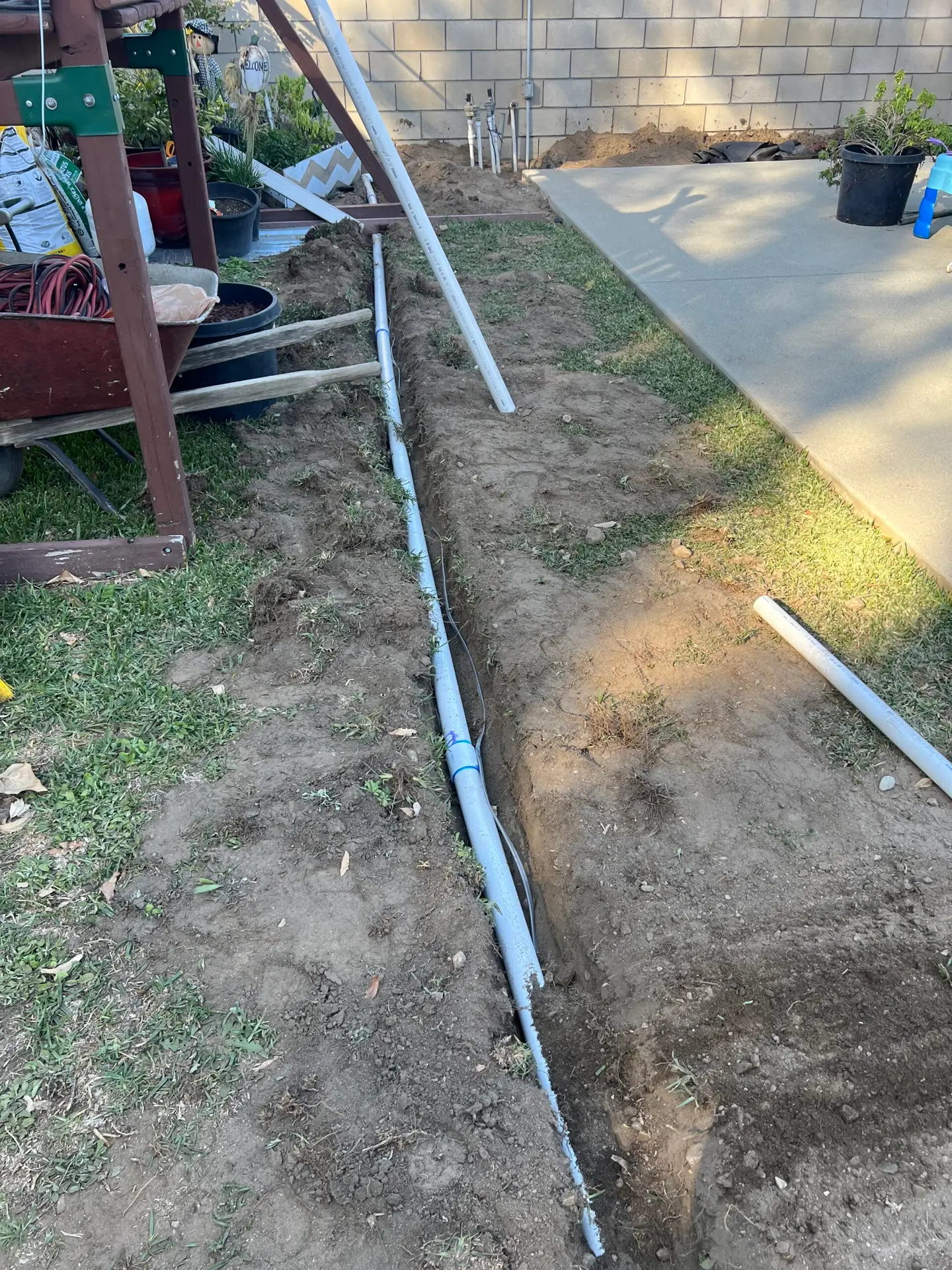
Installation also needs a service plan. Grates should remain removable where the system requires cleaning, outlet connections should be inspectable, and nearby mulch or loose gravel should be controlled so it does not wash over the inlet. Before excavation, utility and irrigation locations must be identified.
Plan drainage before replacing the driveway
A hardscape renovation is the best time to coordinate elevations, channel location, underground piping, and landscape transitions. Retrofitting later may require saw-cutting or removing finished concrete or pavers. OE Landscape can coordinate drainage with landscape design and broader landscaping services so the visible surface and hidden water route are planned together.
Keep the interception line open before rain arrives
Channel drains sit exactly where runoff delivers debris. Leaves can mat over the grate, sediment can settle inside the channel, and roots or material at the outlet can slow discharge. Regular inspection is part of the system, especially before Southern California’s wetter months and after a storm that carries unusual debris.
- Lift leaves and trash from the grate.
- Remove sediment from accessible channel sections.
- Confirm the outlet is open and stable.
- Look for cracked supports or a loose grate.
- Check whether water bypassed either end.
- Correct mulch, soil, or gravel washing toward the inlet.
Use only safe, appropriate cleaning methods. Do not wash oil, paint, fertilizer, concrete residue, or other pollutants into the drainage system. In Orange County, the H2OC Stormwater Program notes that runoff moves untreated through creeks and channels to the Pacific Ocean. Local rules for non-stormwater discharges vary, so confirm requirements with the city before connecting or redirecting runoff.
Follow the water from the top of the driveway to the final outlet.
OE Landscape reviews slopes, low points, hardscape edges, roof runoff, collection components, underground routing, and the surrounding landscape before recommending a channel drain or another drainage approach.
Make the driveway, drain, pipe, and outlet work as one system.
Tell OE Landscape where runoff begins, how it crosses the driveway, and what happens at the low point. Photos or video from a safe location during rain can help document the problem for review.