Yard Drainage to Prevent Water Damage: How to Protect Your Home
Yard drainage to prevent water damage starts with controlling where runoff travels. Learn how grading, French drains, yard drains, channel drains, downspout routing, sump pumps, erosion control, and coordinated landscape planning can help protect your home and outdoor areas.
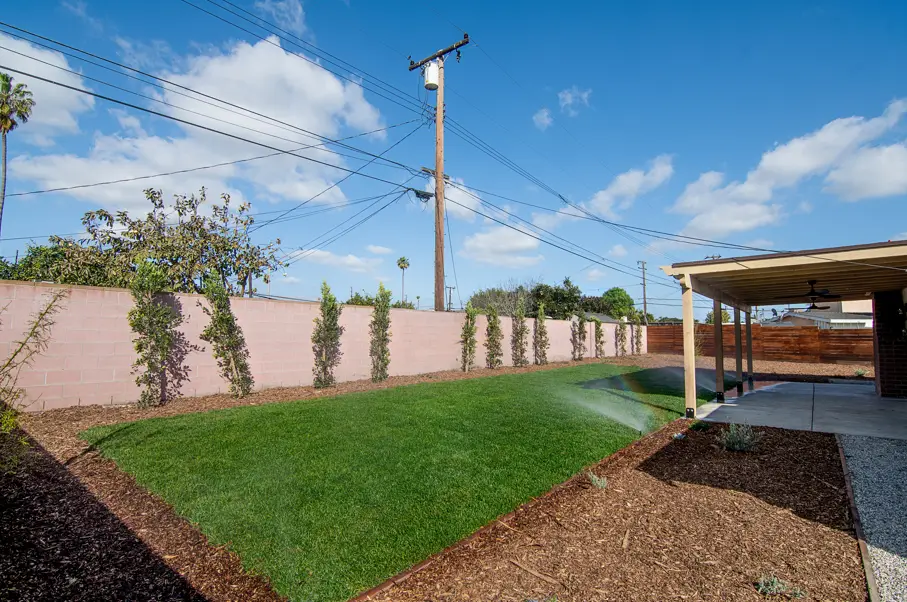
How Yard Drainage to Prevent Water Damage Works
Yard drainage to prevent water damage means giving rainfall, roof runoff, and irrigation a controlled path away from sensitive areas before water can collect, erode soil, or remain trapped near the home.
Rainwater may seem harmless when it falls across a yard, driveway, or roof. The real problem begins when that water has nowhere safe to go.
Poor drainage can allow water to collect beside foundations, remain trapped in low areas, wash soil away from slopes, flood patios, damage planting beds, and repeatedly leave portions of a property saturated after storms.
Over time, what begins as a puddle in the yard can become a much larger property concern.
At OE Landscape, we believe drainage should be treated as an essential part of the landscape—not as an afterthought once flooding begins.
A properly planned drainage system helps control where water travels, how quickly it leaves problem areas, and where it can be discharged safely. For Southern California homeowners, that can be especially important during periods of concentrated rainfall when large amounts of runoff may reach the property in a short period of time.
Understanding responsible stormwater management can help homeowners recognize drainage problems early and protect both their landscape and the areas surrounding their home.
Why Yard Drainage to Prevent Water Damage Matters
Every property receives and redirects water.
Rain may fall directly onto landscaping, but additional runoff can arrive from:
- Roofs
- Gutters and downspouts
- Driveways
- Patios
- Walkways
- Slopes
- Neighboring elevations
- Retaining walls
- Pool decks
- Other hardscape surfaces
When the property is graded correctly and drainage systems are functioning properly, much of this water can be guided away from sensitive areas.
When drainage is poor, the same water may collect in places where it was never intended to remain.
That can create recurring puddles, saturated soil, erosion, or water moving toward the structure instead of away from it.
Proper drainage is therefore less about eliminating water and more about controlling its path.
Water Should Move Away From the Home
One of the most important drainage principles is simple:
Water should generally be encouraged to move away from the house rather than toward it.
The ground immediately surrounding a structure plays an important role in this process.
When surrounding grades slope toward the building, rainfall and irrigation runoff may repeatedly move toward the foundation.
Low areas can make the problem worse by creating locations where water remains trapped.
Correcting these conditions may involve grading, surface drains, underground drainage, or a combination of several solutions.
Understanding positive drainage around residential foundations is an important part of protecting the areas immediately surrounding a home.
Standing Water Is a Warning Sign
A small puddle immediately after heavy rain may not always indicate a major problem.
However, water that repeatedly remains in the same location can signal that the area does not drain efficiently.
Common problem areas include:
- Low spots in lawns
- Corners of backyards
- Areas beside patios
- Narrow side yards
- Spaces between retaining walls and structures
- Downspout discharge points
- Areas below slopes
Repeated standing water can also make outdoor spaces less usable.
Lawns may become muddy.
Plant roots may remain excessively wet.
Gravel may become displaced.
Walkways can stay damp long after surrounding areas have dried.
A drainage plan should identify why water is collecting rather than simply covering the area with another surface.
That source-to-outlet approach is the foundation of yard drainage to prevent water damage across the property.
Poor Drainage Can Affect Areas Near the Foundation
Water accumulation near a home deserves particular attention.
Repeated saturation can keep the soil surrounding the building wetter than intended.
The goal of a good drainage system is to reduce unnecessary water accumulation near the structure and create a reliable route for runoff.
This may involve addressing several sources at once.
For example, a low area near a wall may receive water from rainfall, roof drainage, and a nearby slope.
Installing one small drain without correcting the larger flow pattern may not completely solve the problem.
A better approach considers the entire surface-water drainage pattern around the property.
Grading Is the First Layer of Drainage
Before installing drains, it is important to understand the shape of the land.
Grading determines how water naturally moves across the property.
Even small changes in elevation can influence whether runoff moves toward a drain, toward a planting bed, or toward the house.
Good grading can help:
- Direct runoff away from structures
- Prevent water from becoming trapped
- Move water toward collection points
- Reduce erosion
- Improve the performance of drainage systems
Drainage features work best when the surrounding grade helps deliver water toward them.
A drain located slightly higher than the lowest point of a yard may collect very little water because runoff will naturally remain below it.
This is why landscape grading for controlled runoff should be considered before determining drain locations.
French Drains Help Manage Subsurface Water
Not every drainage problem occurs on the surface.
Some properties experience soil that remains saturated even after visible water has disappeared.
A French drain for a soggy yard can help address certain subsurface drainage conditions.
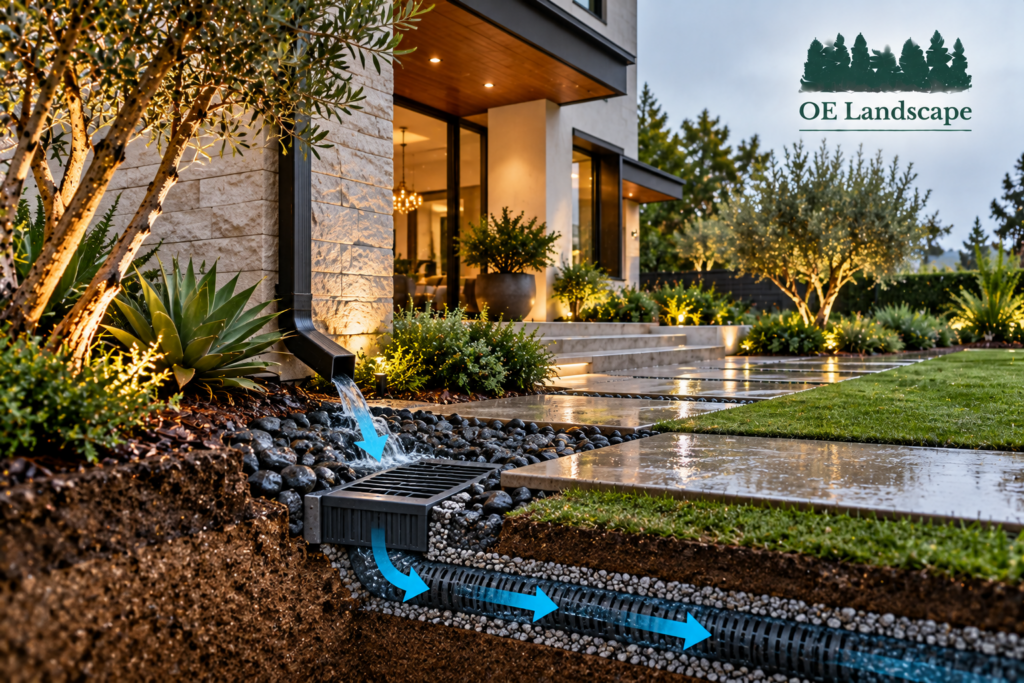
A typical system includes a perforated drainage pipe installed within a gravel-filled trench.
Water enters through the surrounding gravel and pipe openings, then travels through the system toward an appropriate outlet.
French drains can be useful in areas where water moves through the soil or where persistent saturation develops along specific sections of the property.
Possible applications include:
- Along slopes
- Behind retaining areas
- Beside landscape beds
- In persistently wet sections of a yard
However, a French drain is not automatically the correct solution for every drainage issue.
Surface runoff may be better handled with catch basins, grading, channel drains, or other systems.
The drainage problem should determine the solution.
Yard Drains Collect Surface Water
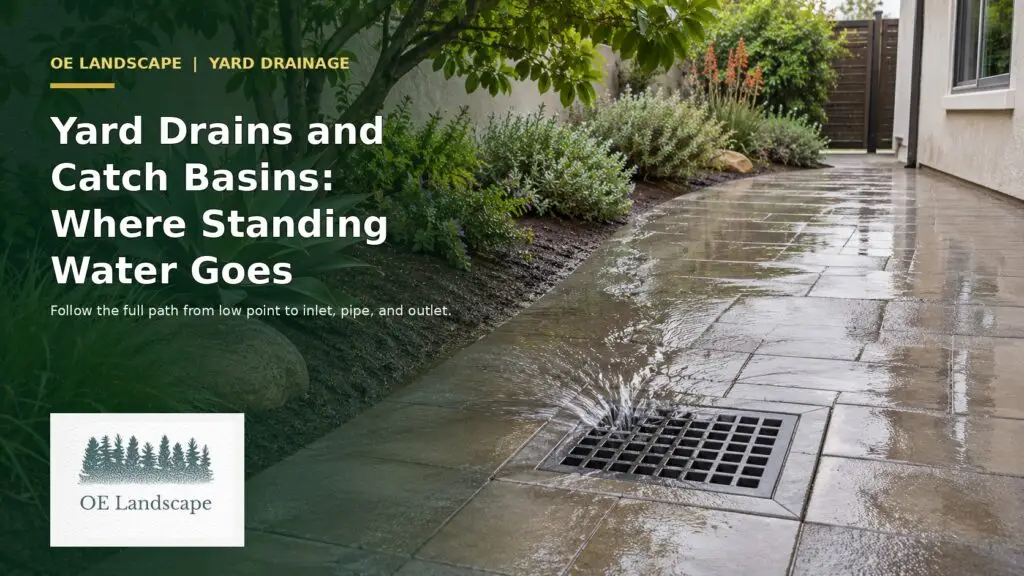
Yard drains and catch basins are designed to collect water from the surface.
They are commonly placed in low areas where runoff naturally gathers.
Once water reaches the drain, underground piping carries it toward the planned discharge location.
These systems may be appropriate for:
- Lawn areas
- Planting beds
- Backyard low points
- Areas near retaining walls
- Patio-adjacent landscape zones
Proper placement is essential.
A drain should generally be located where water naturally travels rather than where it is simply convenient to install.
This is why evaluating the natural drainage flow of the property is so important.
Channel Drains Can Protect Hardscape Areas
Water behaves differently on hard surfaces than it does in planting areas.
Concrete, pavers, and other relatively impermeable materials can allow water to move rapidly across the surface.
When that flow reaches a doorway, garage, patio edge, or low section of hardscape, a channel drain may help intercept it.
Channel drains are long, narrow drainage systems installed across or alongside a paved area.
They can be useful near:
- Driveways
- Garage entrances
- Patios
- Pool decks
- Gates
- Walkway transitions
Rather than waiting for water to collect in one small basin, a channel drain captures runoff across a wider line.
This can be especially useful when protecting hardscape drainage transition points where water changes direction or approaches a structure.
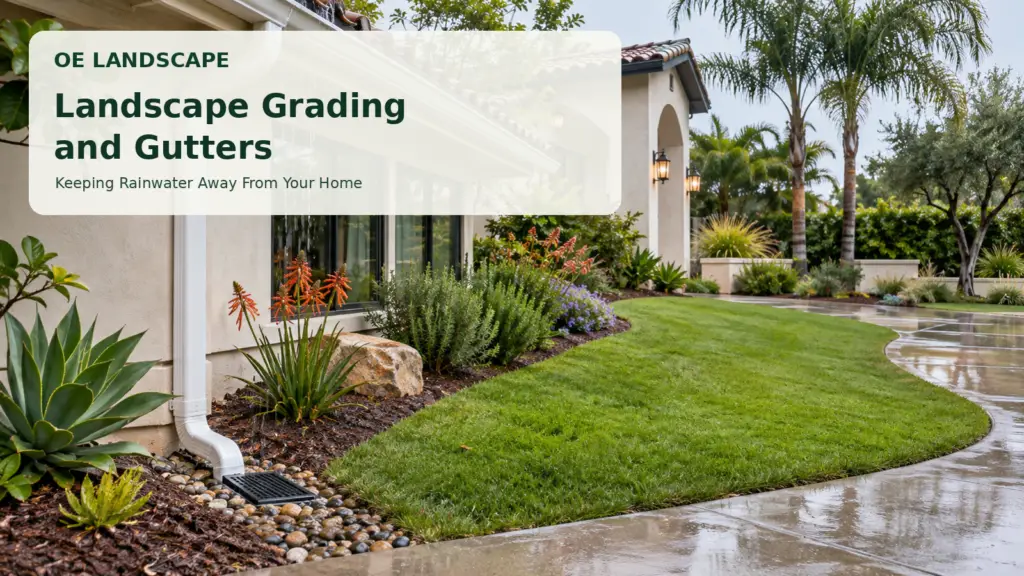
Gutters Are Part of the Yard Drainage System
Roof drainage and landscape drainage should not be treated as separate problems.
A roof can collect a significant volume of water during a storm.
Gutters concentrate that water and direct it toward downspouts.
The next question is critical:
Where does the downspout send the water?
If it discharges directly beside the foundation, the gutter may simply be moving water from the roof to another problem area.
Downspouts can often be connected to an appropriate drainage system so water is carried farther away from sensitive areas.
This creates a more complete roof-to-landscape water management system.
When evaluating downspout drainage away from the foundation, it is important to inspect gutters and downspouts along with the landscape.
Sump Pumps Can Help Where Gravity Drainage Is Difficult
Most drainage systems work best when water can move downhill through gravity.
But some properties contain low areas where a gravity outlet is not practical.
In those situations, a sump basin and pump may be considered.
Water is collected in the basin and mechanically pumped to an appropriate discharge point.
Sump systems may be useful for certain low-lying areas, but they require careful planning.
Considerations can include:
- Pump capacity
- Electrical supply
- Discharge routing
- Basin sizing
- Maintenance
- Backup planning
A sump pump should be part of a broader drainage strategy rather than simply installed in the deepest puddle.
The overall gravity-versus-pumped drainage strategy should be evaluated first.
Slopes Need Special Attention
Sloped properties introduce another challenge.
Water moving downhill can gain speed and concentrate into specific channels.
If that runoff is not controlled, it can move soil, expose roots, create ruts, and carry sediment into lower portions of the property.
Slope drainage may involve combinations of:
- Grading
- Swales
- French drains
- Surface drains
- Erosion-control planting
- Jute netting
- Wattles
- Retaining solutions
- Carefully placed discharge points
Vegetation can also help stabilize soil.
Plant roots support the soil structure while foliage can reduce the direct impact of rainfall on exposed ground.
For hillside properties, erosion-aware landscape drainage should be considered as part of the overall plan.
Drainage Can Help Protect Landscaping Investments
Water problems do not affect only the house.
They can also damage landscaping that homeowners have invested time and money in creating.
Poor drainage can contribute to:
- Washed-out mulch
- Displaced gravel
- Damaged planting beds
- Exposed roots
- Muddy turf
- Soil movement
- Dead or stressed plants
- Uneven hardscape edges
When landscaping is installed without first considering drainage, water may eventually undermine parts of the finished project.
Planning drainage before—or during—a landscape renovation can reduce the need to reopen completed areas later.
Drainage infrastructure should therefore be considered part of long-term landscape protection.
Plants Need Drainage Too
Plant health depends on having the correct balance of water and oxygen around the root zone.
Some plants tolerate wetter conditions better than others, but repeatedly saturated soil can create problems for many landscape species.
A planting bed that remains waterlogged after rain may require more than a change in plant selection.
The underlying drainage should be investigated.
Possible issues include:
- Compacted soil
- Poor grading
- Irrigation overspray
- Downspout runoff
- Nearby hardscape directing water into the bed
Combining good drainage with water-wise planting practices can create healthier, more resilient landscapes.
Irrigation Can Reveal Drainage Problems
Drainage issues are not always caused by rain.
Irrigation can also create excessive water accumulation.
A sprinkler system may apply water faster than the soil can absorb it.
Broken irrigation components can saturate one area.
Overspray may repeatedly send water onto patios or walls.
Drip irrigation may run longer than necessary.
When evaluating drainage, the irrigation system should be inspected as well.
Correcting a watering issue may reduce the amount of water the drainage system needs to manage.
Proper irrigation and drainage should support each other.
Hardscape Changes Runoff Patterns
Adding a patio, driveway, walkway, or other hardscape changes the way water moves across a property.
Soil can absorb at least some rainfall.
A paved surface generally redirects more water across its surface.
This means a landscape renovation can change drainage conditions even when the original yard did not have a major water problem.
Before expanding hardscape, consider where the new runoff will travel.
Will it move toward the lawn?
Toward a wall?
Toward a neighboring property?
Toward a drain?
Thoughtful planning around impervious-surface runoff can help reduce future drainage issues.
Driveway Drainage Deserves Special Consideration
Driveways can collect water from large areas.
Depending on their slope, runoff may travel toward:
- The garage
- Side yards
- The street
- Planting beds
- Neighboring areas
If the driveway slopes toward a garage or low entrance, a channel drain may help intercept water before it reaches the structure.
The surrounding grade and outlet still need to be considered.
Capturing the water is only the first part of the solution.
The system must also have somewhere appropriate to send it.
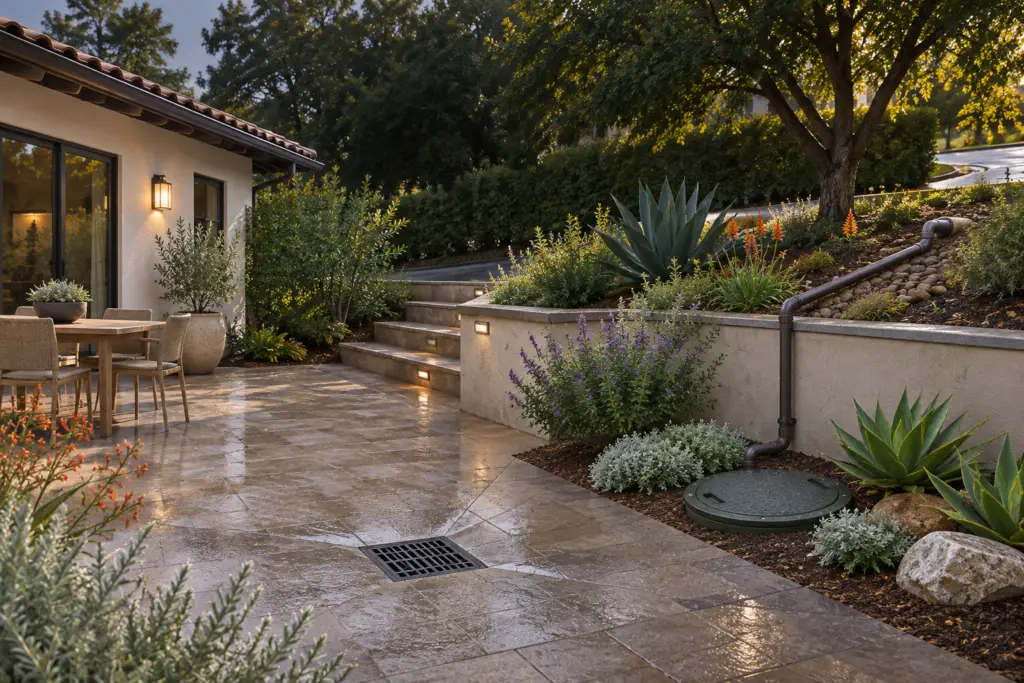
Patio Drainage Helps Keep Outdoor Living Areas Usable
Outdoor living areas should remain comfortable after rainfall.
A patio with insufficient drainage may develop puddles in low sections.
Water may also move toward sliding doors or collect against walls.
When planning patios, contractors should consider:
- Surface slope
- Drain locations
- Adjacent grades
- Roof runoff
- Nearby planting beds
- Existing drainage lines
Good outdoor living drainage design helps integrate water management into the finished space without making drainage components visually dominant.
Retaining Walls Can Change How Water Moves
Retaining walls hold back soil, but they also interact with water.
Moisture can accumulate behind a wall when subsurface drainage is not properly addressed.
Surface runoff from the slope above may create additional pressure or move toward the wall.
Drainage behind and around retaining structures should therefore be considered during planning and construction.
Depending on the project, this may involve gravel, drainage pipe, outlets, or other appropriate methods.
The wall and surrounding landscape should work as one system.
Drainage Problems Often Appear at Property Transitions
Many water issues develop where two different landscape conditions meet.
Examples include:
- Lawn meeting patio
- Slope meeting flat yard
- Downspout meeting soil
- Driveway meeting garage
- Retaining wall meeting planting bed
- Hardscape meeting a side yard
These transitions often become places where runoff slows, changes direction, or becomes concentrated.
Inspecting landscape runoff transition zones can help identify problems that are easy to overlook when evaluating individual areas separately.
Drainage Systems Need a Destination
Installing drains is only useful if collected water has an appropriate place to go.
Every drainage system needs a planned outlet or discharge strategy.
Water should not simply be moved from one problem area to another.
The solution must consider where the collected runoff travels after entering the pipe.
Possible discharge approaches depend on the property, local requirements, elevation, available infrastructure, and drainage design.
A professional assessment should consider the entire route from collection to discharge.
This is the difference between installing drains and creating a complete stormwater conveyance plan.
Pipe Size and Layout Matter
Underground drainage pipe is not all the same.
Pipe sizing can depend on factors such as:
- Expected water volume
- Number of connected drains
- Roof runoff
- Pipe length
- Slope
- Number of turns
- Outlet conditions
A system that is undersized may struggle during heavier rainfall.
Poorly planned pipe routes may also collect debris or reduce flow.
Drainage design should therefore consider the system as a network rather than a collection of individual drains.
Drainage Pipes Need Proper Slope
Gravity drainage depends on elevation.
If underground piping is installed without appropriate slope, water may remain inside the system or move too slowly.
Improper low points in the pipe can also collect sediment.
Before installation, the route should be evaluated to determine whether gravity drainage is practical.
This is especially important on relatively flat properties where small elevation differences can determine whether the system performs effectively.
Cleanouts Help With Long-Term Maintenance
Drainage systems can collect leaves, soil, mulch, and other debris over time.
Access points and cleanouts can make future maintenance easier.
Homeowners should also keep surface grates clear, particularly before periods of expected rain. Ready.gov flood preparedness guidance also recommends keeping drains and gutters clear.
A drainage system that is designed well but never maintained may eventually lose performance.
Long-term drainage planning should include accessible drainage maintenance points, not just underground piping.
Watch for Soil Erosion
Erosion can be one of the clearest signs that water is moving too quickly or becoming overly concentrated.
Look for:
- Channels through soil
- Exposed roots
- Washed-out planting beds
- Soil collecting near drains
- Gravel movement
- Small gullies on slopes
These signs indicate that runoff may need to be slowed, redirected, or distributed differently.
Drainage is not only about moving water quickly.
In some situations, controlling the speed of water is equally important.
Do Not Ignore Water Coming From the Roof
During drainage assessments, homeowners often focus on the yard while overlooking one of the property's largest water-collection surfaces: the roof.
During a storm, roof runoff can create concentrated flows at each downspout.
If several downspouts discharge into landscaped areas, those zones may become overwhelmed.
A coordinated plan between gutters, downspouts, underground drainage, and the surrounding landscape can significantly improve water management.
This whole-property runoff approach is often more effective than addressing isolated puddles one at a time.
Drainage Should Be Planned Before Major Landscape Installation
If a property is being renovated, drainage should be considered early.
It is much easier to install underground drainage before new:
- Pavers
- Turf
- Planting
- Irrigation
- Lighting
- Patios
- Outdoor kitchens
have been completed.
Installing drainage afterward may require opening finished areas.
By identifying drainage requirements during the planning phase, underground infrastructure can be coordinated with other landscape systems.
This approach can reduce unnecessary future disruption.
Good Drainage Can Be Almost Invisible
Drainage is essential, but it does not need to dominate the appearance of the yard.
Well-planned systems can integrate discreetly into the landscape.
Catch basins can be positioned within planting or turf areas.
Channel drains can align with hardscape edges.
Drainage piping remains underground.
Grading can be shaped subtly.
The goal is for the yard to function properly without looking like a collection of drainage equipment.
The best drainage systems often perform their job quietly in the background.
Drainage and Landscape Design Should Work Together
A drainage solution should not be planned independently from the landscape. OE Landscape also explains this integrated approach on our Drainage service page.
Consider how drainage affects:
- Plant placement
- Irrigation
- Hardscape
- Turf
- Outdoor living areas
- Slopes
- Retaining walls
- Lighting
- Access routes
For example, a drain placed in the middle of a future patio may create unnecessary design problems.
A better solution may be to coordinate the drainage system with the edge of the hardscape.
Integrated planning produces cleaner results and can make the drainage system easier to maintain.
Common Signs Your Property May Need Better Drainage
Homeowners may want to investigate drainage if they notice:
- Water remaining in the yard after rain
- Repeated puddles near the house
- Muddy lawn areas
- Water flowing toward doors
- Soil erosion
- Gravel washing away
- Water collecting near retaining walls
- Overflowing yard drains
- Downspouts discharging beside the foundation
- Damp or saturated planting areas
- Water entering garage areas
- Pooling near patios or walkways
These symptoms do not all require the same solution.
The cause should be identified before deciding whether the property needs grading, French drains, yard drains, sump pumps, channel drains, gutter modifications, or a combination of systems.
Why One Drain Is Not Always the Answer
It can be tempting to place a drain directly into the largest puddle and consider the problem solved.
Sometimes that works.
Other times, the puddle is only the visible symptom of a larger drainage pattern.
Water may be arriving from multiple directions.
The area may have incorrect grading.
A downspout may be adding roof runoff.
An upstream slope may be contributing additional water.
A complete drainage evaluation looks beyond the puddle and identifies the full runoff pathway across the property.
That produces a solution designed around the cause rather than only the symptom.
Protect the Landscape Before the Next Heavy Rain
Drainage problems are easiest to notice during storms, but the best time to correct them is usually before the next period of heavy rain arrives.
Dry conditions provide an opportunity to inspect grades, repair piping, install drains, modify downspouts, and complete other improvements.
Homeowners can begin by walking the property and identifying:
- Low areas
- Erosion
- Downspout locations
- Existing drains
- Sloped sections
- Areas where soil remains wet
- Hardscape that directs water toward the home
These observations can provide valuable information when planning a drainage solution.
A Complete Drainage Strategy Protects More Than the Yard
Proper drainage supports the entire outdoor environment.
It can help protect:
- Areas around the home
- Landscape planting
- Soil
- Hardscape
- Turf
- Retaining structures
- Outdoor living spaces
- Walkways and patios
The objective is to collect, redirect, and manage water before it becomes a recurring problem.
That requires understanding where the water originates, where it naturally wants to travel, and where it can safely go.
At OE Landscape, we help Southern California homeowners address drainage challenges through French drains, yard drains, catch basins, channel drains, sump pumps, grading, gutter and downspout drainage connections, erosion-control solutions, and integrated landscape improvements.
By combining drainage with thoughtful landscape planning, homeowners can create outdoor spaces that are not only attractive but also better prepared to handle rainfall and runoff.
Concerned about water collecting around your yard or home? Contact OE Landscape to discuss drainage solutions designed around your property's grading, hardscape, landscape, and water-flow conditions.
Yard Drainage to Prevent Water Damage Starts With the Full Water Path
Yard drainage to prevent water damage works best when the plan considers where water begins, how it moves across the property, where it collects, and where it can be discharged responsibly. Coordinating drainage with grading, irrigation, planting, hardscape, turf, and outdoor living improvements can help create a landscape that performs better during rain and irrigation.
Plan Drainage With the Rest of the Outdoor Project
Drainage often works best when it is coordinated before or during hardscape, turf, planting, irrigation, lighting, and other landscape improvements rather than added after finished areas are already in place.
Protect Your Home by Giving Water a Better Path.
Tell OE Landscape what happens during rain or irrigation, where water collects, and what other landscape improvements you are considering.