A Focused Plant Palette
for a Calmer Yard
Learn how repetition, structure, texture, mature plant size, climate-appropriate choices, and intentional open space can create a calmer, more cohesive Southern California landscape.
Create a Yard That Feels Calm, Cohesive, and Intentional
A beautiful landscape does not need dozens of different plants competing for attention.
In fact, some of the most inviting outdoor spaces rely on a surprisingly small number of carefully selected species.
This approach is known as creating a focused plant palette.
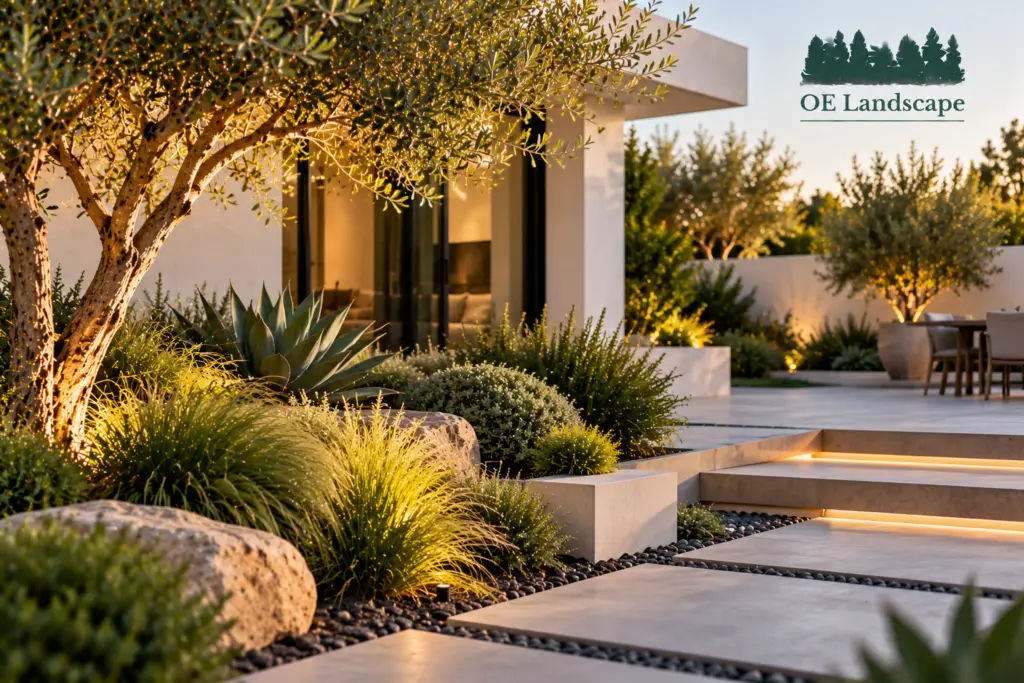
Instead of treating every empty area as an opportunity to introduce something new, a focused landscape repeats compatible plants throughout the property. Trees provide structure, shrubs establish form, grasses introduce movement, and selected accents bring seasonal color.
The result can feel calmer, more intentional, and easier to understand.
At OE Landscape, we believe thoughtful plant selection is just as important as the number of plants installed. Choosing the right combination from the beginning can create an outdoor environment that feels cohesive while remaining practical for long-term care.
What Is a Focused Plant Palette?
A plant palette is simply the collection of plant varieties used throughout a landscape.
A focused palette limits that collection to plants that work especially well together.
Instead of including a different plant in every section of the yard, several key varieties are repeated.
A typical palette might contain:
- One or two tree varieties
- Several structural shrubs
- One or two ornamental grasses
- A consistent groundcover
- A small selection of flowering accents
The exact number depends on the size and character of the property.
The goal is not to create a strict formula.
It is to prevent unnecessary variety from making the landscape feel visually fragmented.
Why Fewer Plants Can Create More Impact
When every plant is different, the eye tries to process each one individually.
Different leaf shapes, colors, heights, flowers, and textures all compete for attention.
Using fewer varieties creates repetition.
Repetition allows the eye to recognize patterns, which makes the landscape feel easier to understand.
Instead of seeing twelve unrelated plants, you begin to see larger compositions:
a row of grasses,
a group of shrubs,
a shaded tree canopy,
or a repeated groundcover connecting different areas.
Those larger patterns often have greater visual impact than individual plants.
Begin With the Character of the Home
Plant selection should respond to the architecture. A thoughtful landscape design helps connect planting choices to the home.
A contemporary property with clean lines may benefit from a relatively restrained palette with strong plant forms.
A softer architectural style might support looser planting and a slightly wider variety of textures.
Look at the home's:
- Exterior colors
- Rooflines
- Wall materials
- Windows
- Entryways
- Architectural proportions
The landscape should complement these characteristics rather than introducing a completely unrelated visual language.
For example, ornamental grasses and architectural plants can soften a modern home without competing with its clean geometry. See more ideas in our modern landscape design guide.
Choose Structural Plants First
Before focusing on flowers, begin with plants that will provide long-term structure.
These may include trees, evergreen shrubs, or larger grasses.
Structural plants establish the basic organization of the landscape.
They can define:
- Entrances
- Property edges
- Outdoor rooms
- Patios
- Views
- Privacy zones
Once these elements are selected, smaller plants can be added around them.
Starting with structure prevents the planting plan from becoming a collection of decorative plants without a clear foundation.
Select a Small Number of Reliable Trees
Trees have an especially strong influence because of their scale.
Using too many unrelated tree varieties can sometimes make a small or medium-sized yard feel fragmented.
Instead, repeating one tree species or selecting only a few compatible varieties can create continuity.
Trees may be chosen for:
- Shade
- Privacy
- Seasonal interest
- Architectural form
- Flowers
- Canopy shape
- Views from inside the home
Their mature size should always be considered. This is also an important part of choosing plants that thrive with less attention.
A tree that fits naturally within its space will usually contribute more to a calm landscape than one that requires constant pruning.
Repeat Shrubs to Build Visual Structure
Shrubs are often where plant palettes become unnecessarily complicated.
It is easy to select one shrub for one corner, another for the entrance, another for a fence, and another beside the patio.
Eventually, the yard contains many different forms with very little repetition.
A calmer approach is to identify several shrubs that perform important functions and repeat them.
One variety might provide background structure.
Another may be used for low planting.
A third could become a flowering accent.
Repeating these plants helps connect the front, side, and backyard landscapes.
Let Ornamental Grasses Provide Movement
Ornamental grasses can introduce softness without adding excessive visual complexity. They can also contribute movement and texture in sensory garden design.
Their fine foliage contrasts with heavier shrubs and architecture.
They also respond naturally to wind.
Instead of using several different grasses, consider selecting one or two varieties and repeating them in groups.
They may appear:
- Along walkways
- Near patios
- Around trees
- Beside walls
- Within gravel planting areas
Repeated grasses can create rhythm while making separate portions of the landscape feel related.
Use Groundcover as a Connecting Layer
Groundcovers can act as a visual foundation.
A consistent groundcover repeated beneath trees or around taller plants helps unify the design and can soften transitions between planting and hardscape areas.
Because it remains relatively low, it does not usually compete with major landscape features.
It can also soften the transition between hardscape and planting areas.
A limited palette becomes stronger when the ground level feels continuous rather than broken into many small sections containing different plants.
Choose One Main Color Direction
Flower color has a strong influence on how calm or energetic a landscape feels.
Using every available color may create a lively garden, but it can also become visually busy.
A focused palette might use a limited family of colors.
For example:
- White and green
- White and soft purple
- Blue and silver
- Warm yellow with green foliage
- Muted pink with neutral planting
This does not mean every flower needs to match.
The goal is simply to establish a dominant direction.
A few controlled accents can often create more impact than many competing colors.
Use Green as the Foundation
Green is often underestimated because it is present almost everywhere in a landscape.
But there are many shades of green.
Deep evergreen foliage can create structure.
Light green leaves can brighten shaded areas.
Blue-green or silver foliage can complement contemporary architecture.
Using these variations creates depth without requiring constant flowering color.
A calm landscape can remain visually interesting through foliage alone.
Flowers can then become temporary highlights rather than the entire design.
Add Texture Instead of More Species
If a planting design feels too simple, the solution does not always need to be another plant variety.
Texture can create variation within a limited palette.
Consider combining:
- Fine grasses
- Broad foliage
- Dense shrubs
- Smooth leaves
- Architectural forms
- Soft groundcovers
These differences create visual depth even when the number of plant species remains low.
Texture is especially valuable in landscapes where homeowners want a restrained color palette.
Plant in Groups Instead of Scattering
A focused palette becomes much stronger when plants are grouped.
Instead of scattering three identical plants across different corners, consider placing them together.
Groups create greater visual presence.
They also resemble natural planting patterns more closely than isolated individual plants.
Depending on the plant and space, designers may use groupings of three, five, or larger masses.
The exact number matters less than creating a clear relationship between them.
Repeat Plant Groups Throughout the Property
Repetition does not require placing plants in perfectly identical arrangements.
A group of ornamental grasses near the front entrance might reappear beside the backyard patio.
A shrub used around the driveway may appear again near a side-yard walkway.
These repeated elements help guide the eye through the landscape.
They create familiarity without requiring symmetry.
The property begins to feel like one complete landscape rather than several unrelated gardens.
Avoid the “One of Everything” Approach
Garden centers make it easy to fall in love with individual plants.
One may have beautiful flowers.
Another has unusual foliage.
A third looks interesting because of its shape.
Purchasing one of each may seem like a good way to create variety.
But once installed together, the result can feel more like a collection than a landscape.
Before adding a new species, ask whether an existing plant in the palette could perform the same role.
Often, repeating something already present creates a stronger result.
Consider Mature Size Before Planting
Plant spacing plays a major role in creating calm.
New plants are usually much smaller than their eventual size.
This makes newly installed landscapes appear open.
Filling every gap immediately can lead to overcrowding several years later.
Instead, consider:
- Mature width
- Mature height
- Growth habit
- Root space
- Distance from structures
- Distance from pathways
Giving plants enough room allows their natural forms to develop.
It can also reduce future pruning and replacement.
Allow Negative Space Between Plant Groups
A focused plant palette works especially well when combined with intentional open space. That relationship between planting and open areas is also central to visual balance in landscape design.
Not every section of a planting bed needs vegetation.
Gravel, mulch, low groundcover, or simply more spacing can create visual separation.
This negative space allows individual plant forms to remain visible.
A sculptural shrub surrounded by simple gravel, for example, may have more visual impact than the same shrub buried among several other species.
Open space helps important plants stand out.
Keep Focal Plants Limited
Some plants deserve special attention.
A specimen tree, large architectural plant, or distinctive flowering shrub can become a focal point.
But if there are too many focal plants, they begin competing with each other.
A calmer landscape usually limits these moments.
One strong feature may anchor an entrance.
Another may become the focus of the backyard.
Supporting plants should remain quieter so the focal elements maintain their importance.
Group Plants With Similar Water Needs
A focused plant palette can also make irrigation planning easier.
Plants with similar water requirements can be grouped together. The UC Davis WUCOLS database is a useful California reference for comparing landscape plant water-use classifications.
For Southern California landscapes, this can be especially helpful when creating drought-conscious planting areas.
Instead of mixing plants with completely different watering needs throughout the same bed, designers can create compatible zones.
This supports healthier plants while allowing irrigation to operate more efficiently. The EPA WaterSense water-smart landscape guide also covers plant selection, site conditions, and efficient outdoor water use.
Visual organization and practical maintenance can work together.
Choose Plants Appropriate for the Microclimate
Even within one property, growing conditions vary.
One side may receive full afternoon sun.
Another remains shaded.
Some areas may be protected from wind, while others are exposed.
A successful plant palette should account for these differences.
The goal is not necessarily to use the exact same plants everywhere.
Instead, compatible plants can be selected for different microclimates while maintaining similar colors, textures, or forms.
This preserves visual continuity without forcing plants into conditions where they will struggle.
Use Climate-Appropriate Plants as the Foundation
Choosing plants suited to local conditions can make the landscape more practical over time.
For Southern California properties, climate-appropriate and drought-tolerant plants can provide substantial variety while supporting more efficient water use. California property owners can also review the California Department of Water Resources MWELO guidance.
Depending on site conditions, the palette may include combinations of:
- Ornamental grasses
- California native plants
- Drought-tolerant shrubs
- Succulents
- Groundcovers
- Climate-appropriate trees
A drought-conscious landscape does not have to look sparse.
Layering compatible plants can create a rich appearance while maintaining a focused palette.
Use Seasonal Flowers as Accents
Seasonal flowers can still play an important role.
The difference is how they are used.
Instead of allowing seasonal plants to dominate every bed, consider concentrating them in selected locations.
Good areas may include:
- Entryways
- Patio edges
- Containers
- Outdoor dining spaces
- Key sightlines
This allows seasonal color to change without disrupting the basic structure of the landscape.
The permanent plant palette remains consistent while smaller areas provide variety.
Make Containers Part of the Same Palette
Potted plants are often treated separately from the rest of the landscape.
That can introduce unnecessary visual noise.
Consider using containers that reinforce the same planting palette.
A grass used in the landscape might also appear in a large planter.
The same foliage color could repeat near the entrance.
Containers can provide flexibility while remaining connected to the overall design.
Using fewer, larger containers often creates a calmer result than many small unrelated pots.
Simplify Planting Around the Front Entrance
The front entry is one of the best locations to demonstrate a focused plant palette.
A clear arrangement might include:
- One feature tree
- A repeated shrub
- One ornamental grass
- A low groundcover
The simplicity allows the architecture and front door to remain visible.
It also helps visitors immediately understand the route toward the entrance.
The planting adds character without becoming distracting.
Give Patios a Calm Planting Edge
Outdoor living areas often benefit from planting, but the perimeter does not need to contain every plant in the landscape.
A limited selection of trees, shrubs, and grasses can soften a patio without enclosing it completely.
Repeating the same plants in several areas creates continuity.
Leaving selected edges open preserves views and circulation.
A patio surrounded by thoughtful planting often feels more comfortable than one surrounded by dense, mixed vegetation.
Simplify Privacy Planting
Privacy is another area where too many plants can accumulate.
Homeowners may install one shrub, then another, followed by additional trees and grasses in an attempt to create faster screening.
A better long-term strategy is to select plants based on mature size and place them where screening is actually needed.
This might involve:
- Trees for upper-story views
- Medium shrubs at eye level
- Lower plants in front
A layered but limited palette can provide privacy without turning the property boundary into a dense collection of unrelated plants.
Use Repetition Along Walkways
Walkways naturally create opportunities for rhythmic planting.
Repeating one plant along portions of a path can help guide movement.
This does not require creating a rigid row.
Plant groups may appear at intervals, allowing open space between them.
For example, ornamental grasses could repeat beside several sections of a walkway while other areas remain more open.
This creates direction without making the landscape overly formal.
Use Trees and Plants to Frame Views
A limited palette can also make important views more effective.
Plants can frame:
- A front entrance
- A distant tree
- A fire feature
- A patio
- A water feature
- A view from a window
When the surrounding planting remains consistent, the focal view becomes stronger.
Too many different plants around the same view can compete with what homeowners are intended to notice.
Consider Views From Inside the House
The landscape is often seen through windows more frequently than it is experienced from every corner outdoors.
Look through major windows and sliding doors.
A focused plant palette can make those views feel composed.
One tree may become the main feature.
A group of grasses may provide movement below it.
Repeated shrubs might create a quiet background.
Because the number of plant varieties is controlled, the outdoor view can resemble a carefully arranged composition rather than a crowded garden.
Create Continuity From Front Yard to Backyard
The front yard and backyard may have different functions, but repeating selected plants can connect them.
For example, the same grass used near the driveway could appear again beside the backyard patio.
A tree variety may repeat in both areas.
A groundcover might continue through the side yard.
This visual connection is especially useful when the property is experienced as a sequence of spaces.
Each area can have its own character while still belonging to the same landscape.
Pair the Plant Palette With a Simple Material Palette
Plants do not exist separately from hardscape.
A focused planting scheme becomes even stronger when the material palette is also controlled. Explore completed combinations in our project gallery.
For example, a landscape might combine:
- Neutral pavers
- One gravel type
- Green and silver foliage
- Repeated grasses
- Natural wood accents
The materials provide a calm background for the plants.
Likewise, the repeated planting softens the harder architectural surfaces.
Together, they create a cohesive environment.
Avoid Excessive Pruning
Plants selected for the correct mature size can often retain more of their natural form.
This supports a calmer appearance.
Constantly clipping every plant into a different shape can turn the landscape into a collection of individual objects.
Instead, allow selected grasses, shrubs, and trees to develop naturally within the boundaries of the design.
Some structured hedging may still be appropriate, but balancing it with looser plant forms creates greater depth.
A Focused Palette Can Make Maintenance Easier
Using fewer plant varieties can simplify landscape care.
When the same species repeats throughout the yard, its needs become more predictable.
Homeowners or maintenance teams can more easily understand:
- Pruning schedules
- Irrigation requirements
- Mature size
- Seasonal changes
- Fertilization needs
That does not mean every focused landscape is automatically low-maintenance.
But reducing unnecessary plant variety can eliminate some of the complexity.
Keep the Palette Flexible Enough for the Site
A focused palette should create consistency, not become a rigid rule.
Different areas may require different plants because of sunlight, soil, drainage, or functional needs.
The goal is to maintain visual relationships.
If one shade-tolerant plant must replace a sun-loving variety near the house, choose something with a similar texture or overall character.
This allows the landscape to respond to real growing conditions while preserving its design language.
Know When the Landscape Has Enough Variety
Adding plants can become an endless process.
There is always another interesting species available.
But eventually, additional variety stops improving the landscape.
Before introducing another plant, consider whether it adds something truly necessary.
Does it provide a function the existing palette cannot?
Does it fill a specific ecological or practical need?
Does it strengthen the overall composition?
If not, repetition may be the better choice.
Knowing when to stop is part of good landscape design.
Calm Does Not Mean Boring
A focused palette can still provide rich outdoor experiences.
Trees create changing shadows.
Grasses move in the wind.
Flowers appear seasonally.
Foliage develops.
Light changes throughout the day.
Texture becomes more noticeable.
The landscape remains dynamic even when the number of plant varieties is limited.
In fact, reducing visual competition can make these subtle changes easier to appreciate.
Create a Landscape That Feels Intentional
A calm yard is rarely created by choosing the most plants.
It comes from choosing the right plants and giving them clear roles.
Trees provide structure and shade.
Shrubs create mass and privacy.
Grasses introduce movement.
Groundcovers connect the planting.
Selected flowers add seasonal interest.
Open space gives everything room to breathe.
When these elements repeat throughout the property, the landscape begins to feel unified rather than crowded.
At OE Landscape, we help Southern California homeowners transform outdoor spaces through professional landscape installation and hardscaping, plant installation, irrigation systems, artificial turf, drainage solutions, and outdoor living improvements.
Whether you're creating a new landscape or simplifying an existing yard, a focused plant palette can help create an outdoor environment that feels calmer, more cohesive, and easier to enjoy.
Ready to create a more balanced planting plan? Contact OE Landscape to explore landscape and planting ideas designed around your property, architecture, and outdoor lifestyle, or start with our Project Estimator.
Create a Landscape That Feels Intentional
A calmer yard does not come from using the most plants. It comes from choosing compatible plants, giving each one a clear role, repeating strong selections, allowing room for mature growth, and keeping enough open space for the overall composition to breathe.
See How Planting, Hardscape, and Open Space Work Together
Explore OE Landscape projects where repeated planting, trees, grasses, open areas, hardscape, and outdoor living features work together as one coordinated landscape.
Explore Project Gallery
Ready to Create a More Balanced Planting Plan?
Tell OE Landscape what you want to improve and start planning a planting palette designed around your architecture, site conditions, irrigation needs, and outdoor lifestyle.