French Drain for Soggy Yard: How It Works and When It Helps
French drain for soggy yard problems can help when the real issue is subsurface water moving through saturated soil. Learn how French drains work, when they may help, how they differ from surface drains, and why grading, soil, irrigation, roof runoff, pipe slope, and a proper outlet all matter.
When a French Drain for Soggy Yard Conditions Makes Sense
French drain for soggy yard conditions is a useful search phrase, but the right system depends on what the water is actually doing. A French drain is most useful when persistent moisture is moving through saturated soil below the surface rather than only forming a temporary puddle on top.
A soggy yard can become more than an inconvenience.
Soft soil, standing water, muddy lawn areas, washed-out planting beds, and persistently wet sections of a property can all indicate that water is not moving through the landscape efficiently.
In many cases, homeowners begin looking for a solution only after the same wet areas return again and again.
One drainage option that may help is a French drain.
At OE Landscape, we install and integrate drainage systems as part of broader landscape improvements throughout Southern California. French drains can be highly effective in the right conditions, but they work best when they are selected for the correct type of water problem and installed as part of a thoughtful drainage plan.
- Soil stays wet after surface water disappears
- Moisture moves downhill through a slope
- Lawn feels soft or saturated for days
- Water collects behind or near retaining areas
- Surface puddles alone may need a yard drain or catch basin instead
For comparison, see our guide to yard drains and catch basins for visible surface runoff.
What Is a French Drain?
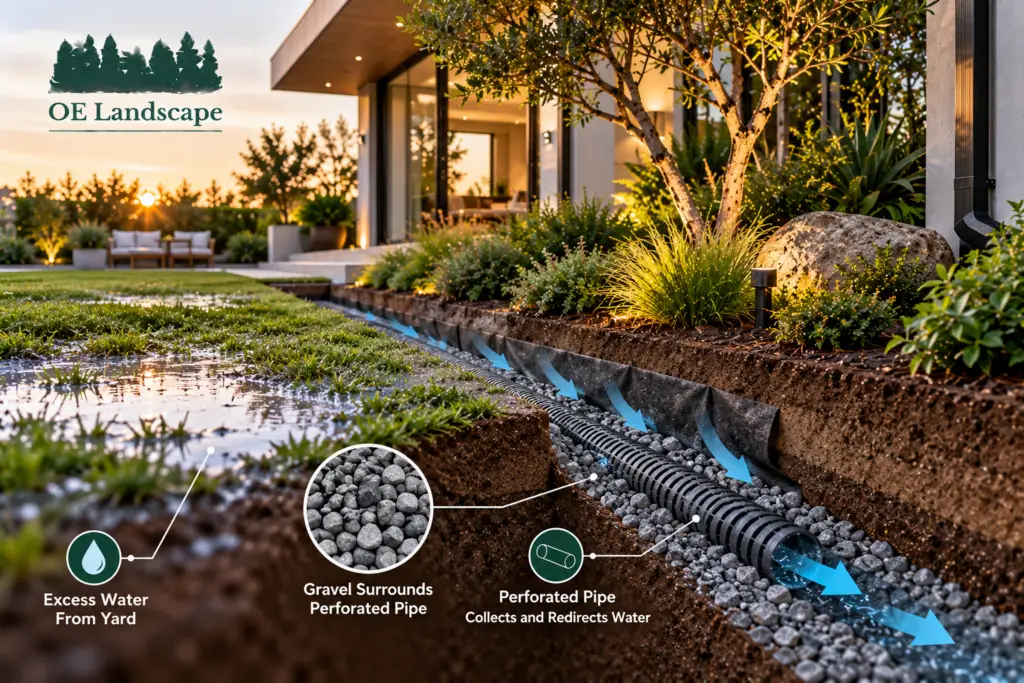
A French drain is an underground drainage system designed to collect and redirect water moving through saturated soil.
A typical system includes:
- A trench
- Perforated drainage pipe
- Drainage gravel
- Filter fabric
- A planned outlet or discharge route
Rather than relying on a visible surface drain alone, a French drain allows water in the surrounding soil to enter the gravel-filled trench and flow into the perforated pipe.
The pipe then carries that water away from the problem area.
French drains are especially useful when the issue involves subsurface moisture rather than only surface puddles.
Why Some Yards Stay Soggy
A yard may remain wet for several reasons.
Common causes include:
- Poor grading
- Compacted soil
- Heavy or slow-draining soil
- Runoff from nearby slopes
- Excess irrigation
- Roof runoff
- Downspouts discharging into planting areas
- Water collecting behind retaining walls
- Low sections of the property
Sometimes several of these conditions occur at the same time.
For example, a low backyard may collect rainwater from the surrounding landscape while also receiving runoff from a nearby roof.
Installing a drainage system without identifying these contributing factors may only address part of the problem.
A successful drainage solution begins by understanding where the water is coming from and how it is moving through the property.
How a French Drain Works
The basic principle behind a French drain is relatively simple.
Water naturally moves toward lower areas.
The gravel-filled trench provides an easier pathway for water than compacted or saturated soil.
Once water reaches the trench, it enters the perforated drainage pipe.
The pipe is installed with an appropriate slope so gravity can carry the water toward a designated outlet.
This creates an underground route for water that might otherwise remain trapped within the soil.
A properly planned French drain does not simply make water disappear.
It intercepts and redirects subsurface water toward a more appropriate location.
French Drains Are Different From Yard Drains
French drains and yard drains are sometimes discussed as though they are the same thing, but they are designed for different situations.
A yard drain, catch basin, or area drain collects water directly from the surface.
If rainwater forms a visible puddle in a low section of lawn, a surface drain may capture that water quickly.
A French drain, on the other hand, is designed primarily to collect water that is moving through or saturating the soil.
In some landscapes, both systems may be used together.
For example, catch basins may collect heavy surface runoff while a French drain helps manage persistent moisture beneath the ground.
The right solution depends on the actual drainage problem.
Signs a French Drain for Soggy Yard Conditions May Be Worth Considering
A French drain may be appropriate if you notice conditions such as:
- Soil that remains wet long after rainfall
- Recurring soggy sections of lawn
- Moisture collecting along a slope
- Water moving through soil toward a lower area
- Persistent saturation near landscape beds
- Water accumulating behind retaining areas
- Muddy zones even when surface puddles are limited
These conditions often point to water being held within the soil rather than simply sitting on top of it.
However, the presence of standing water alone does not automatically mean a French drain is the best solution.
The site should be evaluated first.
Where French Drains Are Commonly Installed
French drains may be used in several parts of a residential landscape.
Possible locations include:
- Along the lower portion of a slope
- Behind or near retaining areas
- Beside planting beds
- Along property edges
- Within persistently wet lawn areas
- Near areas where subsurface water naturally gathers
The exact placement depends on the direction of water movement.
A drain placed in the wrong location may collect very little water.
This is why understanding site drainage patterns matters before excavation begins.
Proper Grading Still Matters
A French drain is not a substitute for good grading and drainage planning.
The shape of the property continues to influence how water moves.
If the surface slopes strongly toward the home, the drainage issue may require grading corrections in addition to underground drainage.
Likewise, if the French drain pipe does not have sufficient slope, water may not move efficiently through the system.
A complete drainage plan considers both:
- Surface water
- Subsurface water
The goal is to create a coordinated path that moves water away from problem areas.
Why Gravel Is Used
Gravel serves several important purposes in a French drain.
It creates open spaces where water can move more freely than it can through compacted soil.
It also helps distribute water toward the perforated pipe.
The gravel-filled trench essentially becomes a high-permeability drainage corridor.
Without appropriate drainage material, soil could restrict water movement and reduce the effectiveness of the system.
The type and placement of gravel should therefore be considered carefully during installation.
Why Filter Fabric Matters
Filter fabric is often used to help separate surrounding soil from the drainage gravel.
Without this separation, fine soil particles may gradually migrate into the gravel and drainage pipe.
Over time, that can reduce water flow.
A properly installed filter layer helps protect the drainage system while still allowing water to move into the trench.
French drains are underground systems, so planning for long-term drainage performance is especially important.
Pipe Placement Is Important
Perforated pipe collects the water entering the gravel trench.
The pipe should be positioned so it can receive water efficiently and carry it toward the outlet.
The perforations, slope, pipe size, route, and discharge location all influence system performance.
Poor installation can create sections where water remains trapped.
This is why drainage should not be planned around the trench alone.
The entire path from collection to discharge needs to work as one system.
Every French Drain Needs Somewhere to Send the Water
One of the most important questions in drainage planning is:
Where does the water go after it enters the pipe?
Collecting water is only the first step.
The system needs an appropriate discharge point.
Possible approaches depend on the property, site elevation, local conditions, applicable rules, and existing drainage infrastructure.
The outlet should not simply move the problem from one part of the yard to another.
A complete design considers the entire water conveyance path.
French Drains Can Help Around Slopes
Sloped landscapes often create drainage challenges.
Water naturally moves downhill and may collect where the slope begins to flatten.
A French drain positioned strategically near the lower section of a slope may help intercept water moving through the soil.
This can sometimes reduce saturation in the lower yard.
However, slopes may also require surface drainage and erosion-control measures.
Depending on conditions, the project may involve:
- Swales
- Surface drains
- Planting
- Erosion-control fabric
- Wattles
- Grading
- Retaining systems
A French drain may be one part of a larger hillside water-management strategy.
French Drains Near Retaining Walls
Water moving through soil can collect behind retaining structures.
Drainage should therefore be considered when walls are installed or renovated.
French-drain-style systems may be incorporated behind or near certain retaining walls to help relieve accumulated water.
The exact approach depends on the wall design and site conditions.
Gravel, drainage pipe, outlets, and other drainage components may all play a role.
Water management around retaining walls and hardscape should be planned during construction whenever possible rather than added only after problems develop.
French Drain for Soggy Yard and Lawn Areas
Persistently soggy lawn areas can be frustrating.
Natural grass may become muddy, and repeated saturation can make portions of the yard difficult to use.
A French drain for soggy yard conditions may help if the moisture is caused by subsurface water moving through the soil.
However, it is important to determine whether the real issue is:
- Overwatering
- Poor surface grading
- Soil compaction
- A broken irrigation line
- Roof runoff
- Subsurface water
If irrigation is the primary problem, correcting the watering system may be more effective than installing drainage.
The correct diagnosis matters.
French Drains Around Planting Beds
Planting areas also need proper drainage.
Some plants tolerate wetter soil, while others require good drainage around the root zone.
If a bed stays saturated after rainfall, plants may struggle even when the irrigation schedule is appropriate.
A French drain may help in certain situations, particularly where water naturally moves into the bed from higher areas.
However, plant selection, soil conditions, grading, and irrigation should also be reviewed.
Healthy landscapes depend on balancing water delivery and water removal.
French Drains Are Usually Hidden
One advantage of a French drain is that most of the system is underground.
Once installed and restored properly, the yard does not need to look like a drainage project.
The trench can often be integrated into:
- Lawn
- Gravel
- Planting beds
- Landscape transitions
This makes French drains useful for properties where homeowners want improved drainage without a large visible drainage feature.
The function happens below the surface while the finished landscape remains usable and attractive.
French Drains Can Be Combined With Other Drainage Solutions
Many properties need more than one type of drainage system.
A complete system might include:
- French drains
- Catch basins
- Yard drains
- Channel drains
- Gutter connections
- Downspout piping
- Sump pumps
- Grading
- Swales
Each component handles a different part of the water problem.
For example, a French drain may collect subsurface moisture while a channel drain intercepts runoff across a driveway.
Thinking of these features as one integrated drainage network can produce a more effective result than treating each wet area separately.
Gutters Can Influence French Drain Performance
Roof runoff can dramatically increase the amount of water entering the landscape.
If a downspout releases water near a French drain, the system may receive much more water than expected.
In some cases, downspouts can be connected to solid drainage piping and routed separately rather than sending concentrated roof runoff directly into a French drain.
This can help keep different types of drainage functioning as intended.
Roof water and ground water should be considered together when evaluating the property. The U.S. EPA guidance on redirecting downspouts is a useful homeowner reference for understanding roof runoff.
Irrigation Should Be Checked First
Before installing drainage, verify that the landscape is not simply being overwatered.
Watch irrigation zones while they operate.
Look for:
- Broken sprinkler heads
- Overspray
- Leaks
- Excessively long watering cycles
- Water running down slopes
- Areas receiving water from multiple zones
Sometimes a soggy area has less to do with rainfall than with irrigation.
Correcting these issues can reduce unnecessary water and may change the scope of the drainage work.
Soil Conditions Affect Drainage
Different soils absorb and release water differently.
Some soils drain quickly.
Others hold moisture for much longer periods.
Compacted soil can also reduce infiltration and create drainage problems even where the underlying soil would normally perform better.
Understanding soil behavior can help determine whether a French drain is appropriate and how it should be installed. Homeowners can also review soil information through the USDA NRCS Web Soil Survey.
Drainage design should respond to the actual property rather than relying on one solution for every yard.
Heavy Rain Can Reveal Hidden Problems
Southern California may experience long dry periods followed by concentrated rainfall.
A yard that appears completely normal during dry weather may show major drainage problems during a storm.
Water may begin:
- Pooling near the house
- Moving down slopes
- Saturating lawn areas
- Washing gravel away
- Collecting around retaining walls
Observing these patterns can provide valuable information. The U.S. EPA Soak Up the Rain resources also explain practical ways homeowners can observe and reduce runoff around a property.
Photos and videos taken during rainfall can help show where runoff starts, where it travels, and where it collects.
That can make future drainage planning more accurate.
French Drains Can Help Protect Hardscape
Persistent water can affect the landscape around patios, walkways, and other hardscape.
Saturated soil beside a paved area may become unstable.
Water can also carry sediment into joints or surrounding surfaces.
By reducing excess subsurface moisture in certain areas, a drainage system may help support more stable landscape conditions around hardscape.
Drainage should ideally be considered before major paving or hardscape installation so underground systems can be coordinated with the finished surface.
Plan Drainage Before Installing Artificial Turf
Artificial turf can create a clean, usable outdoor surface, but the base below it must drain properly.
If the surrounding soil already has significant drainage issues, installing turf over the problem without addressing the cause may not provide the desired result.
Before installation, the property should be evaluated for:
- Existing low spots
- Soil saturation
- Roof runoff
- Drainage routes
- Grading
French drains or other drainage improvements may be needed before the finished turf system is completed.
Good drainage starts below the visible surface.
French Drains Are Not Always the Best Choice
A French drain is useful, but it is not a universal solution.
A different system may be more appropriate when:
- Water is primarily flowing across hardscape
- A driveway sends runoff toward a garage
- A patio has a surface low spot
- A downspout needs direct piping
- A low area requires pumping
- Grading alone can solve the problem
For example, a channel drain may work better across a driveway, while a catch basin may be better for a surface puddle.
The drainage method should match the water problem.
Sump Pumps May Be Needed in Very Low Areas
French drains usually depend on gravity to carry water away.
Some properties do not have enough elevation difference to create a gravity outlet.
If the drainage area is below the available discharge point, a sump basin and pump may be considered.
Water can be collected in the basin and mechanically moved to an appropriate outlet.
This adds complexity because the system relies on equipment and power.
Whenever possible, gravity drainage is often preferable, but site conditions determine what is practical.
Good Installation Requires Proper Slope
A drainage pipe that appears level may not actually move water effectively.
French-drain piping should be planned around elevation.
The installer needs to understand:
- Starting elevation
- Ending elevation
- Pipe length
- Available fall
- Outlet height
Even relatively small elevation differences can matter.
This becomes especially important on flat properties.
Poor slope can reduce drainage performance and allow sediment or water to remain inside the pipe.
Avoid Creating Low Spots in the Pipe
The underground pipe should generally maintain a consistent path toward the outlet.
Unexpected low sections can hold water and sediment.
This can occur when trenches are uneven or when the pipe settles after installation.
Proper trench preparation and installation help reduce these issues.
A drainage system is only as effective as the path the water follows after entering it.
Trees and Roots Need Consideration
French drains sometimes run through landscaped areas containing trees and shrubs.
Existing roots should be considered before excavation.
Large roots can be damaged during trenching, and future root growth may affect drainage infrastructure.
Drainage routes should be coordinated with important landscape plants wherever possible.
This is another reason drainage and planting design should be planned together rather than independently.
Maintenance Still Matters
French drains are largely hidden, but they are not completely maintenance-free.
Leaves, sediment, and soil movement can affect associated inlets, outlets, or connected drainage systems.
Homeowners should keep discharge areas accessible and inspect drainage after major storms.
If the system includes cleanouts, these can provide easier access when maintenance is needed.
Long-term performance depends on both installation quality and continued accessibility.
Do Not Cover Drainage Problems With More Landscaping
A muddy section of yard may tempt homeowners to add gravel, mulch, new soil, or turf.
These changes may improve appearance temporarily without addressing the underlying water issue.
If the area remains saturated, the problem may eventually return.
Before renovating a repeatedly wet section, investigate why water is collecting there.
Drainage improvements can then be completed before the finished landscaping is installed.
This avoids having to remove new work later.
A French Drain Should Fit the Entire Landscape Plan
Drainage is infrastructure, but it still affects landscape design.
The trench may cross:
- Irrigation lines
- Lighting
- Planting beds
- Walkways
- Future hardscape
- Utility areas
Planning all of these systems together can reduce conflicts.
For example, it may be easier to install drainage and irrigation before new pavers or turf are installed.
Good project sequencing can protect finished work and create a cleaner final result.
Common Mistakes With French Drains
French drains may underperform when they are installed without enough planning.
Common problems include:
- Installing the drain in the wrong location
- Failing to provide an appropriate outlet
- Insufficient pipe slope
- Using unsuitable materials
- Ignoring surface grading
- Overlooking downspout runoff
- Failing to account for irrigation
- Installing too shallow or too deep for the actual problem
- Treating every water issue as subsurface drainage
A proper assessment helps avoid these mistakes.
Why the Outlet Is Just as Important as the Trench
Homeowners often focus on where the French drain starts.
The other end is just as important.
Water needs a safe, appropriate destination.
If the outlet is blocked, undersized, too high, or located in another low area, the system may not perform as intended.
Drainage planning should follow the entire route.
Think of the system as a path:
collection → conveyance → discharge
All three stages need to work together.
French Drains Can Be Part of a Larger Yard Renovation
Drainage work is often completed alongside broader landscape improvements.
A project may involve:
- Removing damaged lawn
- Regrading sections of the yard
- Installing French drains
- Adding catch basins
- Updating irrigation
- Installing new plants
- Adding artificial turf
- Rebuilding patios or walkways
- Improving erosion control
Addressing drainage at the same time allows the visible landscape and underground infrastructure to be designed together.
This is often more efficient than renovating the surface first and repairing drainage later.
The Best Drainage Solution Starts With the Water
It is easy to begin with a product:
“Do I need a French drain?”
A better question is:
“Why is this area staying wet?”
Once the source and movement of the water are understood, the correct drainage method becomes much easier to identify.
Sometimes the answer will be a French drain.
Sometimes it will be grading.
Sometimes it will be a catch basin, channel drain, sump pump, or improved gutter connection.
And sometimes the best solution will combine several methods.
Turn a Soggy Yard Into a More Functional Outdoor Space With the Right Drainage
Persistent moisture can make portions of a property difficult to use, difficult to maintain, and frustrating during periods of rain.
A properly planned French drain for soggy yard conditions can provide an effective underground pathway for certain types of subsurface water and help restore better drainage to problem areas.
The key is designing the system around the property rather than installing one simply because the yard is wet.
At OE Landscape, we help Southern California homeowners address drainage problems through French drains, yard drains, catch basins, channel drains, sump pumps, grading, gutter and downspout drainage, and erosion-control solutions, plus irrigation improvements and complete landscape renovations.
By understanding where the water comes from and giving it a controlled path through the property, a soggy yard can become a more functional, usable, and resilient outdoor space.
Dealing with a soggy yard or recurring drainage problem? Contact OE Landscape to discuss drainage solutions designed around your property's grading, soil conditions, landscape, and water-flow patterns.
Is a French Drain for Soggy Yard Conditions the Right Solution?
A French drain for soggy yard conditions can be an effective underground drainage tool when subsurface moisture is the real problem. The best solution begins with the source of the water, how it moves through the property, and where it can be discharged safely and appropriately.
Coordinate Underground Drainage Before Finishing the Yard
French drains, catch basins, channel drains, downspout routing, grading, irrigation, hardscape, and turf often work best when they are planned as one coordinated system.
View OE Landscape Drainage Services
Need a French Drain for Soggy Yard Conditions?
If you are considering a French drain for soggy yard conditions, tell OE Landscape what happens during rainfall or irrigation and where water collects. We can discuss drainage options based on your grading, soil, hardscape, planting, and available drainage routes.