Southern California Yard Drainage
When a Sump Pump Is the Right Solution for a Low-Lying Yard
A sump pump for a low-lying yard makes sense when water can reach a collection basin but cannot flow by gravity to an approved outlet. It is a mechanical solution to an elevation problem, not the first answer for every puddle or soggy lawn.
CA C-27 License #1109316 | Bonded & Insured | Serving Southern California

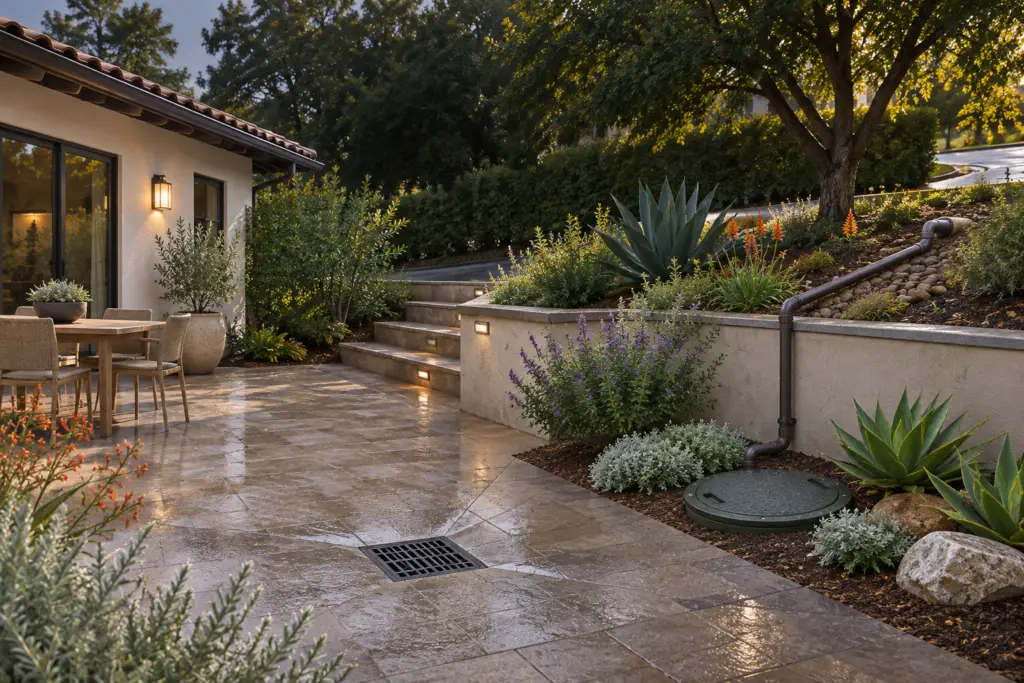
Concept image illustrating a low-yard drainage system; it is not presented as a completed OE Landscape project.
The Decision Rule
Use a pump when the outlet is higher than the water
Most landscape drainage systems are designed to move water downhill. Catch basins collect surface runoff, French drains intercept water moving through saturated soil, and solid pipe carries the collected water toward a lower discharge point. When that lower outlet exists, gravity is usually the simpler approach.
A low-lying yard changes the equation. If the patio, side yard, courtyard, or lawn sits below the street or every practical discharge location, the water has nowhere to go on its own. A sump basin can receive water from the collection system, and a pump can lift it through a discharge pipe to a higher, appropriate outlet.
OE Landscape's drainage service evaluates grade, runoff sources, drains, pipe routes, and discharge conditions as one system. For a broader component-by-component explanation, see When Does Your Yard Need a Sump Pump Drainage System?
- Elevation
- Water source
- Gravity options
- Pump reliability
- Discharge
- Maintenance
Confirm that the yard truly lacks a gravity outlet
The most important measurement is the elevation difference between the low point and the proposed outlet. A yard can look flat while still having enough fall for gravity drainage. It can also appear to slope toward the street while a raised curb, utility crossing, retaining wall, or shallow pipe route eliminates the usable drop.
Before specifying a pump, map the low point, drain inlets, pipe route, obstacles, and final discharge elevation. The pipe needs a continuous workable path. A line with unintended dips can hold water and sediment even when its beginning and end elevations appear acceptable.
Conditions that support evaluating a sump pump
- The recurring flood area sits below the street or other approved outlet
- A sunken patio, courtyard, driveway, or side yard cannot drain downhill
- Catch basins collect water but cannot empty through a gravity line
- A practical pipe route cannot maintain enough fall around site obstacles
- Regrading the entire area would create access, structure, or boundary problems
Identify what is filling the low area
Standing water is a symptom, not a diagnosis. The system should account for where the water originates and how quickly it arrives. A patio receiving rainfall behaves differently from a low lawn fed by irrigation, roof runoff, and water descending from an uphill property.
Surface runoff may call for catch basins or a channel drain. Water moving through saturated soil may call for a French drain. Concentrated roof runoff may need downspout piping. An irrigation leak or overwatering problem should be corrected rather than treated as permanent drainage demand. If the source is uncertain or the volume is unusual, further site investigation may be necessary before equipment is selected.
Controlling upstream water can reduce the work required of the pump. Swales, grading adjustments, downspout routing, erosion control, or additional collection points may keep water from concentrating at one low basin all at once.
Know when gravity drainage is the better solution
| Site question | Gravity drainage may fit | A sump pump may fit |
|---|---|---|
| Outlet elevation | A suitable outlet is lower than the collection area | The practical outlet is higher than the collection area |
| Mechanical dependence | No pump or electrical supply is needed | Water must be lifted mechanically |
| Typical role | Carry water downhill through properly sloped pipe | Complete a drainage path that cannot work by gravity alone |
| Ongoing care | Inspect inlets, pipe, and outlet for blockage | Inspect the entire drainage path plus pump, basin, power, and controls |
Correctable grading should usually be corrected. A patio low spot that can be rebuilt to drain, a downspout dumping beside the foundation, or a clogged outlet does not automatically justify a pump. Passive drainage has fewer moving parts and continues to work during a power outage.
A pump becomes appropriate when elevation is the limiting condition that remains after reasonable passive improvements are considered. This distinction helps avoid adding equipment where simpler site work would solve the actual problem.
Plan the collection basin, pump, pipe, and outlet as one system
A landscape sump pump is only one link in the drainage path. Water first needs to reach properly placed inlets. Those inlets feed a basin large enough to receive incoming flow without causing excessively rapid cycling. The pump then moves the water through a discharge line, and the line ends at a location allowed for the property and jurisdiction.
Equipment selection should reflect the expected inflow, the vertical lift to the outlet, pipe length and fittings, debris exposure, and the required discharge rate. Choosing a pump by a box label alone can overlook how system resistance changes real performance. Access is also essential: the basin, pump, float or level control, check valve when used, connections, and cleanout points need to be serviceable after the landscape is finished.
The yard-drain and catch-basin guide explains how surface water enters a collection network. For recessed hardscape and driveways, the channel-drain guide covers collection across a paved flow line.
Design for power loss, pump failure, and heavy inflow
A gravity drain keeps working without electricity. A pumped system does not, so the consequences of downtime should shape the design. If the sump protects a below-grade garage, doorway, finished courtyard, or other vulnerable opening, reliability deserves more attention than it might in an isolated planting area.
Depending on the risk, planning may include an alarm, secondary pump, backup power, additional storage capacity, or a safe emergency overflow path. These measures are site-specific; they should be selected because they address a real failure consequence, not added as generic accessories.
Questions to answer before installation
- What happens if the power is out during a storm?
- Where will water go if inflow exceeds pump capacity?
- Can the basin and pump be reached without removing finished hardscape?
- Will an alarm be noticed from inside the home?
- Can the discharge line drain or remain protected after the pump stops?
Confirm the discharge route before committing to a pump
Pumping water out of the basin is only useful if the discharge location is suitable. The route should not send water back toward the house, allow it to cycle into the same low area, create erosion, cross a walkway unsafely, or transfer the problem to a neighboring property.
Requirements for connection to a storm system, curb outlet, surface discharge, or other destination vary by jurisdiction and site. Confirm the proposed route with the authority having jurisdiction before construction. The EPA Indoor airPLUS requirements, which address foundation sump drainage, illustrate the broader principle: discharge away from the foundation or to a stormwater system approved by the authority having jurisdiction. Local rules and the actual project conditions control.
For California stormwater context, homeowners can review the State Water Resources Control Board Storm Water Program. A landscape contractor can coordinate the site design, but required civil, electrical, plumbing, or municipal approvals should be identified for the specific scope.
Keep the entire drainage path maintainable
Leaves, mulch, soil, and sediment can reduce inlet capacity or accumulate in the basin. Periodic inspection should cover grates, catch basins, channel drains, inlet piping, the sump basin, pump operation, controls, discharge piping, and the final outlet.
Test access should be straightforward, especially before the rainy season. Any change in pump sound, run time, cycling frequency, water level, or discharge flow deserves attention. A pump that runs more often may be responding to a new water source, a partially blocked line, a control issue, or changing site conditions.
Landscape work can affect the system later. New planting, mulch, pavers, artificial turf, or irrigation changes should preserve the intended grades, keep access covers clear, and avoid burying or obstructing inlets and outlets.
Use this low-lying-yard decision checklist
- Use gravity when possible: confirm whether a lower, legal outlet and workable pipe slope exist.
- Define the water: identify surface runoff, subsurface water, roof flow, irrigation, or multiple sources.
- Correct upstream problems: address grading, leaks, downspouts, and erosion that unnecessarily increase inflow.
- Use a pump for the elevation barrier: select pumped drainage when water must be lifted to complete the route.
- Plan for failure: match backup, alarm, overflow, and access provisions to the consequences of downtime.
- Approve the outlet first: confirm discharge requirements before finalizing equipment and construction.
A sump pump for a low-lying yard should solve a measured elevation problem
The right system begins with grades and a complete water path. If water can move reliably to a lower outlet, gravity drainage is usually preferable. If the low point sits below every practical outlet, a properly planned sump basin and pump can provide the lift the property needs.
One Drainage Plan
Coordinate the low point, inlets, pump, pipe route, and outlet
OE Landscape can evaluate a sump pump alongside grading, catch basins, French drains, channel drains, downspout piping, erosion control, irrigation, hardscape, and planting. Review the project gallery, then share photos and a description of when and where water collects.
Does your low yard have nowhere to drain?
Share the low point, runoff sources, visible outlets, and recent flooding pattern with OE Landscape. The team can evaluate whether grading and gravity drainage are practical or whether the property needs a sump pump system.
Request a Free Drainage Estimate