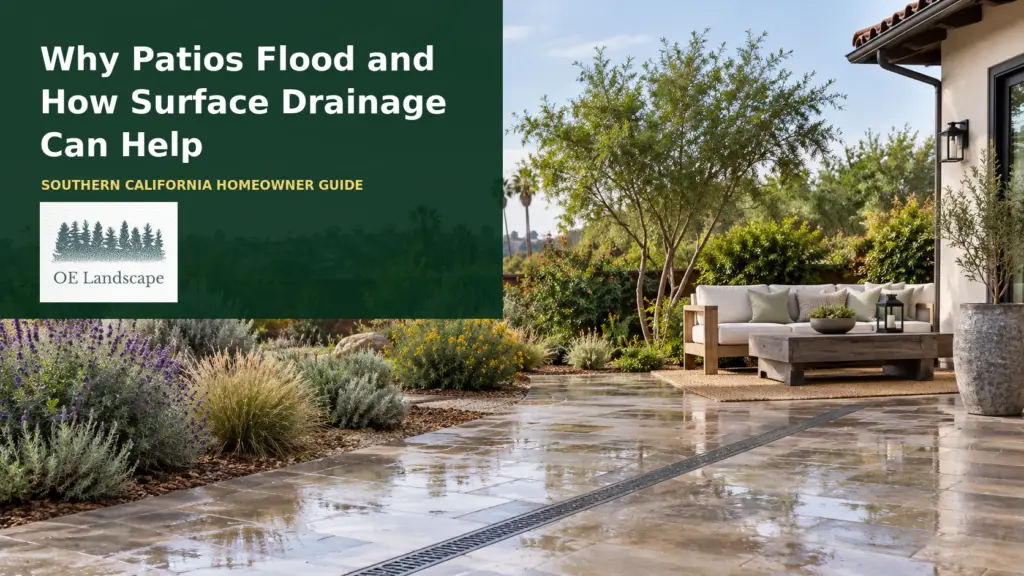
Yard Drainage Water Control: Combining Gutters, Grading, and Yard Drains
Yard drainage water control works best when gutters, downspouts, grading, yard drains, underground piping, and the final outlet are designed as one connected path for rainfall and runoff.
Why Yard Drainage Water Control Works Best as a Complete System
A drainage problem is rarely caused by just one thing.
A gutter may be working properly, but the downspout may release water into a low area.
A yard drain may be installed, but the surrounding grade may direct runoff away from it.
The lawn may be shaped correctly, but roof runoff may overwhelm the soil during heavy rain.
That is why effective drainage often depends on several systems working together.
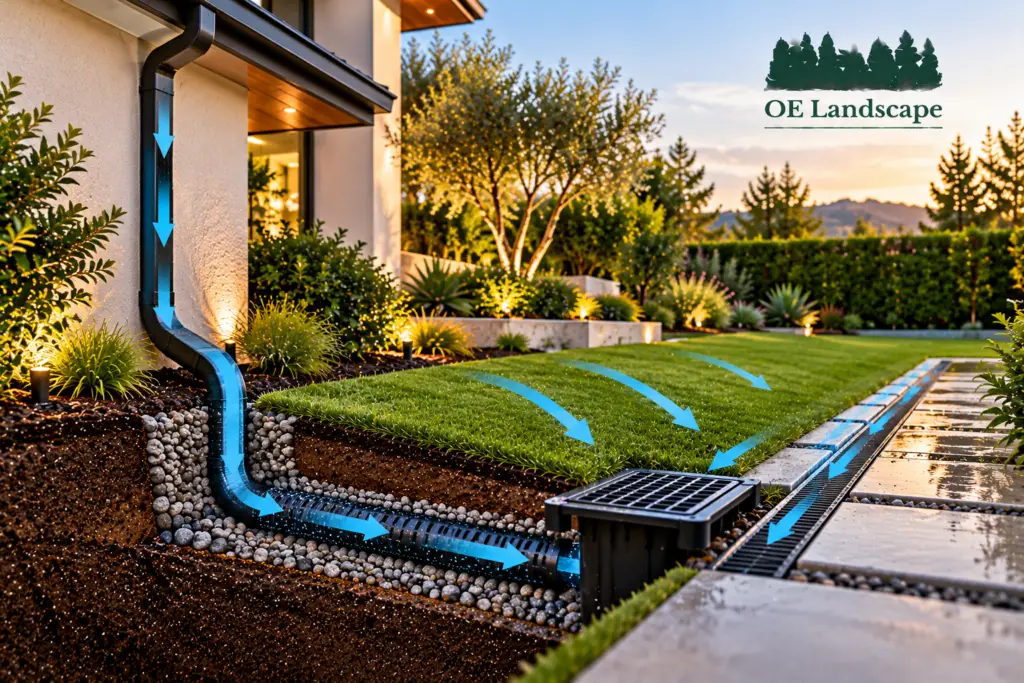
At OE Landscape, we look at water control as a complete property-wide process. Gutters collect roof runoff. Grading determines where surface water travels. Yard drains capture water at strategic low points. Underground piping then carries that water toward an appropriate outlet.
When these elements support each other, the landscape can manage rainfall much more effectively.
Yard drainage water control works best when roof runoff, landscape grading, yard drains, underground piping, and the final discharge route are planned as one connected system. Explore our Drainage Services for a broader look at how these components can work together.
For broader stormwater context, see the U.S. EPA stormwater runoff guidance and the California Water Boards Storm Water Program.
Start With the Entire Water Path
The best drainage planning begins by following the water from start to finish.
Ask:
- Where does the water begin?
- Where does it travel?
- Where does it slow down?
- Where does it collect?
- Where should it ultimately go?
For many homes, the water path begins on the roof.
From there, it may move through:
Roof → gutter → downspout → landscape grade → yard drain → underground pipe → discharge
Each stage influences the next.
If even one part of that path is poorly planned, water can end up where it does not belong.
Gutters Control Roof Runoff
The roof collects a large amount of rainfall.
Gutters help capture that water before it falls directly beside the home.
A functioning gutter system guides runoff toward downspouts.
But gutters do not complete the drainage process.
They only transfer the water from the roof to ground level.
The next question is what happens at the bottom of the downspout.
If water is released directly beside the home, into a low planting bed, or onto poorly graded soil, the gutter may simply be moving the problem from one place to another.
Downspouts Need a Planned Destination
Downspouts concentrate roof runoff into relatively small areas.
That concentrated water needs a controlled path.
Depending on the property, downspouts may discharge into:
- Surface extensions
- Underground solid piping
- Drainage networks
- Appropriate landscape areas
The correct approach depends on elevation, soil conditions, available outlets, and local requirements.
The important point is that downspout water should not be allowed to repeatedly collect near the foundation or flood one small section of the yard.
Why Roof Runoff Can Overwhelm a Yard
A landscape may drain reasonably well during light rain but struggle when roof runoff is added.
Gutters collect rainfall from hundreds or even thousands of square feet of roof area.
That water is then concentrated through only a few downspouts.
If one downspout releases into a small planting bed, the soil may receive far more water than it can absorb.
The result may include:
- Standing water
- Saturated soil
- Erosion
- Washed-out mulch
- Water moving toward the house
- Overflow into adjacent hardscape
This is why roof runoff and landscape drainage should be planned together.
Grading Determines Where Water Goes
Once water reaches the landscape, gravity takes over.
The shape of the ground determines where runoff travels.
Good grading can direct water:
- Away from the home
- Toward yard drains
- Away from doors and garages
- Around patios
- Toward appropriate collection areas
Poor grading can do the opposite.
A small depression may trap water.
A slight slope toward the home may direct runoff toward the foundation.
Even a few inches of elevation difference can change the direction of water across a yard.
What Is Positive Drainage?
Positive drainage means the surface is shaped so water has a clear downhill route away from sensitive areas.
This does not necessarily require steep slopes.
Often, subtle elevation changes are enough.
The goal is to avoid creating areas where water becomes trapped.
A well-graded yard should guide runoff toward a planned destination rather than allowing water to wander unpredictably across the property.
Yard Drains Collect Surface Water
Yard drainage water control often uses purpose-built collection and conveyance components. For examples of catch basins, channel drains, French drain systems, grates, fittings, and other drainage products, see NDS / ADS drainage and stormwater solutions.
Yard drains provide collection points for runoff.
They are commonly installed in:
- Lawns
- Planting beds
- Low side yards
- Gravel areas
- Areas below slopes
A typical yard drain includes a grate or catch basin connected to underground drainage pipe.
Water moves across the surface, enters the inlet, and is carried away.
However, the drain only works if water can reach it.
That is where grading becomes essential.
Yard Drainage Water Control: Grading and Yard Drains Must Work Together
Imagine installing a catch basin in a lawn.
If the basin sits slightly higher than the surrounding soil, water may collect beside it instead of flowing inside.
The drain itself may be perfectly installed, but the grading makes it ineffective.
A better system creates a gentle slope toward the basin.
The process becomes:
Surface runoff → graded low point → yard drain → underground pipe
This is why drain placement should be coordinated with the finished landscape elevations.
Gutters Can Feed Underground Drainage
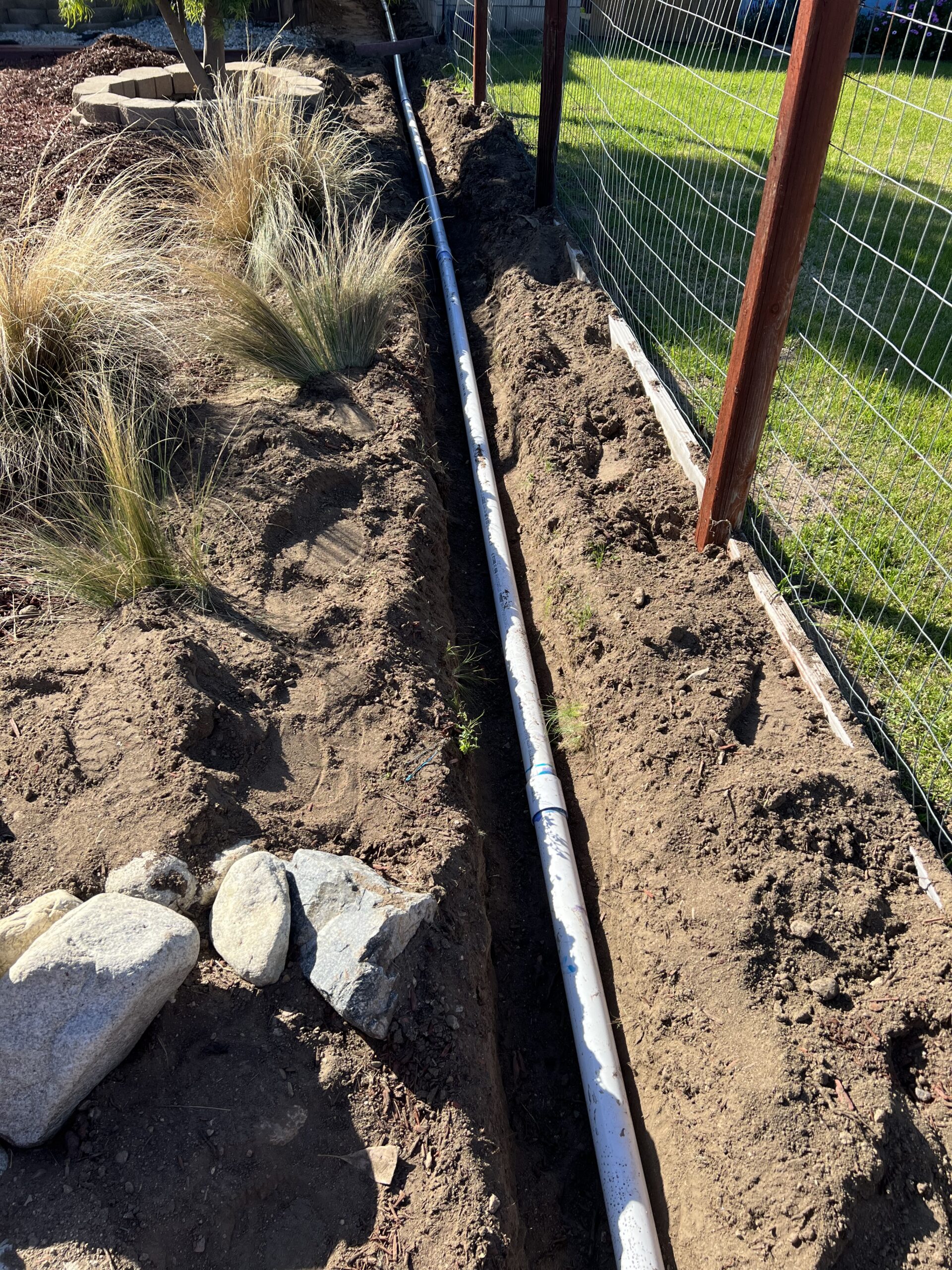
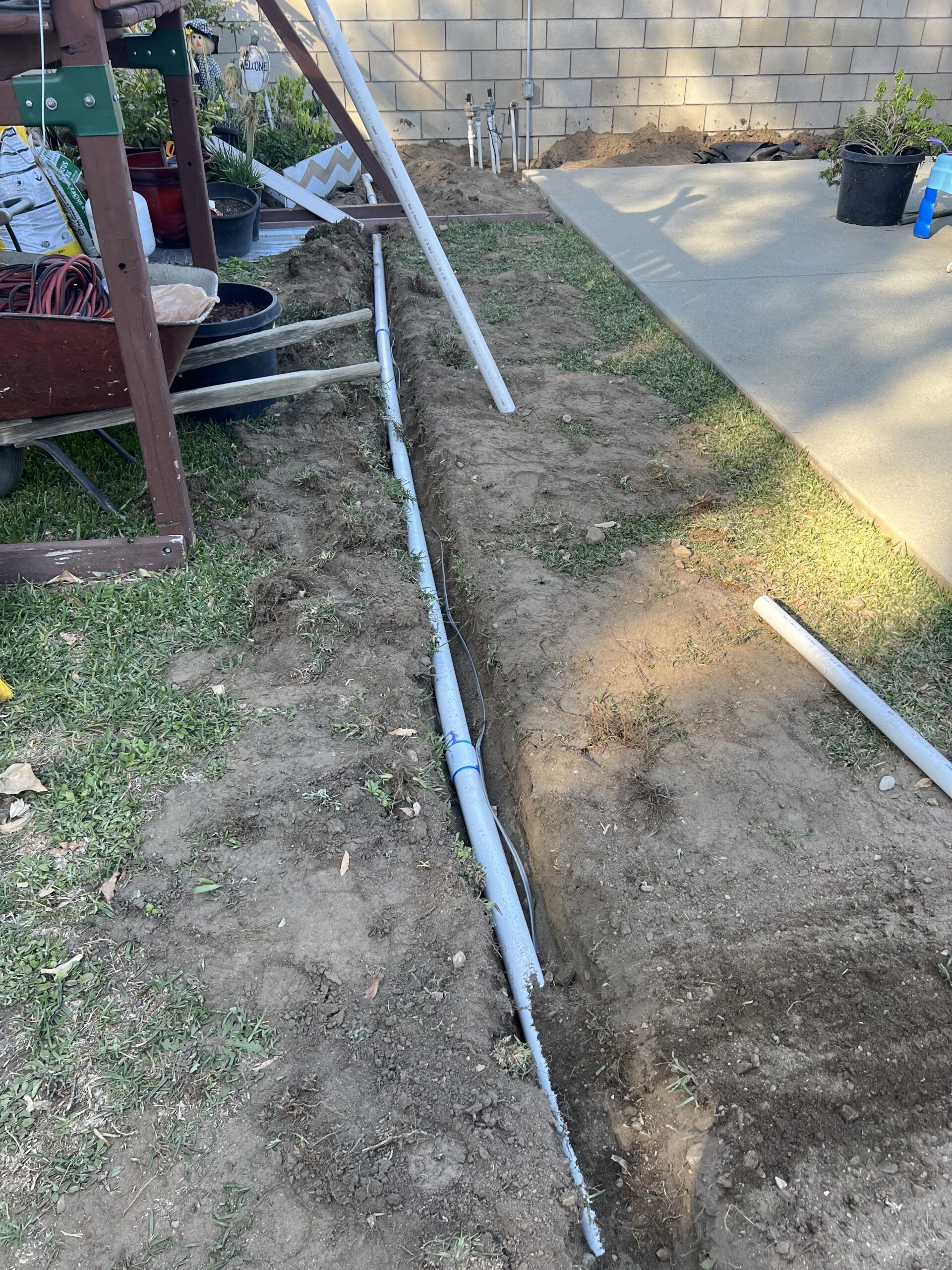
In some properties, downspouts can connect directly to underground solid piping.
This allows roof runoff to be transported away without first spreading across the yard.
The underground line may eventually connect with other parts of the drainage network.
However, the system must be designed carefully.
Adding several downspouts to a pipe already serving yard drains increases the amount of water the system must carry.
Pipe size, slope, and outlet capacity all become more important.
Do Not Assume One Pipe Can Handle Everything
A drainage system may receive water from:
- Roof downspouts
- Yard drains
- Catch basins
- Channel drains
- Patio runoff
Each connection adds flow.
During heavy rain, several sources may be active at the same time.
An undersized pipe can become overwhelmed even if each individual drain seems small.
The drainage network should be evaluated based on the combined runoff load, not only one inlet at a time.
Yard Drains Help With Low Lawn Areas
Low lawn sections often reveal grading problems.
Water from surrounding areas naturally moves toward the depression.
If regrading alone cannot eliminate the low point, a yard drain may provide a useful outlet.
The surrounding surface can be shaped so the lawn gently directs water toward the drain.
This can help reduce prolonged standing water.
The drain does not replace grading.
The two work together.
Catch Basins Can Handle Larger Collection Points
Where more water collects, a catch basin may be used.
A catch basin provides a larger inlet area and may also provide space for some sediment to settle before entering the pipe.
These are often useful where runoff arrives from multiple directions.
For example:
- A slope drains downhill
- A patio sends water toward the lawn
- A downspout contributes additional flow
A catch basin at the low point can collect the combined surface runoff.
But the upstream sources should still be evaluated.
Sometimes part of the water can be redirected before it ever reaches the basin.
Downspouts Should Not Create Yard Puddles
If a puddle forms directly below a downspout after every storm, the problem may not require a complicated drainage system.
The first step may be simply improving the downspout discharge.
Possible solutions can include:
- Extending the downspout
- Connecting it to underground pipe
- Regrading the surrounding soil
- Redirecting it to a more appropriate location
The goal is to prevent roof runoff from repeatedly overwhelming the same section of landscape.
Grading Around the Foundation Is Especially Important
The area immediately around the home deserves careful attention.
Water should generally be encouraged away from the structure.
If the landscape slopes toward the house, roof runoff and yard runoff may both collect nearby.
Improving the grade can reduce the amount of surface water reaching the foundation area.
Depending on the site, additional drainage may still be needed.
The strongest strategy often combines:
- Proper downspout routing
- Positive grading
- Surface drains where necessary
Side Yards Often Need All Three Systems
Side yards are common places where gutters, grading, and yard drains intersect.
They are often narrow and may contain multiple downspouts.
At the same time, limited space can make it difficult to create enough surface slope.
A side-yard drainage solution may involve:
- Downspouts connected to solid pipe
- Surface grading toward one or more drains
- Catch basins or yard drains
- Underground piping toward an outlet
If the side yard sits below the available discharge elevation, a sump pump may also be needed.
Patios Can Change the Drainage Pattern
A new patio creates a large surface that sheds water.
That runoff must go somewhere.
If the patio slopes toward the lawn, the lawn may receive more water than it did before.
If it slopes toward the house, the problem can be more serious.
Drainage planning for patios may include:
- Correct surface slope
- Channel drains
- Yard drains nearby
- Grading of adjacent planting areas
Existing downspouts should also be reviewed.
A patio may unintentionally redirect roof water in a new direction.
Channel Drains Can Connect With Yard Drainage
Hardscape runoff is often best collected with a channel drain.
For example, a patio or driveway may send water across a wide surface.
A channel drain can intercept that flow before it reaches a low landscape area.
The collected water may then connect to the same broader drainage network used by yard drains.
A coordinated system might look like:
Patio runoff → channel drain
Lawn runoff → catch basin
Roof runoff → downspout pipe
All three may then connect into a properly sized main drainage line.
Avoid Sending Every Surface Toward One Small Drain
A common mistake is directing several large runoff areas toward one small catch basin.
The drain may receive:
- Roof water
- Patio runoff
- Lawn runoff
- Slope runoff
During a strong storm, that basin may not collect water fast enough.
A better design may divide the runoff among several collection points or intercept certain sources earlier.
Water control improves when the drainage system distributes flow rather than allowing everything to concentrate at one location.
Slopes Need Special Attention
Water from a slope can gain speed before reaching the lower yard.
If that flow combines with roof runoff, a low catch basin may become overwhelmed.
Slope drainage may require:
- Swales
- Additional catch basins
- French drains
- Erosion-control planting
- Grading adjustments
The goal is to manage runoff before it reaches the lowest part of the property.
Controlling both water direction and water velocity can reduce erosion and improve drainage performance.
Gutters Can Contribute to Hillside Saturation
Downspouts should be placed carefully on sloped properties.
If roof runoff is released near the top of a slope, that water may travel downhill through the soil or across the surface.
This can contribute to:
- Erosion
- Saturated planting areas
- Runoff at the bottom of the slope
Routing the downspout through controlled piping may help reduce unnecessary water entering the hillside.
The roof should not become an additional source of uncontrolled slope runoff.
French Drains May Be Added for Subsurface Water
Gutters, grading, and yard drains mainly address roof runoff and surface water.
Some landscapes also have subsurface moisture.
A French drain may be useful where water moves through saturated soil.
For example, a complete system might include:
- Gutters for roof collection
- Solid pipe for downspouts
- Grading for surface direction
- Catch basins for visible runoff
- French drains for subsurface moisture
Different drainage components solve different parts of the water problem.
Do Not Confuse Surface Water With Subsurface Water
This distinction can help avoid unnecessary drainage work.
If water is flowing across the lawn, grading and surface drains may be most important.
If the soil remains wet after the surface water disappears, subsurface drainage may also need attention.
The strongest drainage plan identifies both conditions.
Installing a French drain for a surface puddle or a catch basin for deep soil saturation may not fully solve the issue.
Irrigation Should Be Included in the Evaluation
Rain is not the only source of water in a landscape.
Irrigation can contribute to drainage problems.
Before making major drainage changes, inspect:
- Sprinkler heads
- Drip lines
- Valves
- Watering schedules
Overwatering can keep low areas saturated.
A broken irrigation line can create what looks like a drainage failure.
Good water control includes reducing unnecessary water before designing systems to remove it.
Hardscape Can Block Existing Drainage Routes
A property may have drained reasonably well before a new:
- Patio
- Walkway
- Driveway
- Retaining wall
was installed.
These features can interrupt the original flow of water.
A walkway may block runoff that previously moved through a planting bed.
A patio may redirect water toward a side yard.
When new hardscape is added, the grading and drainage routes should be reevaluated.
Retaining Walls Affect Water Movement
Retaining walls change the elevation of the property.
They may create new low points above or below the wall.
Surface runoff should be directed carefully around these areas.
Subsurface drainage may also be needed behind the wall.
A drainage system around retaining features may combine:
- Grading
- Surface drains
- French drains
- Underground piping
Downspouts should also be routed so they do not unnecessarily add water behind the wall.
Planting Beds Should Not Become Drainage Basins
Planting areas can absorb some rainfall.
But they should not automatically become the destination for every downspout and patio.
Too much water can result in:
- Saturated soil
- Root stress
- Mulch washout
- Erosion
- Overflow into nearby hardscape
If a planting bed receives significant runoff, its grading and drainage should be evaluated.
A yard drain may be needed, or the incoming water may need to be redirected before reaching the bed.
Mulch Movement Is a Useful Warning Sign
After rain, inspect where mulch ends up.
If it repeatedly washes out of a planting bed, runoff may be moving too quickly through the area.
That can indicate:
- Poor grading
- Concentrated roof runoff
- Hardscape draining into the bed
Correcting the water path is more effective than repeatedly replacing the mulch.
The movement of landscape materials can reveal hidden drainage patterns.
Gravel Can Hide Standing Water
Gravel surfaces may look dry shortly after rain.
But water can still collect beneath the gravel.
If the underlying grade contains a low spot, the soil may remain saturated.
The same principles still apply:
- Shape the grade
- Direct runoff
- Provide drainage where necessary
Changing the surface material alone does not correct the water-flow pattern.
Artificial Turf Needs a Drainage Plan Too
Artificial turf projects should consider both surface and subsurface drainage.
If the site is low before turf installation, covering it will not remove the low point.
The project may require:
- Grading
- Catch basins
- Drainage pipe
- Proper base preparation
Nearby downspouts should also be reviewed.
Roof runoff should not simply be redirected onto new artificial turf without considering where that water will go.
Multiple Yard Drains Can Work Better Than One
Large properties may need several collection points.
Instead of forcing all runoff toward one location, drains can be positioned in separate low areas.
For example:
- One basin may collect backyard runoff
- Another may serve the side yard
- A channel drain may protect the patio
These may connect to a shared main line when the pipe capacity and elevation allow.
The system should reflect the actual shape of the property.
Pipe Slope Is Just as Important as Surface Slope
Grading gets water to the drain.
Underground pipe gets water away from the drain.
Both depend on slope.
If the pipe does not have enough fall, water may drain slowly or remain inside the line.
Before installation, the drainage route should consider:
- Starting elevation
- Outlet elevation
- Pipe length
- Obstacles
- Available fall
A surface drain with a poor underground route will still perform poorly.
Every System Needs an Outlet
Gutters collect water.
Grading directs it.
Yard drains capture it.
Underground pipes transport it.
But eventually, the water needs an appropriate destination.
The outlet may depend on:
- Site elevation
- Existing drainage infrastructure
- Property layout
- Applicable local requirements
A drainage system should not simply move water from one part of the yard to another low area.
A complete plan follows the water all the way to discharge.
Flat Properties Can Be More Challenging
Some yards have very little natural fall.
This can make both surface grading and underground drainage more difficult.
Small elevation changes become extremely important.
If there is no lower outlet available, a sump pump may need to be considered.
In that situation, gutters and grading still matter.
They help guide water into the collection system before the pump moves it to a higher discharge location.
When a Sump Pump Becomes Part of the System
A pumped drainage layout may look like:
Roof runoff → downspout piping
Surface runoff → yard drains
Grading → directs water toward inlets
Underground drainage → sump basin
Sump pump → discharge
The pump solves the elevation problem, but the rest of the property still needs to manage water correctly.
A pump cannot compensate for poor grading everywhere else.
Drainage Should Be Planned Before Landscape Construction
The best time to coordinate gutters, grading, and yard drains is before the finished landscape is installed.
This allows the project team to determine:
- Final elevations
- Drain locations
- Downspout routes
- Pipe sizes
- Outlet locations
Underground systems can then be installed before:
- Turf
- Planting
- Pavers
- Lighting
- Irrigation
This usually creates a cleaner project and reduces the need to disturb finished work later.
Observe the Property During Rain
One of the best ways to understand how these systems interact is to watch the property during a storm.
Look at the roof first.
Check whether:
- Gutters overflow
- Downspouts discharge properly
- Water pools below downspouts
Then follow the water into the landscape.
Notice:
- Which direction it travels
- Whether the grade moves it toward drains
- Whether drains are being bypassed
- Where water begins to collect
This creates a real-world picture of the roof-to-yard drainage path.
Inspect the Yard After Rain
After the storm, look for evidence of poor water control.
Warning signs include:
- Standing water
- Muddy lawn
- Saturated soil
- Mulch washout
- Erosion
- Gravel movement
- Water stains
- Sediment around drains
These signs can reveal where the system is underperforming.
They may also show whether the problem is related to gutters, grading, drains, or a combination.
Existing Drains May Need Maintenance Rather Than Replacement
If a yard already has drains but water still collects, the system may not necessarily need to be rebuilt.
First check for:
- Leaves on grates
- Sediment inside basins
- Clogged pipes
- Blocked outlets
A partially clogged system may perform well during light rain but fail during heavier storms.
Maintenance is part of long-term water control.
Gutter Maintenance Is Just as Important
Leaves and debris can prevent gutters from directing water into the downspouts.
When gutters overflow, rainfall may fall directly beside the home.
This bypasses the planned drainage route.
Periodic gutter cleaning helps keep the first stage of the water-control system functioning properly.
The drainage system begins at the roof, not at the yard drain.
Do Not Fix Only the Lowest Puddle
A puddle shows where water ends up.
It does not necessarily show where the problem starts.
A backyard puddle could be receiving water from:
- Two downspouts
- A patio
- A lawn slope
- A side yard
Installing one drain in the puddle may help, but reducing the upstream runoff can make the system more effective.
A better approach follows the entire source-to-discharge water path.
Common Mistake: Great Gutters, Poor Ground Drainage
A home may have clean gutters and properly functioning downspouts but still experience water problems.
If the downspout releases into an area sloping toward the home, the runoff may return immediately.
The roof system is working.
The landscape system is not.
This is why drainage should not be divided into separate roof and yard problems.
They are connected.
Common Mistake: Installing Drains Without Correcting the Grade
Another common issue is installing multiple drains in a yard that still slopes incorrectly.
Water may continue bypassing the inlets.
Correcting the surface elevations can sometimes improve drainage more than adding another basin.
The drains should support the grade rather than fight it.
Common Mistake: Grading Without Planning Roof Runoff
A newly graded landscape may perform well until the first major rain.
Then several downspouts begin releasing concentrated water across the surface.
The additional roof runoff can change the expected flow pattern.
Downspout locations should be identified before final grading is completed.
Common Mistake: Sending Too Much Water Into One Pipe
Combining drainage systems can be efficient, but only if the pipe can carry the total flow.
Several downspouts plus multiple yard drains can create substantial volume during a storm.
The main line and outlet need to be sized accordingly.
A drainage network should become larger as additional water sources are added.
Better Yard Drainage Water Control Comes From Coordination
No single component does everything.
Gutters handle one part of the problem.
Grading handles another.
Yard drains handle another.
The strongest results come from coordinating them.
Think of the system this way:
Gutters control where roof water comes down.
Grading controls where surface water travels.
Yard drains control where surface runoff is collected.
Underground piping controls where collected water goes.
Together, these components create a more predictable drainage system.
A Complete Yard Drainage Water Control Strategy
Depending on the property, a complete strategy may include:
- Gutters and downspouts
- Underground downspout piping
- Landscape grading
- Catch basins
- Yard drains
- Channel drains
- French drains
- Sump pumps
- Erosion-control measures
Not every yard needs every component.
The goal is to use the right tools for the actual water problem.
At OE Landscape, we help Southern California homeowners evaluate how water moves from the roof, across hardscape, through planting areas, and into low points throughout the property.
By combining gutter and downspout drainage, landscape grading, yard drains, catch basins, French drains, channel drains, sump pumps, erosion-control solutions, irrigation improvements, and complete landscape renovations, we can build drainage strategies around the way each property actually handles water.
OE Landscape – CA C-27 License #1109316 | Bonded & Insured
Noticing water collecting near your home, low areas staying soggy, or downspouts overwhelming your landscape? Contact OE Landscape to discuss a coordinated drainage solution designed around your roof runoff, grading, hardscape, landscape, and overall water-flow conditions.
Better Yard Drainage Water Control Starts With Coordination
Yard drainage water control is most reliable when roof runoff, grading, collection points, underground piping, and discharge are planned together. OE Landscape can help evaluate how water moves across the entire property and match each problem area with the right drainage method.
Plan Gutters, Grades, Drains, Pipe, and Outlet Together
Instead of treating the roof, lawn, hardscape, and drainage system as separate problems, coordinate them as one water-control network. This approach can reduce recurring puddles, erosion, soggy areas, and overloaded collection points.
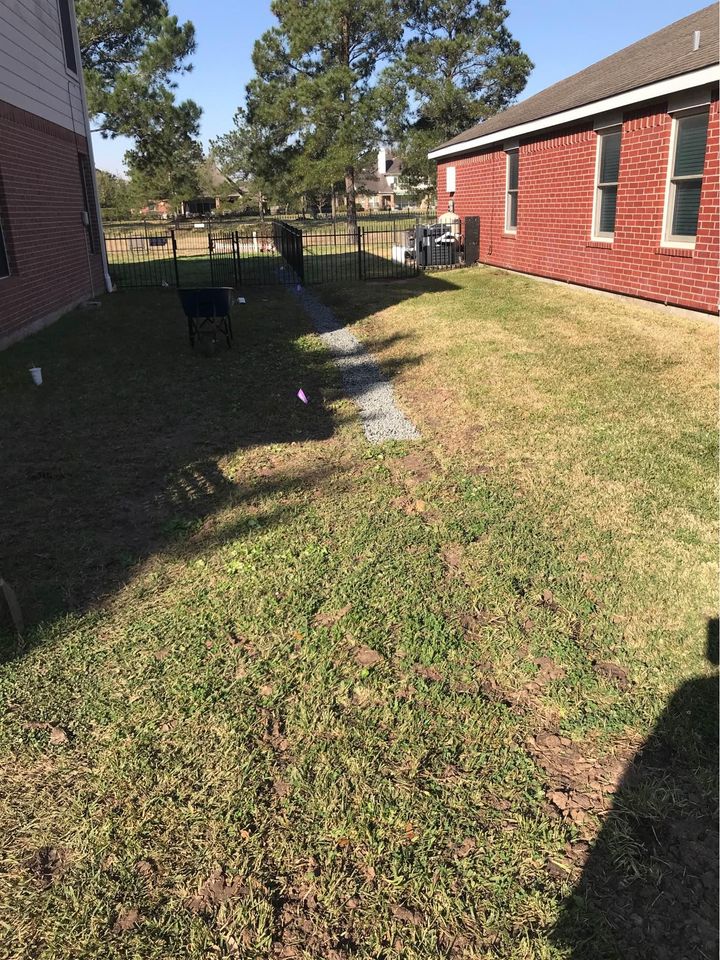
Give Every Drop a Planned Path Through the Property.
Tell OE Landscape where roof runoff lands, where the yard slopes, where water collects, and which drains already exist. We can help evaluate a coordinated drainage approach around the full property.